
Poly AI is one of those tools you may have heard about in passing — maybe during a sales demo, in a LinkedIn post, or while researching ways to reduce customer support costs — but chances are you haven’t fully understood what it’s actually capable of. Most people instantly assume it’s just another chatbot, or at best a slightly smarter IVR system with better voice quality. In reality, poly.ai (also written as poly.ai) is doing things in customer support that many businesses still believe require large human teams.
What makes this interesting is not just the technology itself, but the way it alters the customer experience when they reach out for help. Instead of frustration, repetition, and long waits, Poly AI aims to create conversations that feel natural, calm, and surprisingly human. If you’re exploring poly AI chat solutions, voice automation, or simply trying to understand whether this platform deserves a place in your support stack, this article will walk you through it without hype or buzzwords.
Find More: How AI Is Transforming Shopify Stores in 2026 (Personalization, CRO, Automation)
What is Poly AI and Why Enterprises Are Adopting It
A Quick Overview of Poly AI as a Conversational AI Platform
At its core, Poly AI is a conversational AI platform built specifically for customer support, not for casual chat or entertainment. Its main strength lies in handling real conversations through both voice and chat, in a way that feels flexible and human-like. Customers can interrupt, change their request mid-sentence, ask follow-up questions, or explain their issue in their own words — and poly.ai can still keep up.
This is very different from traditional automation tools that expect customers to behave perfectly. Poly AI is designed around how people actually speak, especially when they’re tired, annoyed, or in a hurry. That’s why it’s mostly adopted by mid-sized and large enterprises that deal with high volumes of customer interactions every single day.
How Poly AI Differs from Traditional Chatbots and IVR Systems
Traditional chatbots usually rely on predefined rules and flows. They work fine as long as the customer follows the expected path. The moment someone phrases a question differently, mixes multiple requests, or changes their mind, the experience starts to fall apart.
IVR systems are even more limiting. Long menus, robotic voices, and endless transfers have trained customers to expect frustration before the call even begins. Poly AI takes a completely different approach. Instead of pushing users through menus, it listens for intent, understands context, and responds conversationally. The system adapts to the customer, not the other way around.
Who Should Use Poly AI in Customer Support?
Poly AI makes the most sense for businesses that:
-
Handle thousands or millions of customer interactions each month.
-
Rely heavily on voice support, not just chat.
-
Want to reduce wait times without lowering service quality.
-
Care deeply about brand tone and customer experience
For companies where customer support directly impacts reputation and retention, Poly AI quickly becomes more than just an automation tool — it becomes part of the brand experience.
1. Poly AI Handles Natural Conversations Without Scripts
How Poly AI Understands Free-Flowing Human Language
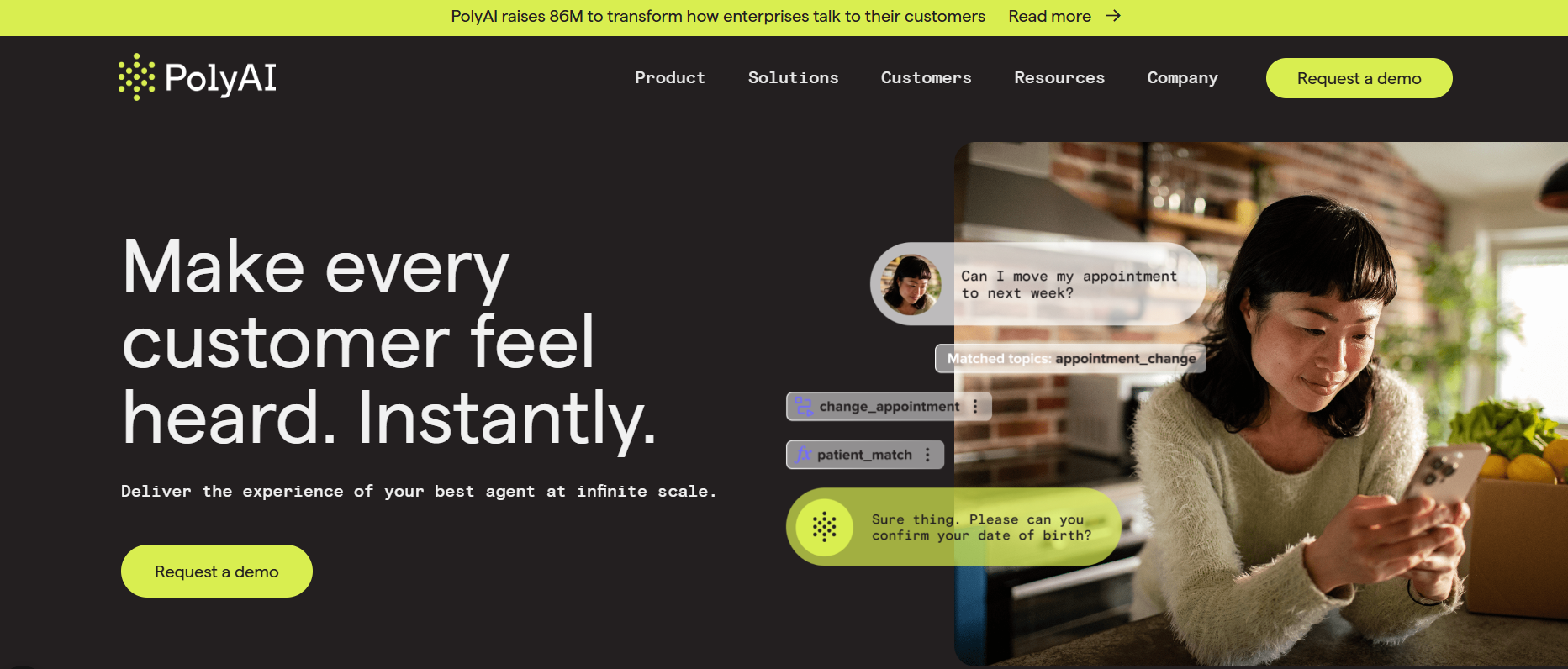
One of the most impressive things about Poly AI is how natural conversations feel from the customer’s side. People don’t need to think about how to phrase their request. They can ramble, pause, correct themselves, or explain their issue emotionally. Poly AI listens, extracts intent, and responds in a way that feels surprisingly intuitive.
This matters a lot in voice interactions, where people rarely speak in clean, structured sentences. Poly.ai is built to understand real speech patterns, not perfect textbook language. That alone removes a huge amount of friction from customer support conversations.
Why Script-Based Bots Fail in Real Customer Support
Scripted bots assume customers are calm, logical, and predictable. Real customers are often stressed, confused, or impatient. They jump between topics, ask multiple questions at once, and expect fast answers. This is where most bots fail and where Poly AI stands out.
Because Poly AI is built around intent and context instead of fixed paths, it can adapt when the conversation changes direction. That flexibility is what makes interactions feel human rather than mechanical.
Real Customer Scenarios Where This Makes a Difference
Imagine a customer calling about a delayed delivery, then halfway through the call asking about a refund policy or changing the delivery address. A traditional bot would likely break or restart the flow. Poly AI understands the shift and continues smoothly, without forcing the customer to repeat themselves or start over.
2. Poly AI Resolves Complex Customer Issues End-to-End
Moving Beyond Simple FAQs and Basic Requests
A common misconception is that AI is only useful for answering FAQs. Poly AI goes much further. It’s designed to handle full customer journeys from start to finish, including booking changes, account updates, order tracking, cancellations, and service modifications.
The goal here isn’t just deflecting tickets away from human agents. The real goal is resolution — solving the customer’s problem completely in one conversation.
How Poly AI Maintains Context Across Long Conversations
Context is everything in customer support. Poly AI remembers what was said earlier in the conversation and uses that information to guide future responses. Customers don’t need to repeat details, re-authenticate unnecessarily, or explain their issue again after every question.
That continuity alone dramatically improves the customer experience and reduces frustration.
Examples of Complex Support Cases Poly AI Can Handle
From rescheduling flights and changing reservations to troubleshooting service issues or updating account details, poly.ai can handle scenarios that previously required a trained human agent. And when escalation is necessary, the system passes full context to the agent, making the handoff smooth and efficient.
3. Poly AI Integrates Seamlessly with Existing Support Systems
CRM, Helpdesk, and Backend System Integrations
Poly AI doesn’t operate in isolation. It integrates directly with CRMs, helpdesk platforms, booking systems, payment tools, and internal databases. This allows it to take real actions like updating records, processing requests, or retrieving account information instead of just providing generic answers.
How Poly AI Works with Live Agents Instead of Replacing Them
Despite common fears, poly AI is rarely positioned as a full replacement for human agents. Instead, it acts as a first line of support, handling repetitive and high-volume interactions so human teams can focus on complex or emotionally sensitive cases.
This balance often leads to happier agents, not fewer jobs, because their work becomes more meaningful and less repetitive.
Reducing Handoffs and Customer Friction
When Poly AI does escalate a conversation, it passes full context to the human agent. Customers don’t feel like they’re starting from scratch, and agents don’t waste time asking the same questions again. This significantly reduces friction on both sides.
4. Poly AI Delivers Human-Like Voice Support at Scale
Voice AI Capabilities That Feel Natural, Not Robotic
Voice is where PolyAI truly shines. The pacing, tone, and responses sound natural rather than robotic. In many cases, customers don’t even realize they’re speaking with AI during the first part of the conversation.
This matters because voice interactions are often tied to urgent or emotional issues, where empathy and clarity are critical.
Supporting High Call Volumes Without Long Wait Times
Poly AI can handle massive call volumes simultaneously, even during peak times. This means fewer customers waiting on hold and fewer abandoned calls, which directly impacts satisfaction and retention.
Why Voice Still Matters in Customer Support
Even with the growth of chat, voice remains essential for complex, urgent, or sensitive issues. Poly.ai recognizes this and invests heavily in making voice AI feel natural and trustworthy instead of frustrating.
5. Poly AI supports Multiple Languages and Global Customers
Multilingual Customer Support Without Extra Teams

For global businesses, offering multilingual support usually means hiring and training large teams. Poly AI supports multiple languages, allowing companies to serve customers across regions without massively increasing operational costs.
Handling Accents, Dialects, and Regional Speech Patterns
Language support isn’t just about translation. It’s about understanding how people actually speak. Poly AI is trained to handle accents, dialects, and regional expressions, which makes conversations smoother and more accurate.
Benefits for Global and Enterprise-Level Businesses
This capability makes Poly AI especially valuable for international brands that want consistent support quality across all markets without building separate systems for each region.
6. Poly AI Learns and Improves from Real Conversations
How Poly AI Uses Data to Improve Accuracy Over Time
Poly AI isn’t static. It continuously learns from real customer conversations, improving intent recognition, response quality, and overall performance over time.
Monitoring, Training, and Optimizing Conversations
Support teams can review conversations, identify where customers struggle, and fine-tune the system. This ongoing optimization makes Poly AI smarter and more effective month after month.
Turning Customer Interactions into Actionable Insights
Beyond automation, poly.ai provides valuable insights into customer behavior, common issues, and recurring pain points. These insights can influence product decisions, policy changes, and overall business strategy.
7. Poly AI Reduces Support Costs While Improving CX
Cost Savings Compared to Human-Only Support Models
By automating a large portion of interactions, Poly AI significantly reduces support costs while maintaining or even improving service quality. Businesses often see lower cost per contact without sacrificing customer satisfaction.
Improving Customer Satisfaction and First-Contact Resolution
Faster responses, fewer transfers, and better understanding lead to higher first-contact resolution rates and stronger customer loyalty.
Measuring ROI from Poly AI Customer Support Automation
Most businesses measure success through reduced handling time, lower operational costs, and improved CSAT scores — areas where Poly AI consistently delivers strong results.
Is Poly AI the Right Customer Support Solution for Your Business?
Key Factors to Consider Before Choosing Poly AI
Poly AI is powerful, but it’s not a one-size-fits-all solution. It works best when customer support is high-volume, voice-heavy, and strategically important to the business.
Industries That Benefit Most from Poly AI
Telecom, travel, banking, retail, insurance, and hospitality are among the industries that benefit most from poly AI chat and voice automation.
When Poly AI Might Not Be the Best Fit.
Smaller businesses with low interaction volumes may not see the same return on investment. In those cases, simpler tools may be more practical.
Conclusion – Why Poly AI Is Redefining Customer Support
Poly AI isn’t just another chatbot or automation trend. It represents a shift in how businesses think about customer conversations. By combining natural language understanding, deep integrations, and scalable voice support, poly.ai makes customer support faster, smoother, and more human.
For brands that take customer experience seriously, Poly AI is not just worth considering — it’s becoming hard to ignore.
Find More: Boost Your Sales With SEO Services
FAQs
1. What makes Poly AI different from other AI chatbots?
Poly AI focuses on natural, context-aware conversations, especially in voice support. It’s built specifically for real customer service environments, not simple scripted demos.
2. Is Poly AI suitable for small businesses or only enterprises?
Poly AI is mainly designed for mid-sized and large enterprises with high customer interaction volumes and complex support needs.
3. How long does it take to implement Poly AI for customer support?
Implementation timelines vary, but most enterprise deployments take several weeks to a few months, depending on system complexity and integrations.
4. Can Poly AI fully replace human customer support agents?
No. Poly AI works best as a support layer that handles repetitive tasks while human agents focus on complex or emotional cases.
5. Is Poly AI secure and compliant with data protection regulations?
Yes. Poly AI is built with enterprise-grade security standards and compliance requirements in mind.