
Best cloud data modeling tools are no longer a “nice to have” — they’re a survival tool if you’re working with modern analytics, cloud data warehouses, or anything remotely close to scale. As data stacks grow more complex, the gap between having data and actually understanding it keeps getting wider. If you’ve ever felt that your dashboards look impressive but no one fully trusts the numbers, the problem often lives in the modeling layer.
I’ve seen teams with incredible data engineers, modern warehouses, and expensive BI tools still struggle because their data models were rushed, undocumented, or built differently by each person on the team. Over time, this creates confusion, endless Slack questions, and decisions based more on gut feeling than data.
This guide is for people who already know data modeling matters but don’t want another boring, copy-paste list. We’ll talk honestly about what makes a tool powerful in practice, where each one shines, where it might fall short, and how to think about choosing the best cloud data modeling tools for your specific situation — not just what’s popular on Twitter or mentioned in conference talks.
Find More: 11 Timeless Marketing Fundamentals That Still Outperform Trends
What Makes a Cloud Data Modeling Tool “Powerful”?
Before jumping into tools, it’s worth being clear about what “powerful” actually means in real life. It’s not about having 500 features you’ll never touch or diagrams that look good in presentations. Power shows up in day-to-day work: fewer errors, clearer logic, and models people actually trust.
A powerful cloud data modeling tool should help you think clearly about your data, communicate that thinking to others, and evolve your models as the business changes — without everything falling apart.
Cloud-Native Architecture and Scalability
A powerful tool should feel at home in the cloud. That means it works smoothly with cloud data warehouses, scales without drama, and doesn’t choke when your tables go from thousands to billions of rows. Cloud data grows fast, often faster than expected.
If a tool still behaves like it was designed for on-prem databases in 2010, you’ll feel that pain very quickly. Slow syncs, broken diagrams, and manual workarounds are usually signs that the tool isn’t truly cloud-native.
Support for Modern Data Warehouses
The best cloud data modeling tools play nicely with platforms like Snowflake, BigQuery, Redshift, Databricks, and Azure Synapse. Native integrations matter because they reduce friction, speed up development, and prevent mismatches between what’s modeled and what actually runs in production.
When tools understand how modern warehouses handle partitions, semi-structured data, and compute separation, everything feels smoother and more reliable.
Collaboration, Version Control, and Governance
Data modeling isn’t a solo sport anymore. Teams need collaboration, comments, change tracking, approvals, and version control. Without these, models slowly drift apart, and trust erodes.
If your tool doesn’t help multiple people work together without stepping on each other’s toes, it’s not powerful — it’s risky. Governance features become especially important as teams grow and compliance requirements enter the picture.
Ease of Use vs Advanced Capabilities
There’s always a tradeoff. Some tools are incredibly powerful but require serious expertise and a long onboarding process. Others are beginner-friendly but limited once your needs grow.
The sweet spot is a tool that’s easy to start with but doesn’t box you in later. Ideally, it grows with your team rather than forcing a painful migration down the line.
10 Powerful Cloud Data Modeling Tools You Probably Haven’t Tried Yet
This list focuses on tools that are genuinely useful but often overlooked because they’re not always the loudest, trendiest, or backed by massive marketing budgets. Many of these are also emerging as Data Analytics Tools Of 2026 due to their adaptability and relevance in modern cloud environments..
Tool #1 – dbt
Let’s get this one out of the way. DBT isn’t new, but many teams still underestimate how powerful it really is. DBT turns data modeling into software engineering, with tests, documentation, version control, and deployment workflows baked in.
DBT is ideal for analytics teams working directly in the warehouse, especially in environments supported by modern data warehouse services. It shines when you want transparency, modular models, and strong collaboration across engineers and analysts. If SQL is already your language, dbt feels natural and empowering.
Tool #2 – ER/Studio Data Architect (Cloud-Enabled)
ER/Studio has been around forever, but its cloud-enabled capabilities are often overlooked. It’s strong in enterprise environments where governance, lineage, and formal modeling standards matter.
This tool is best for large organizations that need detailed conceptual, logical, and physical models across cloud platforms, especially when compliance and documentation are non-negotiable.
Tool #3 – Hackolade
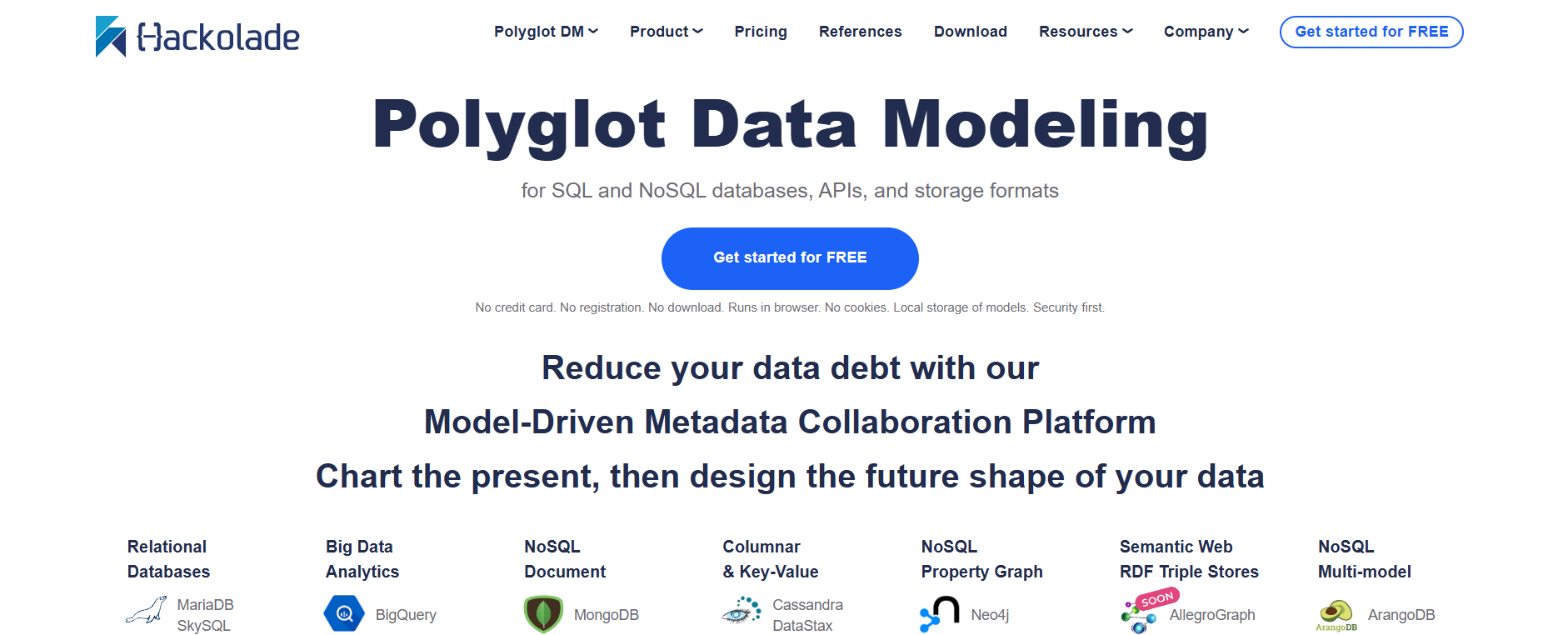
Hackolade is especially interesting if you’re dealing with semi-structured or NoSQL data in the cloud. It supports JSON, MongoDB, DynamoDB, and other cloud-native architectures that traditional modeling tools struggle with.
If your data doesn’t fit neatly into rows and columns, Hackolade can be a game-changer and help bring structure to otherwise chaotic datasets.
Tool #4 – SQLDBM
SQLDBM is fully browser-based and designed specifically for cloud data warehouses. No installs, no heavy setup — just open your browser and start modeling.
It’s great for teams that want fast visual modeling directly connected to Snowflake, BigQuery, or Redshift, without enterprise-level complexity or overhead.
Tool #5 – Dataedo
Dataedo focuses heavily on documentation, metadata, and data discovery. It helps teams understand what data exists, where it comes from, and how it’s actually used across the organization.
While it’s not the most advanced modeling engine, it’s incredibly valuable for clarity, onboarding, and reducing tribal knowledge.
Tool #6 – Moon Modeler
Moon Modeler supports both relational and NoSQL modeling and works well in hybrid cloud environments. It’s lighter than big enterprise tools but more structured than simple diagramming apps.
This is a solid choice for teams that want flexibility without overwhelming complexity or steep learning curves.
Tool #7 – Vertabelo
Vertabelo is a web-based modeling tool that balances ease of use with serious modeling features. It supports collaboration, versioning, and direct SQL generation for cloud databases.
It’s especially appealing for startups and mid-sized teams that want professional modeling without enterprise pricing or heavy processes.
Tool #8 – DbSchema
DbSchema works across many database types and supports reverse engineering, schema synchronization, and collaboration. It’s not cloud-only, but it adapts well to cloud environments.
This tool is best for teams managing multiple database technologies at once and wanting a single modeling interface.
Tool #9 – Open ModelSphere
Open ModelSphere is open-source and surprisingly capable. While the UI feels dated, it supports serious data modeling concepts used in enterprise environments.
If the budget is tight and you have the patience to learn it, this can be a powerful and cost-effective option.
Tool #10 – Archi (with Cloud Modeling Extensions)
Archi is often used for enterprise architecture, but with the right approach, it can model cloud data ecosystems in a very holistic way.
This tool is best when data modeling is part of a bigger architecture and strategy conversation.
Best Cloud Data Modeling Tools by Use Case
Choosing the best cloud data modeling tools depends heavily on what you’re actually trying to do and who will be using them.
Best Tools for Data Warehouses (Snowflake, BigQuery, Redshift)
DBT, SQLDBM, and Vertabelo are excellent choices here. They integrate deeply and respect the way cloud warehouses actually work at scale.
Best Tools for Analytics and BI-Driven Teams
dbt and Dataedo stand out. They make models understandable, documented, and aligned with how analysts and business users think.
Best Tools for Enterprise Data Governance
ER/Studio, Hackolade, and Archi are strong when governance, lineage, and compliance are non-negotiable requirements.
Best Budget-Friendly Cloud Data Modeling Tools
Vertabelo, Open ModelSphere, and Moon Modeler offer a lot of value without enterprise pricing or long-term contracts.
How to Choose the Best Cloud Data Modeling Tool for Your Team
There’s no universal winner. The best cloud data modeling tools are the ones your team will actually use consistently.
Team Size and Skill Level
Small teams usually benefit from simplicity and speed. Large teams need structure, governance, and clear ownership. Be honest about where you are today — not where you hope to be in two years.
Integration With Your Existing Data Stack
If a tool doesn’t integrate smoothly with your warehouse, CI/CD pipelines, or BI tools, it will create friction you don’t need and slow everyone down.
Pricing, Licensing, and Hidden Costs
Some tools look cheap at first and get expensive fast as teams grow. Others are expensive but save time, reduce errors, and prevent costly rework. Always think in terms of the total cost of ownership.
Future Scalability and Vendor Lock-In Risks
Ask yourself how hard it would be to leave the tool later. Tools that lock logic into proprietary formats can become a long-term liability.
Common Mistakes to Avoid When Selecting Cloud Data Modeling Tools
A bad choice here can slow you down for years and create technical debt that’s hard to undo.
Focusing Only on Features Instead of Workflow
A powerful feature you never use is worthless. Optimize for daily workflow, not marketing checklists or feature comparisons.
Ignoring Collaboration and Version Control
If only one person understands the model, you don’t have a model — you have a bottleneck waiting to happen.
Underestimating Cloud Performance Requirements
Cloud scale changes everything. Tools that don’t respect performance, cost, and scalability will break when you need them most.
Conclusion
The best cloud data modeling tools aren’t about diagrams or documentation for their own sake. They’re about clarity, trust, and speed. When your models are clean, shared, and well-governed, teams move faster, argue less, and make better decisions.
Take the time to test a few tools, involve your team in the decision, and think long-term. A good modeling tool won’t just organize your data — it’ll change how your team thinks about it and how confidently it uses data every day.
Find More: Boost Your Sales With SEO Services
FAQs
1. What are the best cloud data modeling tools for beginners?
For beginners, tools like Vertabelo, SQLDBM, and Dataedo are great starting points because they balance usability with real modeling power and don’t require deep expertise.
2. Are cloud data modeling tools better than traditional on-prem tools?
In most cases, yes. Cloud-native tools are built for scale, collaboration, and modern data stacks, which traditional tools often struggle to support.
3. Which cloud data modeling tools work best with Snowflake or BigQuery?
DBT, SQLDBM, and Vertabelo are among the best cloud data modeling tools for these platforms due to their native integrations and warehouse-first design.
4. Can cloud data modeling tools handle large-scale enterprise data?
Absolutely, as long as you choose tools designed for governance, performance, and collaboration, such as ER/Studio or Hackolade.
5. Are there free or open-source cloud data modeling tools?
Yes. Open ModelSphere and dbt (core) are popular options if you’re looking for powerful tools without licensing costs.