
The music creation landscape has been profoundly transformed by artificial intelligence, democratizing the process for creators of all skill levels. AI tools now enable aspiring songwriters and producers to effortlessly turn lyrical ideas into full musical pieces. The ability to input lyrics and have AI generate accompanying music, or a complete song, is a current reality. These innovative platforms use advanced algorithms to analyze text, interpret mood and rhythm, then compose instrumental tracks, melodies, or full vocal arrangements. This technology speeds up creative processes and opens new avenues for experimentation. Understanding these leading tools is crucial whether prototyping, creating background music, or experimenting with AI.
1️⃣ MakeSong — Transform Your Words into Music
What It Is
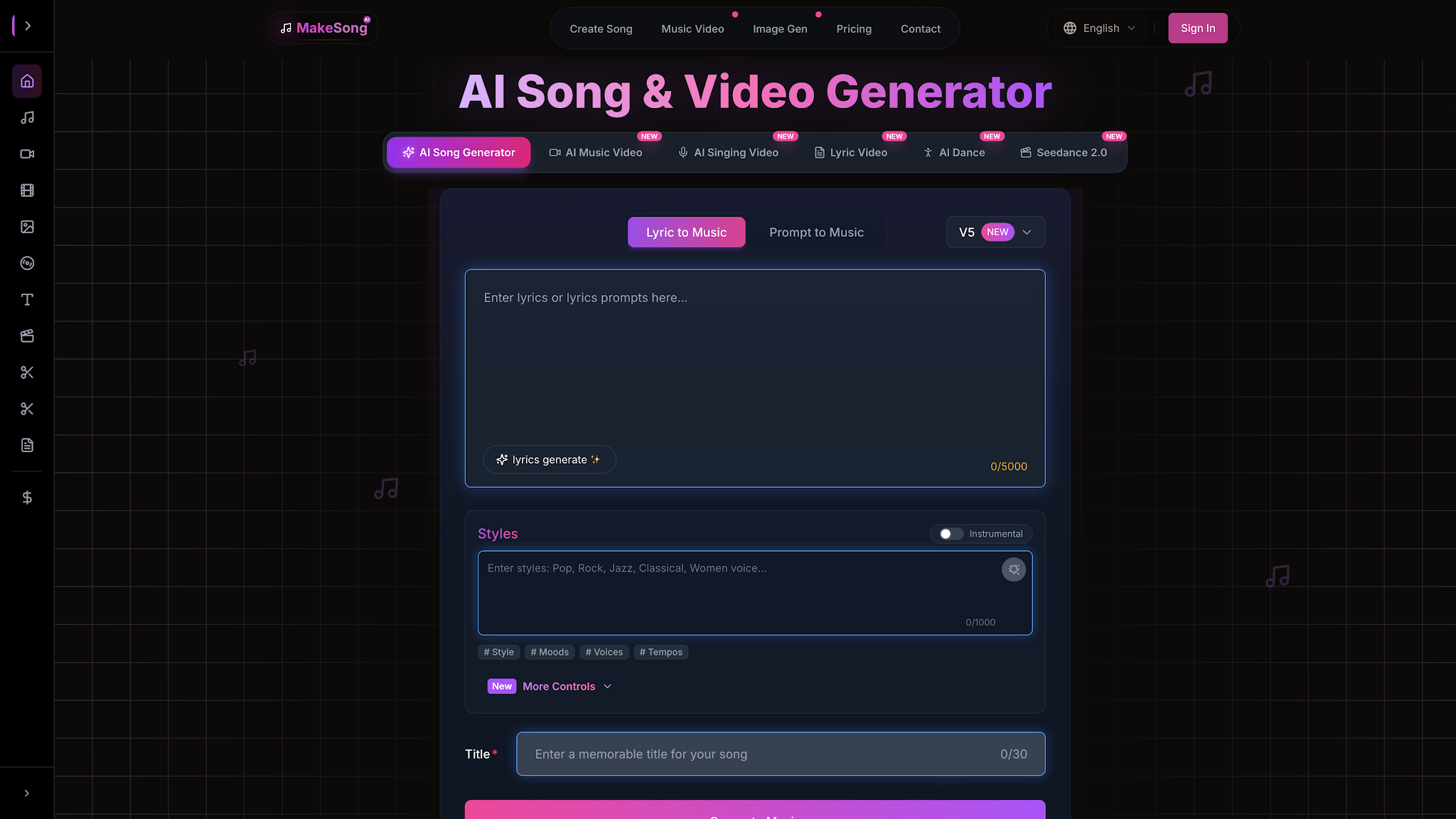
MakeSong is a leading AI Song Generator, transforming written lyrics into fully composed songs. It uses sophisticated AI to understand text’s narrative, mood, and rhythm, crafting musical arrangements. Users select genres, instruments, and vocal styles for creative control. Simply input lyrics; the AI generates a unique track. Ideal for songwriters, content creators, or AI music exploration, it bridges lyrical inspiration with a finished musical product, making complex production accessible.
Advantages
MakeSong excels with its user-friendly interface, simplifying music production. Its strength is directly interpreting lyrics and adapting music, a true “lyrics to song” solution. The platform offers wide genre and mood selections for high customization and rapid prototyping. Generated instrumental tracks often possess professional sound quality. It also provides various vocal styles, pushing boundaries for integrated AI vocal performances, making it a comprehensive tool for complete song creation and vocal synthesis.
Limitations
While powerful, MakeSong has limitations. Experienced producers might find granular control less extensive than traditional DAWs. The AI’s interpretation of nuanced lyrical meaning can occasionally miss emotional undertones. Advanced features and high-fidelity outputs often require subscription. Generated vocal performances may not always perfectly match desired human touch, requiring refinement. Thus, while excellent for rapid ideation and full song generation, it may not satisfy those seeking fine-grained control over every musical element.
2️⃣ AIsong — Instant Free AI Song Maker
What It Is
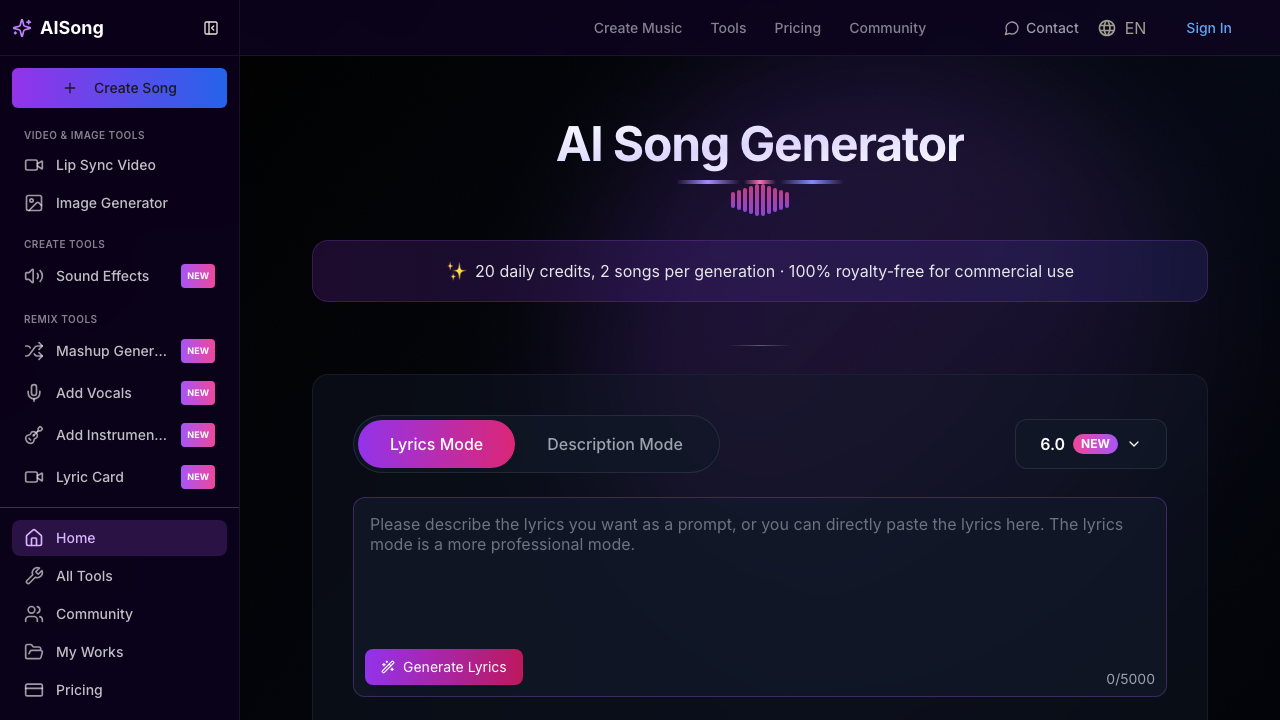
AIsong positions itself as an accessible Free AI Song Maker, prioritizing simplicity and speed in converting textual ideas into musical compositions. Users input lyrics or prompts for a rapid musical track. Its core functionality offers a direct path from text to instrumental music, excellent for those without extensive technical knowledge. AIsong emphasizes diverse styles, providing a functional outlet for exploring AI music without significant commitment, offering quick, high-quality output for various moods and genres.
Advantages
AIsong’s main advantage is its ease of use and powerful free tier. Its intuitive interface is highly accessible for beginners or those needing quick musical accompaniment. Rapid track generation facilitates experimentation. AIsong’s algorithm produces music across various moods and genres, offering ample sonic backdrops. For content creators and hobbyists, quickly generating unique background music or song ideas without financial investment is a significant draw. It serves as an excellent entry point into AI music creation.
Limitations
Despite accessibility and speed, AIsong has limitations. Customization and fine-tuning options are less extensive, offering fewer choices to tweak individual sounds, melodies, or rhythms. Musical complexity may sometimes lack intricate layering or dynamic shifts. Users seeking high-end studio quality or extensive post-production might find features basic. Its instrumental focus means advanced vocal synthesis is typically not robust. Therefore, while superb for quick instrumental generation, it may require additional tools for comprehensive vocal integration.
3️⃣ Riffusion — AI for Experimental Audio Generation
What It Is
Riffusion is an innovative AI tool leveraging diffusion models to generate unique music and abstract soundscapes from text prompts. Unlike traditional generators, it operates by creating spectral images of sound, which are then converted into audio. This allows for experimental exploration of new sonic textures, ambient soundscapes, and abstract musical ideas. It appeals to generative art and sound design enthusiasts, offering a distinct, AI-driven audio perspective focused on novel and unconventional sonic experiences.
Advantages
Riffusion’s primary advantage lies in generating truly unique, experimental soundscapes, actively pushing the boundaries of AI music. Its visual-spectrogram approach provides precise manipulation of audio characteristics, offering unparalleled creative control for abstract sound design. It excels in producing atmospheric textures, novel instrument sounds, and complex ambient compositions. For researchers and sound designers exploring the bleeding edge of AI audio synthesis, Riffusion provides a robust platform for innovation.
Limitations
While powerful for experimental sound design, Riffusion is not suited for direct “lyrics to song” composition with structured melodies or vocal integration. Output can be less predictable and harder to control for traditional musical structure, making it unsuitable for conventional songwriting or pop tracks. Users might encounter a steeper learning curve if unfamiliar with spectrograms. Its strengths are in abstract generation, limiting its appeal for mainstream music production.
4️⃣ SongR — AI for Prompt-Driven Instrumental Music

What It Is
SongR is an AI music generation platform specializing in creating instrumental tracks from descriptive text prompts. Users input keywords for genre, mood, instrumentation, and tempo, allowing the AI to compose an original musical piece tailored to specific requirements. This provides a versatile solution for generating background music, musical cues, or foundational instrumentals for various projects. SongR aims to make professional-sounding instrumental music accessible to content creators and musicians without extensive composition skills.
Advantages
SongR excels in quickly generating diverse instrumental tracks across numerous genres and moods, proving invaluable for content creators, game developers, and filmmakers. Its prompt-driven interface simplifies creation, enabling rapid experimentation without extensive musical theory. The platform produces high-quality, fully arranged instrumental pieces directly usable in projects or as a robust starting point. This efficiency and breadth of styles provide a significant advantage for those needing rapid, customizable instrumental music for various media production needs.
Limitations
A notable limitation of SongR is its primary focus on instrumental generation; it does not directly facilitate “lyrics to song” transformation or incorporate advanced vocal synthesis. While it creates excellent backings, users will need separate tools for adding vocals. Granular control over individual elements like specific note changes or chord progressions might be less extensive compared to human composition or traditional DAWs. Users seeking complex lyrical interpretation or fully integrated vocal performances might find its scope narrow.
5️⃣ Musicfy — AI for Vocal & Voice Generation

What It Is
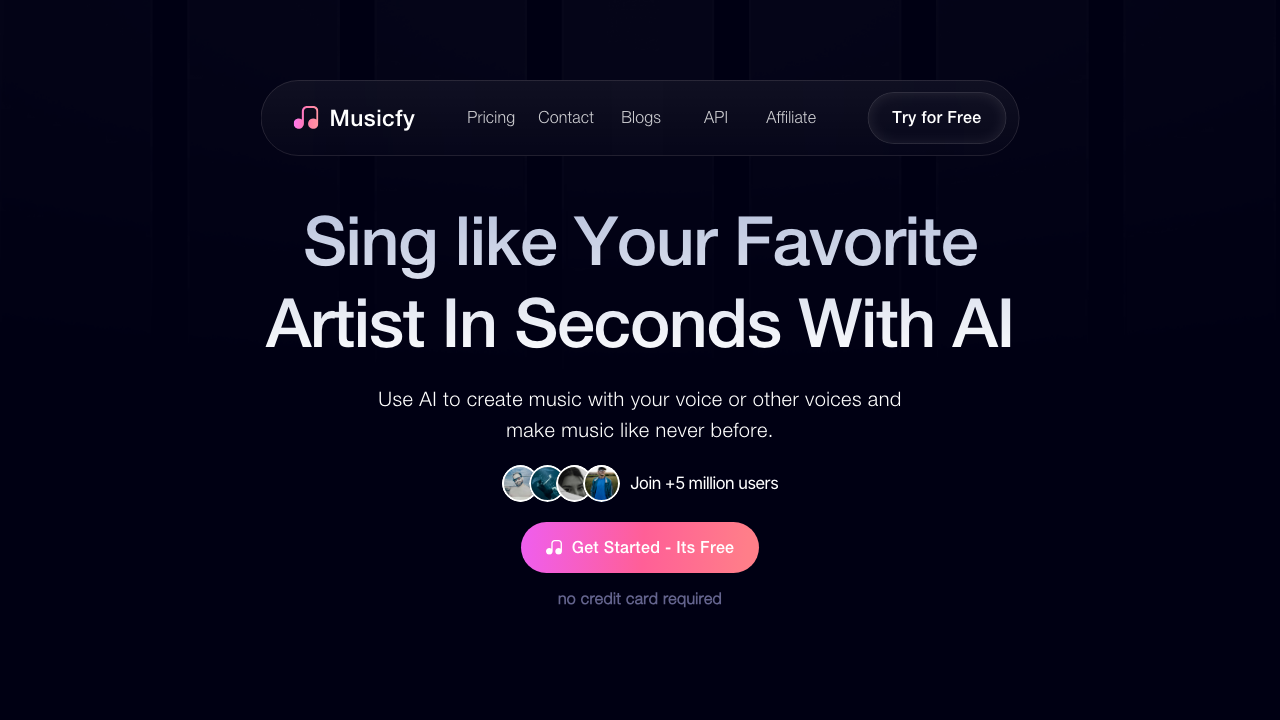
Musicfy is an advanced AI platform focused on vocal generation, precise voice cloning, and applying AI voices to musical compositions. It empowers users to create custom vocal tracks, generate singing or spoken performances from text, and accurately replicate specific voices using cutting-edge AI. The platform offers high-quality AI voices and extensive customization for pitch, emotional inflection, and delivery, making it a powerful tool for vocalists, producers, and content creators exploring new vocal artistry.
Advantages
Musicfy’s main advantage is its sophisticated vocal synthesis, offering high-fidelity and expressive AI voices that bring lyrics to life with nuanced performances. Its voice cloning feature is particularly notable, allowing users to create personalized vocal identities or replicate existing ones. It provides excellent control over vocal delivery, enabling precise adjustments to emotional tone, articulation, and stylistic nuances. For artists experimenting with unique vocal textures, producers seeking to add professional-grade AI vocals, or creators needing specific voiceovers, Musicfy is invaluable.
Limitations
Musicfy is not a comprehensive “lyrics to song” generator that directly composes instrumental backings from text. Its core functionality is centered around the vocal component; users typically need to provide instrumental tracks separately. While vocal capabilities are advanced, achieving perfectly natural, human-like performance capturing every subtle emotional nuance remains a challenge. Integrating generated vocals seamlessly often requires additional audio mixing expertise. Its highly specialized focus makes it a powerful complement rather than a standalone full song creator.
MusicGPT
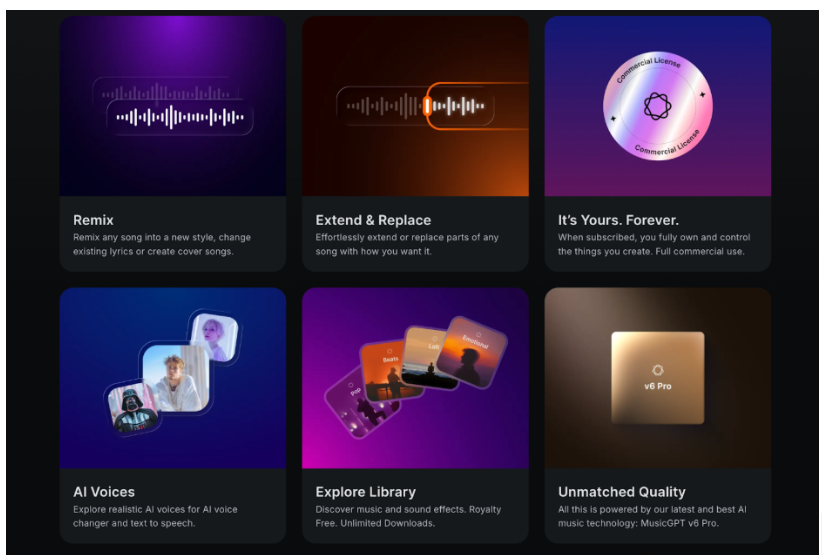
MusicGPT is an AI platform made for making music. Users don’t have to write music by hand; instead, they tell the platform what they want, and it makes original content based on those instructions.
It supports more than music generation. Users can also create voiceovers, lyrics, background tracks, and sound effects, making it a complete toolkit for many creative projects.
Top Features That Make MusicGPT Worth Trying
-
Turn Ideas Into Original Music
You don’t need music theory or production experience to get started. Type a prompt describing the mood, genre, or purpose of your track, and MusicGPT generates music that matches your request.
This feature is useful for video intros, presentations, advertisements, and social media content.
-
Create Professional Voiceovers
The integrated AI voice generator helps users produce spoken audio without recording their own voice. It’s useful for tutorials, explainer videos, podcasts, online courses, and marketing content.
For creators working on tight deadlines, this feature can save hours of production time.
Conclusion
The rapidly evolving landscape of AI music offers an exciting array of tools, each tailored for distinct creative needs. For direct lyric-to-music conversion, MakeSong stands out as an excellent AI Song Generator, providing robust instrumental and vocal solutions. Similarly, AIsong proves a highly accessible Free AI Song Maker, ideal for rapid text-to-music output. Beyond these, Riffusion excels in experimental sound design, SongR provides diverse instrumental backings, and Musicfy specializes in sophisticated AI vocal synthesis. These innovations empower creators to transform lyrical concepts into compelling musical experiences, making music creation more accessible and versatile.