
Introduction
As modern businesses continue expanding their digital infrastructure, the demand for experienced networking professionals has never been higher. Organizations depend on secure, reliable, and scalable networks to support cloud computing, cybersecurity, collaboration, and business continuity. While entry-level certifications help professionals begin their networking careers, advanced certifications demonstrate deeper technical expertise and leadership capabilities.
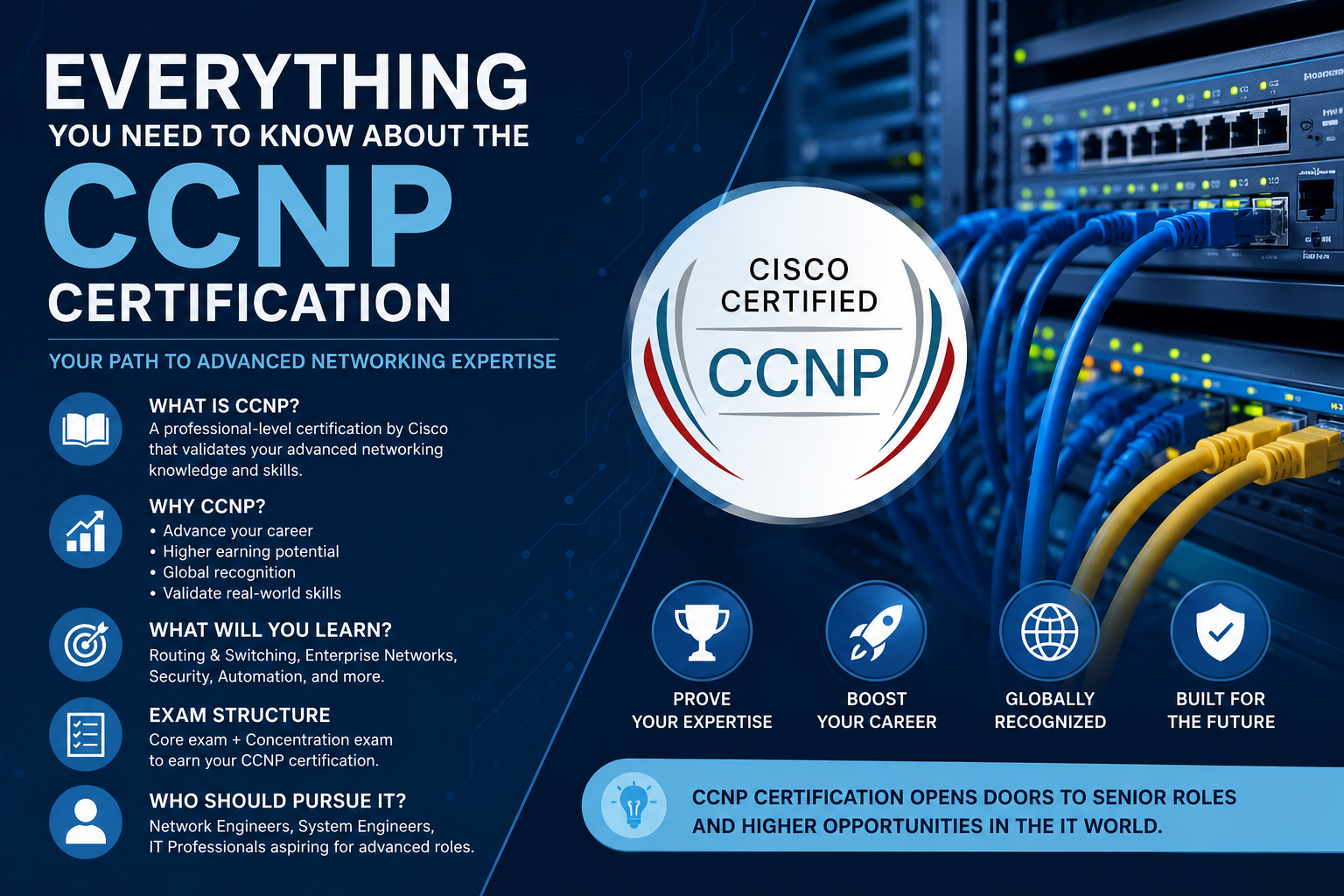
The Cisco Certified Network Professional (CCNP) certification is one of the most respected credentials for experienced networking professionals. It validates advanced knowledge in enterprise networking, security, automation, troubleshooting, and infrastructure management. Whether you are looking to advance into senior networking roles or strengthen your technical expertise, earning the CCNP certification can significantly enhance your professional profile.
This guide explores what the CCNP certification is, its benefits, exam preparation strategies, career opportunities, and practical tips for success.
What Is the CCNP Certification?
The Cisco Certified Network Professional (CCNP) certification is an advanced networking credential designed for IT professionals who already possess a solid understanding of networking fundamentals.
Unlike entry-level certifications, CCNP focuses on designing, implementing, managing, securing, and troubleshooting enterprise network environments.
Candidates develop expertise in areas such as:
- Enterprise networking
- Advanced routing
- Switching technologies
- Network security
- Wireless networking
- Automation
- Virtualization
- Infrastructure services
The certification prepares professionals to handle complex networking environments found in medium and large organizations.
Why Choose the CCNP Certification?
Networking technologies continue evolving with cloud computing, software-defined networking, and automation becoming standard components of enterprise infrastructure.
Some major advantages of earning the CCNP certification include:
- Enhanced technical credibility
- Better employment opportunities
- Stronger troubleshooting skills
- Increased networking expertise
- Preparation for leadership roles
- Professional recognition within the IT industry
Many employers value CCNP-certified professionals because they demonstrate advanced networking knowledge beyond entry-level skills.
Core Skills Covered in CCNP
The certification develops practical knowledge across several networking domains.
Enterprise Network Design
Candidates learn how to design scalable and reliable enterprise networks that support modern business requirements.
Topics include:
- Network architecture
- High availability
- Scalability
- Redundancy
- Infrastructure planning
Proper network design improves performance while minimizing downtime.
Routing and Switching
Routing and switching remain the foundation of enterprise networking.
Candidates study:
- Advanced routing protocols
- VLAN implementation
- Layer 2 technologies
- Layer 3 technologies
- Traffic optimization
- Network segmentation
These skills are essential for maintaining efficient communication across enterprise environments.
Network Security
Cybersecurity is integrated throughout today’s enterprise networks.
Important security topics include:
- Access control
- Authentication
- Secure network design
- VPN technologies
- Device hardening
- Threat mitigation
Strong security practices help organizations protect sensitive business information.
Automation and Programmability
Modern enterprise networks increasingly rely on automation.
Candidates learn about:
- Network automation
- APIs
- Configuration management
- Software-defined networking
- Infrastructure automation
Automation improves operational efficiency while reducing manual configuration errors.
Benefits of Earning CCNP
Professionals who earn the CCNP certification often experience several career advantages.
Improved Career Opportunities
Many organizations seek networking professionals capable of managing complex enterprise infrastructures.
The certification demonstrates readiness for advanced technical responsibilities.
Greater Technical Confidence
Preparing for CCNP requires extensive study and practical experience.
Candidates become more comfortable configuring, optimizing, and troubleshooting enterprise networks.
Foundation for Advanced Learning
CCNP also serves as preparation for expert-level certifications and specialized networking career paths.
Creating an Effective Study Plan
Passing the CCNP certification requires consistent preparation.
An effective study strategy should include:
- Reviewing Cisco’s official exam objectives
- Building practical networking labs
- Practicing router and switch configurations
- Learning automation concepts
- Reviewing network security
- Completing practice assessments
- Revisiting challenging topics regularly
Consistent study sessions help reinforce technical knowledge over time.
Importance of Practical Experience
Networking is highly practical.
Candidates should gain hands-on experience by working with:
- Cisco routers
- Cisco switches
- Virtual networking labs
- Routing protocols
- VLAN configuration
- Network troubleshooting
Practical experience helps transform theoretical knowledge into real-world skills.
Professionals seeking additional information about advanced Cisco networking certification can explore Exam Snap for educational resources, networking concepts, and preparation guidance related to the CCNP certification journey.
Common Mistakes During Preparation
Many candidates make avoidable mistakes that reduce their chances of passing.
Memorizing Instead of Understanding
Enterprise networking requires practical problem-solving.
Candidates should understand how technologies interact rather than simply memorizing commands.
Ignoring Automation
Modern enterprise networks increasingly depend on automation.
Candidates should dedicate time to learning network programmability concepts.
Skipping Hands-On Labs
Practical laboratory experience significantly improves understanding of routing, switching, and troubleshooting.
Inconsistent Study Schedule
Studying regularly is more effective than attempting to learn everything shortly before the exam.
Career Opportunities After CCNP
The CCNP certification supports numerous advanced networking careers.
Popular roles include:
- Network Engineer
- Senior Network Administrator
- Infrastructure Engineer
- Network Consultant
- Systems Engineer
- Enterprise Network Specialist
- Network Operations Engineer
- Solutions Architect
Many organizations across finance, healthcare, telecommunications, education, manufacturing, and government actively seek experienced networking professionals.
Tips for Exam Success
Before taking the CCNP exam, candidates should:
- Read every question carefully.
- Understand the business requirements.
- Apply networking best practices.
- Focus on troubleshooting logic.
- Manage time effectively.
- Review answers before submitting.
Scenario-based questions often require selecting the most appropriate networking solution rather than recalling simple technical facts.
Frequently Asked Questions (FAQs)
What is the CCNP certification?
The Cisco Certified Network Professional certification validates advanced networking knowledge in enterprise infrastructure, routing, switching, security, automation, and troubleshooting.
Who should pursue CCNP?
The certification is ideal for network engineers, systems administrators, infrastructure specialists, technical consultants, and experienced networking professionals.
Is CCNP more advanced than CCNA?
Yes. CCNP builds upon networking fundamentals and focuses on more complex enterprise networking technologies and real-world implementation scenarios.
Is practical experience important for CCNP?
Yes. Hands-on laboratory experience greatly improves understanding and prepares candidates for both the certification exam and professional networking responsibilities.
How should I prepare for the CCNP exam?
Candidates should combine structured study, practical lab exercises, official learning resources, networking simulations, and regular practice assessments.
What careers are available after CCNP?
CCNP-certified professionals often pursue careers as Network Engineers, Senior Network Administrators, Infrastructure Engineers, Enterprise Network Specialists, and Solutions Architects.
Conclusion
The Cisco Certified Network Professional certification is one of the most valuable credentials for experienced networking professionals seeking to advance their careers. It validates advanced technical skills, strengthens troubleshooting abilities, and prepares candidates to manage modern enterprise network infrastructures.
Success in the CCNP certification requires more than memorizing technical concepts. Candidates should combine structured learning with practical networking experience, laboratory practice, and consistent review of enterprise technologies. With proper preparation and continuous skill development, the CCNP certification can open the door to rewarding career opportunities while establishing a strong foundation for long-term success in the networking industry.