
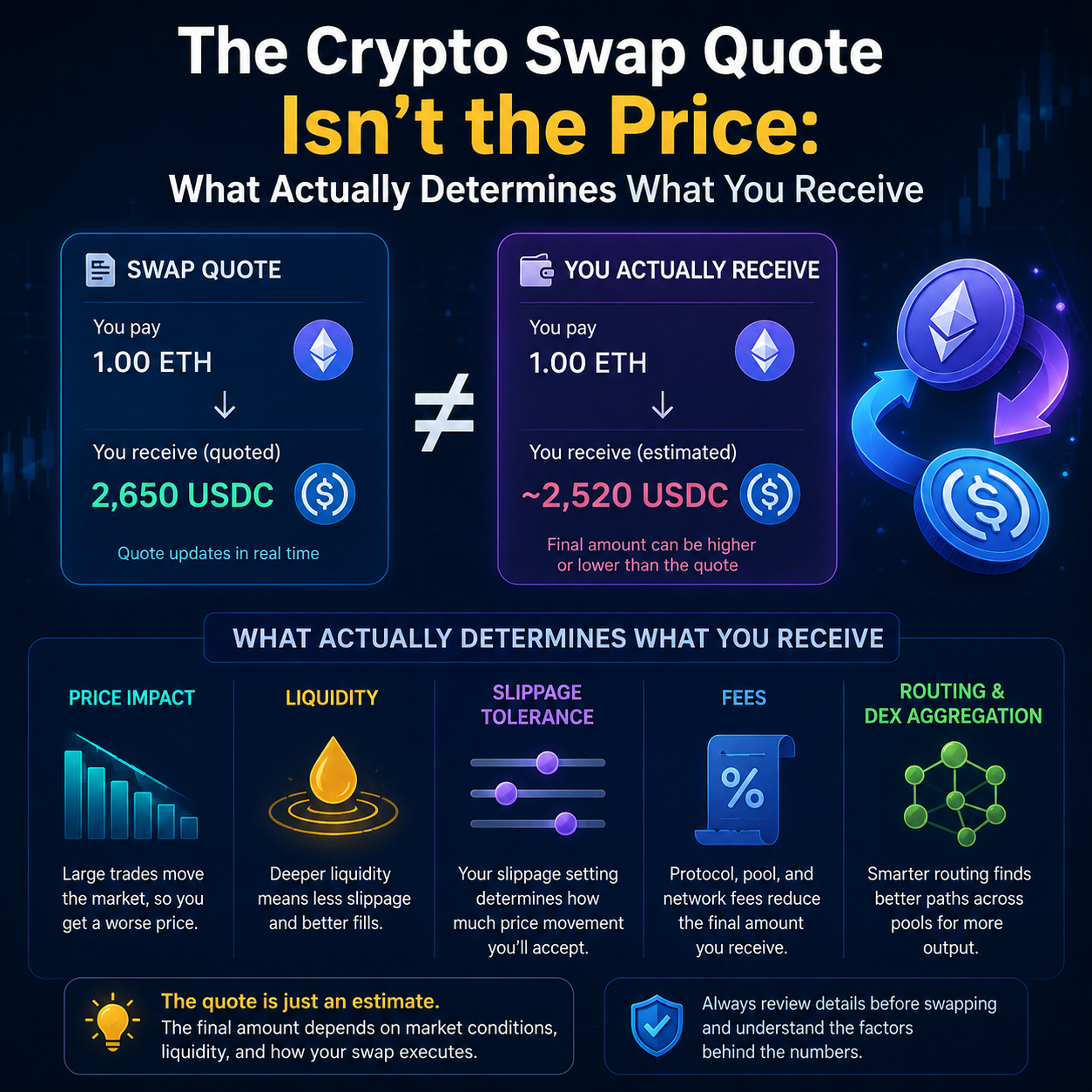
You open a swap page, enter an amount, and get a number: send 0.5 ETH, receive 1.83 SOL. Twenty minutes later, the amount that lands in your wallet is different — sometimes by a little, occasionally by a lot. Nothing was stolen. Nothing broke. The quote was simply never a fixed promise; it was an estimate built from several moving parts, and most of them aren’t visible on the screen where you see the number.
Understanding those parts doesn’t just satisfy curiosity — it changes which provider you’d pick and which rate type you’d choose.
Three cost layers hiding inside every quote
A swap quote is rarely a single price. It’s usually built from three layers stacked on top of each other, and platforms disclose each layer with very different degrees of honesty.
The first is the service fee — the percentage a provider says it charges. Some publish it plainly. Others fold it into “the rate” and call it zero.
The second is the spread — the gap between the real market price and the price you’re quoted. This is where “0% fee” services usually make their money. A 2026 review of instant-swap pricing found effective spreads on identical trading pairs varying by hundreds of basis points between providers all advertising “zero commission,” meaning two platforms with the same headline fee can deliver noticeably different amounts for the same trade.
The third is the network fee — what the blockchain itself charges to move your coins. This one is unavoidable and roughly the same everywhere, but it still needs to be shown inside the quote, not added as a surprise at the end.
None of these three layers is dishonest on its own. The problem is that a single quote from a single provider shows you its own mix of the three, with no way to tell how much of the “good rate” is real and how much is a wide spread doing the work.
Fixed vs. floating: what each protects you from
Most providers let you choose between a fixed and a floating rate, and the choice matters more than it looks.
A fixed rate locks in the exchange rate for a short window, usually 10–15 minutes, so market movement during that window doesn’t change what you receive. In exchange, fixed rates typically carry a wider built-in spread, because the provider is absorbing the risk of the market moving against it before your transaction settles.
A floating rate tracks the market in real time. It can work in your favor if the price moves your way while your transaction confirms, and against you if it doesn’t. On networks with slow confirmation times, even a few minutes of price movement can turn a favorable quote into a smaller-than-expected payout — this is the slippage that catches a lot of first-time swappers off guard.
Neither option is universally better. A fixed rate suits a nervous or volatile market; a floating rate suits a stable one and a fast network. The mistake is not knowing which one you picked.
Why a low headline fee isn’t the same as cheapest
A provider advertising the lowest fee isn’t necessarily the cheapest one to actually use — a wider spread can absorb more of your funds than a disclosed, higher fee would, even though the marketing headline reads better. The only number that tells the truth is the amount that actually lands in your wallet, not the number on the marketing banner.
The practical way to check this is to compare the receive amount, not the advertised fee, across a few providers for the same pair, the same amount, at the same moment. That’s a fairer test than trusting any single quote, and it’s the reason side-by-side comparison across multiple crypto exchange providers has become a standard step for anyone moving a meaningful amount, rather than a nice-to-have.
The risk no rate shows: KYC after you’ve already sent funds
The cost layers above affect how much you receive. A separate risk affects whether the transaction completes at all: identity verification requested after you’ve already sent crypto.
Many instant-swap providers don’t require KYC for a typical, small crypto-to-crypto transaction. According to Changelly’s own published verification tiers and independent reviews conducted through mid-2026, standard swaps generally don’t require ID — but, like most providers in this category, Changelly applies risk-based checks that can pause a transaction and request verification once it’s already been flagged by its internal risk system. That’s not a flaw unique to one provider; it’s how risk-based compliance works across most instant-swap platforms. The problem for users is that the trigger isn’t disclosed in advance, so it can’t be checked before you send funds — only a provider’s KYC history, gathered from past cases, gives you any real signal ahead of time. You can review Changelly’s own Changelly exchange track record on this before choosing it for a given swap.