
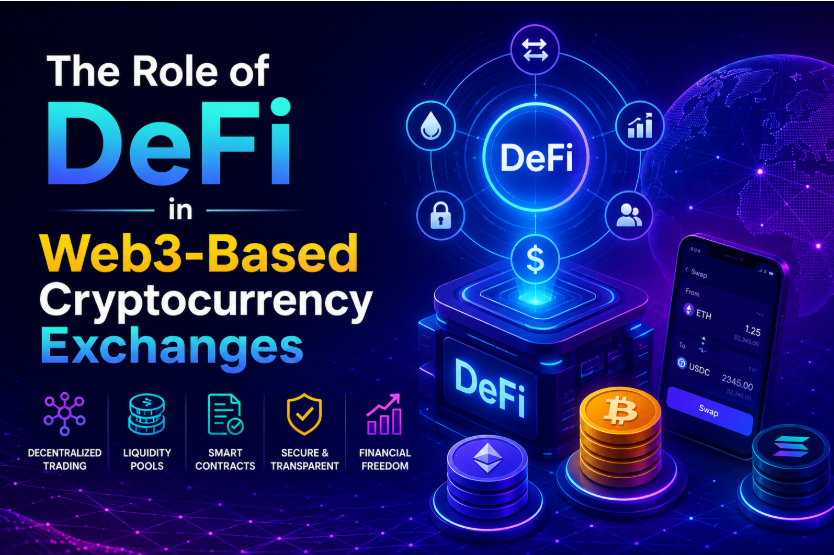
The cryptocurrency space is edging past the older centralized setups, moving toward more decentralized, open, and user-led financial environments. Right in the middle of that shift sits Decentralized Finance (DeFi); it makes financial services possible without depending fully on banks, brokers, or those centralized middlemen. And when DeFi is paired with Web3-style cryptocurrency exchanges, you suddenly get a bunch of fresh chances for trading, borrowing, liquidity handling, staking, and even a clearer form of asset ownership.
Since interest in decentralized finance solutions keeps rising, more and more companies end up partnering with web3 development companies to create exchanges that mix blockchain infrastructure, smart contracts, decentralized liquidity, and user-controlled wallets.
Understanding DeFi in the Web3 Exchange Ecosystem
DeFi is basically blockchain-based financial applications where users can tap into financial services via smart contracts. Instead of relying on some central authority, DeFi protocols kind of run the whole deal by automating transactions and other financial routines based on rules that are already set ahead of time, more or less.
In a Web3 cryptocurrency exchange, DeFi can help with a bunch of core tasks like decentralized trading, liquidity provision, token swapping, staking, yield generation, and even peer-to-peer exchanges. People can connect their non-custodial wallets straight to the platform and use blockchain-based services without handing over full control of their funds to a centralized middleman.
Overall, this shifts the usual cryptocurrency exchange setup, because users become active contributors in the financial ecosystem rather than just plain customers of a centralized platform.
How DeFi Enhances Web3-Based Cryptocurrency Exchanges
1. Decentralized Trading
One of the most important contributions of DeFi is decentralized trading. Also, unlike regular exchanges where everything goes through some central order-matching engine, decentralized trading can lean on automated market makers, AMMs, liquidity pools, or even decentralized order books. The result is a more transparent trading environment, and it also reduces reliance on one controlling entity, which is usually the problem.
2. Non-Custodial Asset Management
Web3 exchanges that are powered by DeFi can also support non-custodial transactions. That means users keep control of their private keys and assets via compatible wallets. Instead of depositing money into an exchange-controlled wallet, you just manage it yourself, at least at the technical level.
3. Liquidity Through DeFi Protocols
Liquidity matters for any cryptocurrency exchange, because traders need enough available assets to execute swaps efficiently. Here DeFi steps in with liquidity pools that let users contribute digital assets into trading pools.
In exchange, liquidity providers might receive transaction fees or other protocol incentives. So it becomes a decentralized way of keeping market liquidity alive, and it still lets users take part directly in the exchange ecosystem.
For businesses building exchanges, integrating well-known liquidity protocols, or designing customized liquidity mechanisms can improve trading functionality, and it may also boost user participation.
4. Smart Contract-Based Automation
Smart contracts are kind of the backbone in DeFi, especially for exchanges. They do predefined stuff automatically as soon as the set conditions are hit.
Like, a smart contract can take care of token swaps, distribute trading fees, pay staking rewards, or even run liquidity operations without needing a human hand from some centralized admin, and honestly, that’s the whole idea.
Because of this, automation usually improves operational efficiency while also leaving a clean, transparent trail of transactions right there on the underlying blockchain, so it feels more verifiable than just someone saying, “Trust me.”
DeFi Use Cases in Web3 Cryptocurrency Exchanges
DeFi in actual practice goes way beyond simple token swapping. Today’s Web3 exchanges can connect several decentralized financial services together, so the final result is a broader digital asset environment. Not just one action, but a cluster of related tools working side by side.
Yield Opportunities: DeFi systems can let users participate in liquidity supply or other strategies, with the goal of generating returns.
Lending and Borrowing: Exchanges can plug into decentralized lending protocols, so users can either lend assets or get collateral-backed loan amounts.
Liquidity Mining: Users supply liquidity to chosen pools and receive protocol-driven incentives, sometimes in rewards that are not really “free money” but still pretty enticing.
Cross-Chain Transactions: More advanced platforms can link multiple blockchain networks, which makes assets easier to access and improves interoperability.
These capabilities can transform a basic exchange into a full decentralized finance platform, more like a small ecosystem than a single marketplace, and it’s pretty compelling.
The Role of Smart Contracts in DeFi Exchange Development
Smart contracts kind of become the operational core of a lot of DeFi exchange features. They basically say how assets get deposited, swapped, kept in escrow, moved, and finally distributed. In practice, it’s the behind-the-scenes logic that makes everything run without too much manual handling.
For example, an automated market maker might rely on smart contract rules to figure out token prices from the liquidity sitting inside a pool. Likewise, staking contracts can coordinate deposits and then handle reward distribution based on predetermined conditions, and those conditions are set ahead of time. It all feels pretty seamless when it works.
But of course, smart contract development needs careful planning and, yes, extensive security testing too. Even small bugs, or subtle vulnerabilities, can end up causing real financial losses. So businesses should treat audits as a must, use secure coding methods, run thorough testing, and keep ongoing monitoring while the system is live. That part doesn’t really “end” after launch.
Benefits for Businesses and Users
Bringing DeFi into Web3-powered cryptocurrency exchanges can bring upside for both platform owners and the end users.
From the user side, DeFi can offer more direct control over funds, auditable transaction history, and direct wallet connectivity. It also opens the door to a wider assortment of decentralized financial services, beyond the usual limited menu.
From the business side, DeFi can create more revenue paths via transaction fees, liquidity-related services, staking features, and even premium financial products. It can also help platforms stand out in a crowded cryptocurrency landscape, where differentiation matters a lot.
Still, getting it right takes more than just “adding DeFi.” Businesses need to think about chain choice, contract safety, liquidity management, regulatory expectations, and user experience. They also have to plan for scalability and interoperability.
Why Choose Experienced Web3 Development Companies?
Building a secure DeFi-powered exchange needs a real mix of know-how, like blockchain development, smart contract work, wallet connection stuff, token standards, APIs, frontend building, and cybersecurity. So in practice, experienced web3 development companies tend to become kinda essential tech partners for businesses that want to step into decentralized finance.
A good development partner can support the whole path, from choosing which blockchain network makes sense to sketching the exchange architecture to bringing DeFi protocols into the system, then writing smart contracts, getting wallet connectivity working smoothly, and running security testing, not only once but in a thorough way.Also, businesses can judge cryptocurrency exchange development companies by looking at several things.
Challenges of Integrating DeFi With Web3 Exchanges
Even with the obvious benefits, DeFi integration comes with hurdles. Smart contract vulnerabilities are still a big worry, and on top of that, network congestion plus blockchain fees can slow things down and impact transaction efficiency. Liquidity fragmentation—across different protocols and networks—can also make exchanges feel harder to manage than expected.
Then there is regulatory uncertainty. Companies running cryptocurrency exchanges have to figure out what rules apply in their target regions and then adjust the platform design based on that reality.
What Does the Future Hold for DeFi-Based Exchanges?
The future of Web3 exchanges seems like it will lean into deeper fusion between decentralized trading and all those other mainstream financial services. Things like cross-chain interoperability, account abstraction, advanced automated trading, tokenized real-world assets, decentralized identity, and AI-assisted money tools could keep stretching what DeFi platforms can actually do. In a way, it’s not just swaps anymore; it’s more like a broader suite, even if the interface still feels familiar.
As blockchain infrastructure gets more scalable and more approachable for regular people, DeFi-powered exchanges may end up moving beyond “just” token trading. They might turn into full decentralized financial ecosystems.
Conclusion
DeFi is doing a big job in reshaping how Web3-based cryptocurrency exchanges run. With decentralized trading, non-custodial wallets, liquidity pools, smart contracts, staking, lending, and automated financial services, DeFi can give users better command over funds while also opening up fresh chances for companies.
For businesses that want to step into this market, picking the correct tech architecture and a solid development partner matters a lot. Working with experienced Web3 development firms or specialized cryptocurrency exchange development companies can help organizations launch secure, scalable, and packed-with-features platforms that are ready for how the Web3 economy keeps moving.
And as decentralized finance keeps maturing, its tie-ins with Web3 cryptocurrency exchanges will likely stay one of the key sparks for innovation across the digital asset world.