
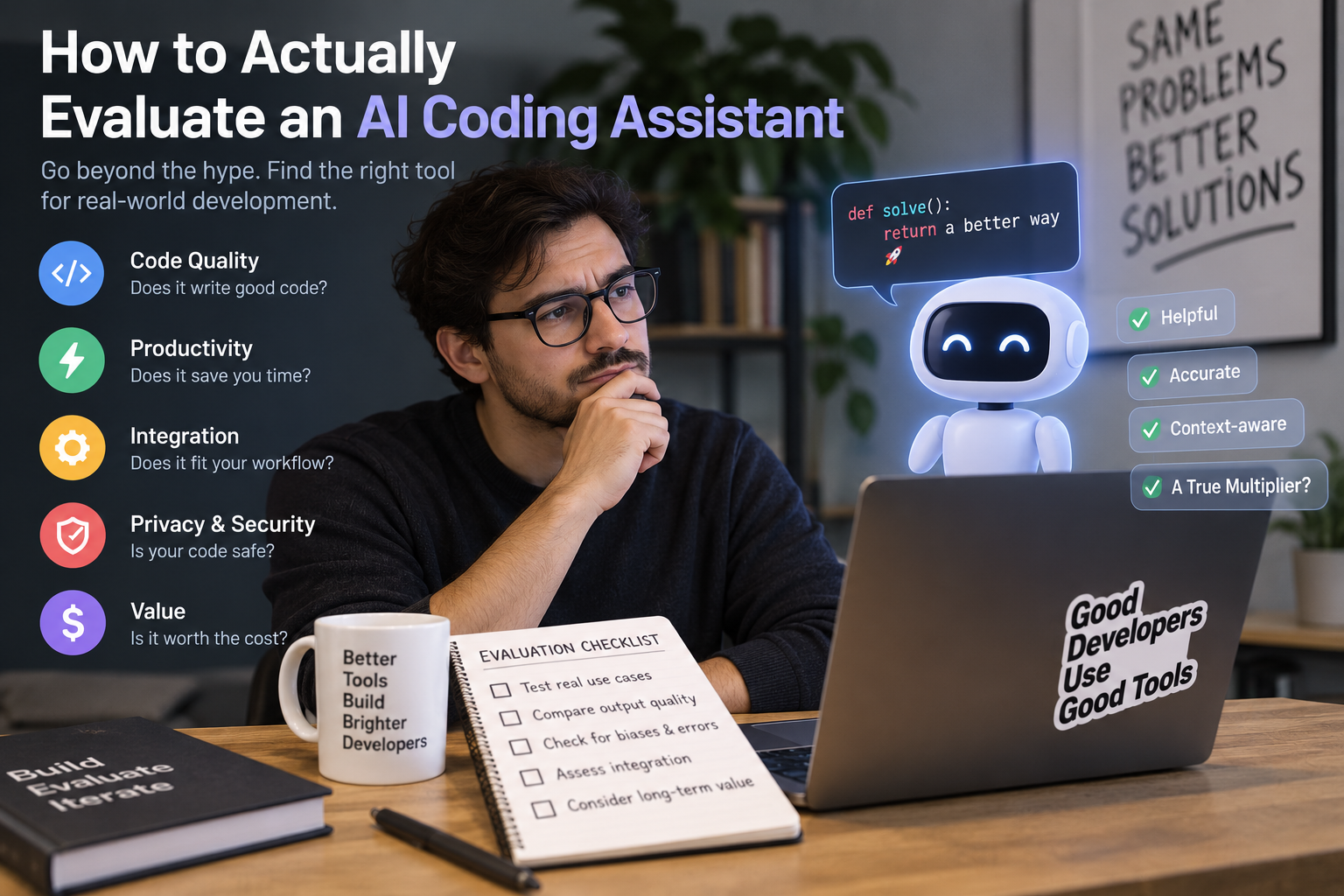
Most teams choose an AI coding tool the same way: someone influential tries one, likes it, and the organisation standardises. Six months later half the team has quietly gone back to something else, the licences renew automatically, and nobody has measured anything.
There is a better process, and it takes about three weeks.
Start by admitting there are three product categories
The market is usually discussed as one thing. It is at least three, and they fail in different ways.
Inline completion predicts the next lines as you type. The interaction model is autocomplete. It is unobtrusive, it works well on boilerplate, and its ceiling is low because it never sees more than local context.
Chat-in-editor answers questions about the code with the editor’s index available. It handles explanation, refactoring within a file or two, and test generation. The bottleneck is context assembly — how well the tool picks what to show the model.
Autonomous agents take a task, read the repository, make changes across files, run tests, and iterate. This is a different activity with different risks. The productivity ceiling is far higher and so is the review burden, because you are reading a diff you did not write.
Comparing a completion tool to an agent on “code quality” is a category error, and a large share of published comparisons do exactly that. Edgewisely’s comparison of Claude Code and GitHub Copilot on pricing, credit limits and agent capability is useful precisely because it keeps the agent question separate from the completion question rather than averaging them.
The pricing model matters more than the sticker price
Per-seat pricing is easy to budget and mostly honest. Credit or usage-based pricing is where organisations get surprised, because agent runs consume dramatically more tokens than completions and the variance between developers is enormous.
Before committing, establish three things: what a heavy user costs at full utilisation, what happens when the allowance runs out mid-task, and whether unused allowance pools across the team or expires per seat. The third detail is worth real money in teams where usage is concentrated in a few people, which is the normal pattern.
There is also a genuine open-source path. Tools that run against your own API keys shift the cost from a subscription to inference, which is cheaper at low volume, more expensive at high volume, and gives you model choice. Edgewisely’s cost and capability comparison of an open-source terminal agent against a vendor-shipped one sets out that trade in detail, and the answer genuinely varies by how much your team uses it.
Editor lock-in is the underrated cost
The strongest opinions on these tools are rarely about the AI. They are about the editor it is attached to.
A tool that requires switching editors is asking developers to give up years of accumulated configuration, keybindings, extensions and habits in exchange for a capability improvement. That trade is frequently worth it and is almost never presented honestly. Teams that mandate an editor switch should expect a productivity dip of several weeks and some permanent non-compliance.
Performance is the other axis people underweight until they feel it. A fast native editor with fewer extensions is a different daily experience from a feature-rich one that occasionally stalls, and which matters more depends entirely on the person. Edgewisely’s comparison of an open-source native editor against the incumbent AI-first one lands on a verdict by user type rather than a single winner, which is the correct shape for this decision.
Security and licensing questions that come up late
Two issues reliably surface after the tool is deployed, when changing course is expensive.
The first is what leaves the building. Every one of these tools sends code somewhere unless configured otherwise, and the configuration varies: some send only the active file, some index the entire repository, some retain context between sessions on the vendor’s infrastructure. Ask specifically what is transmitted, what is retained, for how long, and whether it is used for training. The answers differ substantially between tiers of the same product, and the free tier’s answer is almost always the least favourable.
The second is provenance. Suggestions derived from training on public repositories can reproduce licensed code, and some tools offer filtering against public sources while others do not. For most internal software this is a theoretical concern. For anything you distribute, license, or sell, it is a real one, and legal will eventually ask. Finding out whether the filter exists during evaluation costs nothing; finding out during a due diligence process costs a great deal.
Neither issue should block adoption. Both should be answered in writing before a rollout rather than after, because retrofitting a policy onto a tool developers already rely on is a considerably harder conversation.
The three-week evaluation
Week one: instrument the baseline. Cycle time from first commit to merged PR. Review turnaround. Escaped defect rate. Without these, every subsequent claim is anecdote. Most teams already have this data and have never looked at it.
Week two: run two tools in parallel on real work. Not a bake-off on toy tasks. Split the team, assign genuine tickets, and require each developer to log two things per task: time to first working version, and time spent reviewing or correcting AI output. The second number is the one that separates tools, and it is the one nobody collects.
Week three: look at the tail. Averages hide the failure mode. What matters is the worst outcome — the task where the agent confidently produced a plausible wrong answer that took two hours to unpick. A tool with a better average and a worse tail is usually the wrong choice for a team shipping to production.
What to measure afterwards
Two metrics are worth tracking permanently.
Review load. If AI output increases PR volume while review capacity stays fixed, you have moved the bottleneck rather than removed it. This is the single most common failure mode in teams that adopt agents enthusiastically, and it shows up as reviewer burnout before it shows up in cycle time.
Defect origin. Tag defects by whether the originating code was human-written, AI-assisted or agent-generated. Do this for six months. The result will tell you more about where to apply these tools than any vendor benchmark, and it is the only evidence that will survive a disagreement between two senior engineers with strong opinions.
The unglamorous conclusion
The differences between the leading tools are smaller than the differences between teams using them well and badly. A team with good tests, small PRs and fast review will get value from almost any of these. A team with a flaky test suite and week-long reviews will amplify its existing problems, because agent-generated code increases the volume flowing through a process that was already the constraint.
Fix the process, then pick the tool. The order matters more than the choice.