

Studying from long PDFs often fails not because the material is weak, but because the format works against attention. Long paragraphs, static pages, and delayed feedback create friction between intention and follow-through. In my own tests, tools built around passive reading rarely changed that dynamic. What stood out about Brainrot Study was not that it promised “faster learning,” but that it quietly reorganized how information shows up in front of you, shifting dense documents into a format that feels closer to modern attention habits without fully abandoning structure.
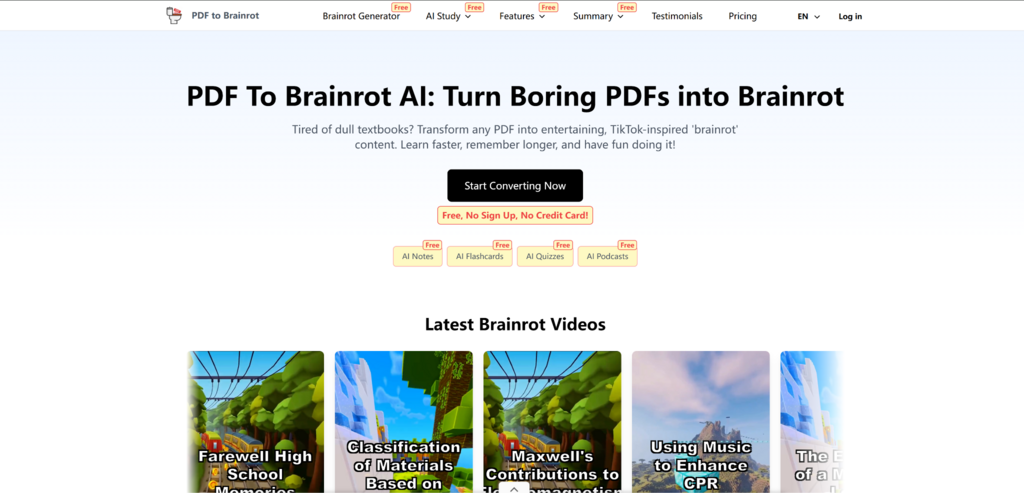
Instead of asking you to read harder or focus longer, the system reframes input itself. It breaks material down, sequences it into short audiovisual units, and lets rhythm and pacing carry part of the cognitive load. The result is not effortless understanding, but a noticeably lower barrier to starting and continuing a study session, especially with material that would otherwise feel heavy.
Why Static Documents Conflict With Modern Attention Patterns
Linear Reading Assumes Sustained Focus That Rarely Exists
Traditional PDFs assume uninterrupted attention from beginning to end. In practice, most people skim, pause, and abandon long documents multiple times before finishing. This mismatch is not a personal failure; it is a structural one.
Passive Formats Delay Feedback and Reinforcement
When reading alone, comprehension gaps often surface late. By the time confusion appears, motivation has already dropped. Short-form, segmented delivery tends to surface misunderstanding earlier, even if it does not solve it outright.
High Information Density Raises Entry Resistance
Large blocks of text create psychological resistance before learning even begins. Reducing perceived density can change whether a study session happens at all.
How Brainrot Study Restructures Information Delivery
Content Is Re-segmented Rather Than Simply Read Aloud
From my observation, the system does more than convert text to speech. Source material is divided into shorter conceptual units that align better with short video timing, making each segment feel finite and approachable.
Audiovisual Layers Share Cognitive Load
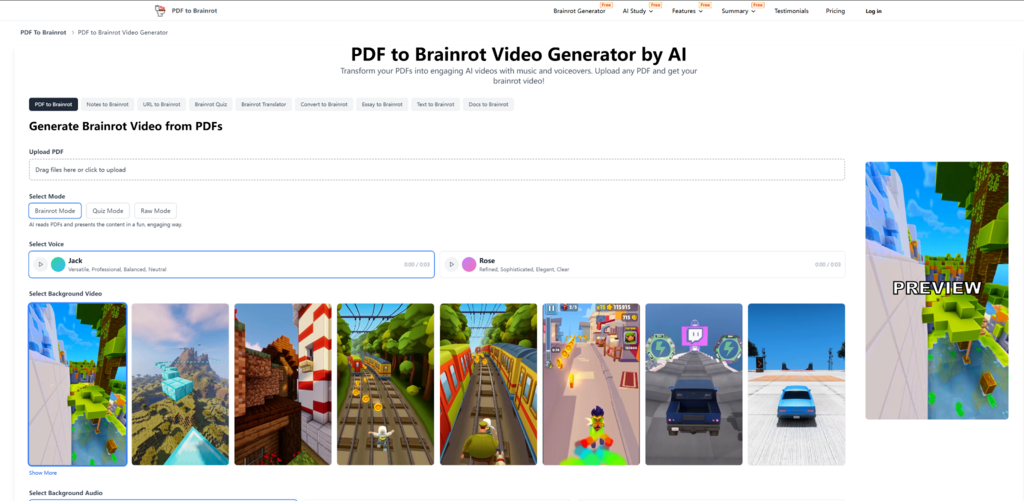
Voice, background motion, and optional music distribute attention across channels. When balanced well, this can make it easier to stay engaged, though overly active visuals can occasionally distract depending on the background choice.
Multiple Presentation Modes Encourage Different Study Behaviors
Rather than enforcing a single “correct” learning style, the platform offers distinct modes that emphasize recall, exposure, or review, allowing the same material to be revisited with different cognitive intentions.
Modes That Shape How Information Is Experienced
Brainrot-Oriented Presentation for Rapid Exposure
This mode emphasizes pace and rhythm. It appears most useful for first-pass exposure, where familiarity matters more than precision.
Question-Driven Structuring for Active Recall
Quiz-oriented structuring reframes content as prompts rather than statements. In practice, this made gaps in understanding more visible during testing.
Minimalist Output for Straightforward Review
Raw-style presentation removes most stylistic layers. It feels closer to structured listening than entertainment, which may suit users sensitive to distraction.
Where This Approach Differs From Conventional Study Tools
| Aspect | Traditional PDF Reading | Brainrot Study Approach |
| Information pacing | User-controlled, often inconsistent | System-paced, segmented |
| Cognitive entry cost | High for long documents | Lower due to short units |
| Feedback timing | Delayed until confusion accumulates | Earlier through segmentation |
| Engagement style | Primarily visual | Audio-visual hybrid |
| Revisit flexibility | Manual rereading | Mode-based reprocessing |
The contrast is less about replacing reading and more about lowering the activation energy required to engage with complex material.
Observed Strengths In Practical Use
Lower Friction for Starting Study Sessions
In repeated use, the most noticeable benefit was not deeper comprehension but improved consistency. Starting felt easier, which often mattered more than efficiency gains.
Improved Tolerance for Dense Source Material
Technical or academic PDFs felt less intimidating when broken into short-form sequences, even when the underlying complexity remained unchanged.
Flexible Reuse of the Same Source
Being able to revisit identical material in different modes reduced redundancy. Instead of rereading, the content felt reframed.
Limitations Worth Acknowledging
Results Depend Heavily on Source Quality
Poorly structured PDFs still produce uneven outputs. In my tests, cleaner source documents consistently led to better segmentation and flow.
Visual Stimulation Can Become Counterproductive
Some background video options are visually engaging enough to compete with the content itself. Choosing calmer visuals improved comprehension.
Not a Replacement for Deep Work
While helpful for exposure and review, the format does not replace careful reading when precision, notation, or detailed argumentation is required.
How The Official Workflow Actually Functions
Step 1: Provide Source Material
Upload a document or paste text directly into the input interface. Supported formats include common document types and copied content.
Step 2: Select Presentation Mode And Media Style
Choose a mode, voice, background video, and optional audio layer. These selections define pacing and engagement style.
Step 3: Generate And Review Output
The system processes the content and produces short-form video segments ready for review or reuse.
This workflow aligns closely with what is visible on the official interface, without hidden configuration layers.
Positioning Within Broader Learning Trends
Across the AI learning space, there is growing experimentation with multimodal delivery and microlearning. Many platforms emphasize personalization or adaptive testing. What differentiates this approach is its focus on format transformation rather than content creation. It does not attempt to teach new material, but to reshape how existing material is encountered.
For broader context, recent discussions around short-form learning and cognitive load theory can be found in non-commercial research summaries such as:
https://www.frontiersin.org/journals/psychology
https://arxiv.org/abs/2305.00000
These discussions suggest that segmentation and modality balance can support engagement, though outcomes vary widely by learner and subject.
A Measured Perspective On Its Potential
Brainrot-style study formats are not a universal solution. Their value appears strongest at the intersection of motivation, consistency, and exposure. For learners who struggle to begin or persist with dense documents, this reframing can act as a bridge rather than an endpoint.
In my experience, the most realistic way to view Brainrot Study is as a complementary layer. It sits between raw documents and deep analysis, helping material feel approachable enough to return to, even when full mastery still requires traditional effort.