


Imagine a melody stuck in your head. It is vivid, emotional, and completely yours. You can hear the drums kicking in, the swell of the strings, and the exact rhythm of the lyrics. But when you open your mouth to explain it or try to tap it out on a desk, it falls flat. The bridge between your imagination and reality is broken.
For decades, this has been the silent struggle of creatives, writers, and dreamers. We have been told that music production is an exclusive club. You need to know music theory. You need to master complex Digital Audio Workstations (DAWs) that look like airplane cockpits. You need thousands of dollars for studio time or session musicians. So, what happens to those brilliant song ideas? They fade away, unrecorded and unheard. It is a graveyard of creativity, and frankly, it is heartbreaking.
But what if the barrier to entry wasn’t a ten-year learning curve, but a simple sentence? What if you could hire a full production team just by typing out your thoughts? This is where the landscape shifts.
This is where Text to Music AI enters the narrative, not just as a tool, but as a translator for your creative soul.
The Day I Became a Composer (Without Knowing a Single Note)
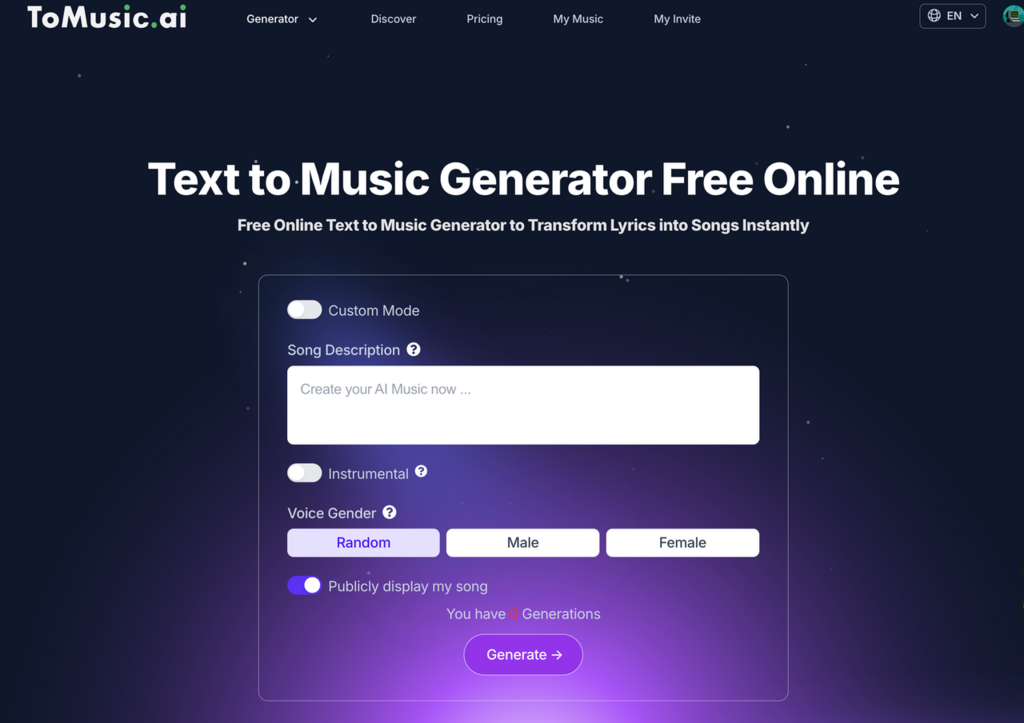
I remember the first time I logged onto the platform. I was skeptical. As a writer, I have always envied musicians. I can describe a scene with words, but I cannot make you feel it the way a swelling cello can. I had a poem I wrote years ago—a melancholic piece about rain in London—that I always secretly imagined as a lo-fi jazz track.
I sat down with my morning coffee, opened the interface, and decided to test the limits. I didn’t upload a complex MIDI file or tweak oscillator settings. I simply typed: “A melancholic lo-fi jazz track with soft piano keys, the sound of rain in the background, and a slow, steady hip-hop beat. Mood: nostalgic, lonely but warm.”
I hit generate.
The few seconds of processing felt like holding your breath before a dive. Then, I pressed play. The sound that filled my headphones wasn’t just a generic stock loop. It was my song. The piano chords were dusty and imperfect, exactly as I had imagined. The beat dragged slightly behind the snare, giving it that human, unquantized feel. It was the first time I felt the rush of being a composer, stripped of the anxiety of technical incompetence. It was a moment of pure, unadulterated creative liberation.
The Narrative Engine: Turning Text into Texture
To understand why this shifts the paradigm, we have to look at how we traditionally create. Usually, creation is a subtractive process. You start with a complex idea and lose fidelity as you struggle with tools you don’t fully understand.
ToMusic flips this. It is an additive process. You provide the seed—the text, the lyrics, the vibe—and the AI acts as a seasoned session musician who instantly “gets it.”
Think of it like this: In the old world, if you wanted a painting of a sunset, you had to buy the canvas, mix the oils, and learn brush strokes. With this technology, you are the art director. You tell the artist, “Give me a sunset that looks like it’s burning,” and the engine renders it. You are no longer limited by your hands, only by your vocabulary and imagination.
Breaking Down the Magic: The Before and After
To truly appreciate the leap forward, we must look at the friction that existed before. The gap between “I have an idea” and “Here is my song” used to be a canyon.
The Old Way: The Friction of Traditional Production
You have a lyric idea. You open a complex software like Ableton or Logic Pro. You spend two hours staring at a blank timeline, trying to find a kick drum that doesn’t sound cheap. You get frustrated with chord progressions because you don’t know which key you are in. By the time you have a 4-bar loop, the inspiration is gone. The technical grind killed the creative spark.
The New Way: The Flow State
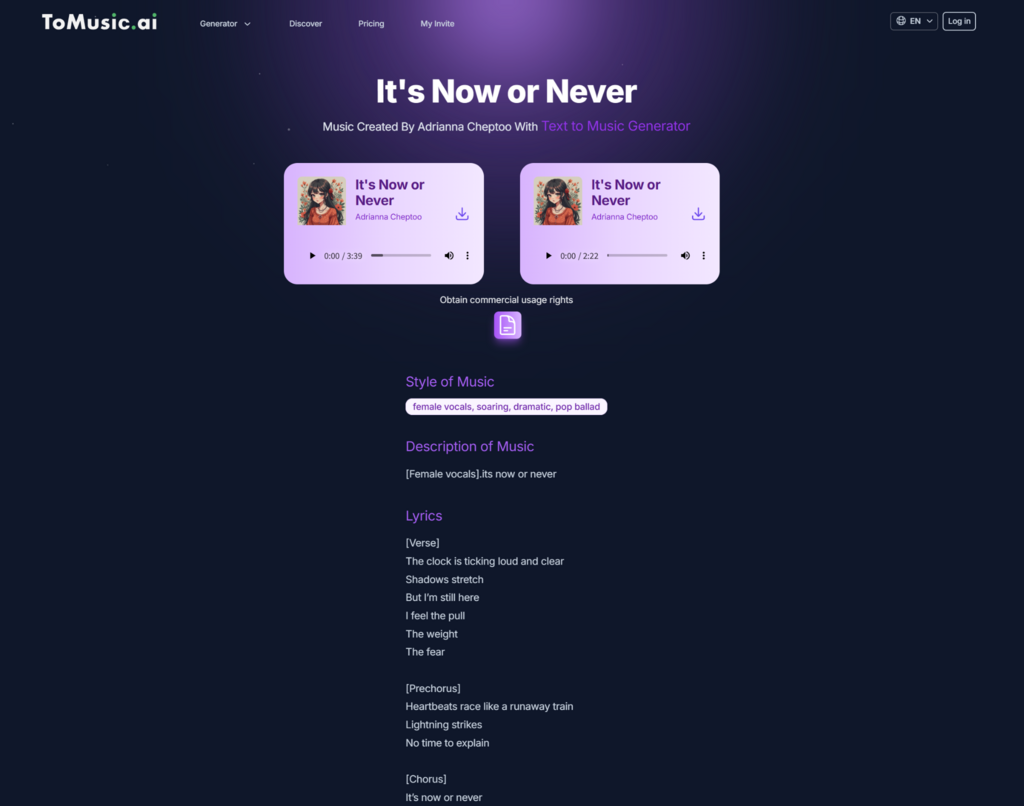
You have a lyric idea. You open ToMusic. You type in your lyrics and describe the genre: “Upbeat indie pop with a driving bassline.” Within moments, you have a full track. The structure is there. The melody is there. Now, instead of fighting the software, you are iterating. “Make it faster.” “Change the mood to somber.” You are staying in the creative flow state, surfing the wave of inspiration rather than drowning in technical details.
Feature Comparison: Why Accessibility Matters
In the crowded market of generative AI, clarity is king. Many tools promise the world but deliver a dashboard so complicated it requires a PhD to operate. Others are too simple, producing tinny, robotic ringtones.
Below is a breakdown of how this approach stands out against traditional methods and other complex AI tools.
| Feature / Aspect | Traditional Music Production | Complex Studio AI Tools | ToMusic.ai Experience |
| Barrier to Entry | Extremely High (Years of practice) | High (Requires prompt engineering skills) | Zero (Natural language input) |
| Time to Result | Days or Weeks | Hours of tweaking parameters | Seconds |
| Cost Efficiency | $$$$ (Equipment, Studio, Engineers) | $$ (Expensive subscriptions) | Free / Affordable |
| Creative Control | Manual manipulation of every wave | Parameter-based sliders | Intent-based (Text & Mood) |
| Vocal Integration | Requires recording equipment & talent | Often instrumental only | Integrated AI Vocals |
| Primary Focus | Technical perfection | Granular sound design | Emotional expression & Speed |
Beyond the Hobbyist: Real World Applications
You might be thinking, “This is fun, but is it useful?” The answer lies in the diversity of modern content. We are living in a multimedia age where silence is the enemy of engagement.
For the Content Creator
If you run a YouTube channel or a TikTok account, you know the nightmare of copyright strikes. You spend hours editing a video, only to have it muted because you used a popular song. With this tool, you generate a unique, royalty-free soundtrack tailored exactly to the length and mood of your video. It is your personal score composer.
For the Songwriter
Writers often struggle with melody. You might have a notebook full of poetry but no idea how it sounds. This platform serves as a sketching tool. You can feed your lyrics into the engine to hear different melodic possibilities. It might not be the final radio cut, but it is the demo that helps you pitch the song to a band or producer.
For the Educator and Storyteller
Teachers can create custom songs to help students memorize historical dates or scientific formulas. Storytellers can generate background ambience for Dungeons & Dragons campaigns or audiobooks. The utility stretches as far as your need for sound.
The Emotional Connection: Why Your Voice Matters
There is a distinct human element to this technology. It is not about replacing the musician; it is about empowering the non-musician. It is about giving a voice to the silent majority who feel deeply but lack the dexterity to play an instrument.
When I played that lo-fi jazz track to a friend, I didn’t say, “Look what this computer made.” I said, “Listen to this idea I had.” And that is the crucial difference. The AI didn’t have the idea; I did. The emotion, the choice of genre, the specific lyrics—those were mine. The AI was simply the brush I used to paint the canvas.
Conclusion: Your Orchestra Awaits
We are standing at the precipice of a new era in art. The gatekeepers are gone. The expensive studio doors have been blown off their hinges. The only thing left separating you from the song of your dreams is the willingness to type the first word.
You do not need to wait for permission. You do not need to wait until you can afford piano lessons. You have a symphony in your mind right now. It is waiting for you to release it.
Visit the platform, type in your wildest idea, and listen to what happens. You might just find that you have been a musician all along—you just needed the right instrument.