...
UK: +44 2038074555 info@atamgo.com
6 Ways AI in the Workplace Boosts Rewards Efficiency
6 Ways AI in the Workplace Boosts Rewards Efficiency

AI in the Workplace

Organizations with effective recognition programs have 31% lower voluntary turnover compared to those without such initiatives.

Companies are constantly searching for ways to enhance employee satisfaction and retention. The intersection of artificial intelligence and employee recognition is revolutionizing how organizations reward their workforce.

AI technologies are addressing longstanding challenges in rewards management from personalization issues to budget constraints and administrative burdens.

The transformation is significant, enabling more meaningful, timely, and impactful recognition that resonates with employees across generations and work environments.

Harnessing AI for More Personalized Rewards

Before diving into specific applications, it’s important to understand how AI fundamentally changes the rewards landscape. The technology doesn’t just automate existing processes—it creates entirely new possibilities for personalization and efficiency.

Understanding Employee Preferences Through Data

AI in the workplace is revolutionizing how companies understand their employees’ preferences. Advanced algorithms analyze past reward selections, redemption patterns, and even social media activity to create comprehensive preference profiles. These systems can detect subtle patterns that human managers might miss.

Traditional rewards programs often rely on generic gift cards or one-size-fits-all recognition. AI-powered employee rewards platforms use machine learning to continuously refine their understanding of what motivates each individual, creating a virtuous cycle of improvement.

Real-Time Recognition Opportunities

One of the most powerful applications of AI is its ability to identify recognition-worthy moments as they happen. Unlike traditional systems that rely on manager observation, AI can monitor performance metrics across various platforms and highlight achievements in real-time.

For sales teams, this might mean automatic recognition when closing a difficult deal. For customer service representatives, it could trigger rewards when resolving complex issues efficiently. The immediacy of this recognition dramatically increases its impact on employee motivation.

Adaptive Learning for Evolving Preferences

People change over time, and so do their preferences. AI systems excel at detecting these shifts and adjusting reward recommendations accordingly. This adaptive capability ensures that workplace productivity remains high through consistently relevant recognition.

The data-driven nature of AI creates a continuously improving system that evolves with your workforce, ensuring rewards remain fresh and motivating rather than becoming stale or predictable over time.

Automating Recognition Workflows for Greater Efficiency

Automation represents one of the clearest ways that benefits of AI manifest in rewards programs. By streamlining administrative processes, organizations can recognize more achievements without increasing overhead costs.

Reducing Administrative Burden

Traditional recognition programs often involve significant manual work—from identifying deserving employees to processing rewards and tracking budgets. This administrative overhead can discourage busy managers from participating consistently.

AI systems automate these workflows, making it frictionless to recognize employees. Some platforms can even draft personalized recognition messages based on the specific achievement, saving managers valuable time while maintaining the personal touch that makes recognition meaningful. Silent Partners is one such solution that enables enterprises to automate internal workflows, including employee recognition, by identifying friction points and embedding AI-driven processes directly within teams. 

Ensuring Consistent Application of Recognition Criteria

Human-managed recognition programs can suffer from inconsistency. Some managers might be more generous with recognition than others, creating perceptions of unfairness.

AI helps standardize recognition across departments by applying consistent criteria to evaluate performance. This fairness builds trust in the rewards system and enhances employee rewards effectiveness across the organization.

Creating Scalable Recognition Programs

As organizations grow, scaling recognition programs becomes challenging. AI makes it possible to maintain personalized, meaningful recognition even across large, global workforces.

The technology can handle recognition for thousands of employees simultaneously, ensuring no deserving achievement goes unnoticed regardless of department size or geographic location.

Optimizing Rewards Budgets Through Predictive Analytics

Smart allocation of recognition resources is essential for maximizing impact. AI excels at identifying the highest-value applications of limited rewards budgets.

Forecasting Budget Requirements

AI analyzes historical recognition trends and business cycles to predict future reward needs, helping HR allocate budgets more effectively across departments and timeframes.

Peak Period Adjustments

During high-demand times like holidays or major project completions, AI automatically reallocates budgets to meet increased recognition demands.

Measuring Recognition ROI

Advanced analytics link recognition efforts to key metrics such as productivity, retention, and customer satisfaction—enabling data-driven optimization of reward strategies.

Continuous Program Improvement

Insights from AI help organizations focus on high-impact recognition activities and refine or phase out less effective ones over time.

Dynamic Budget Reallocation

AI allows for real-time budget shifts based on emerging business needs, ensuring efficient and responsive use of recognition funds across all departments.

Enhancing Recognition Impact Through Natural Language Processing

The words used in recognition can be as important as the reward itself. NLP technology is transforming how organizations communicate appreciation to maximize emotional impact.

Analyzing Recognition Message Quality

NLP systems can evaluate the emotional resonance and specificity of recognition messages. Generic praise like “good job” carries less motivational impact than specific acknowledgment of an employee’s unique contribution.

AI tools can guide managers to create more meaningful recognition by suggesting specific achievements to highlight and language that will resonate with the recipient’s communication preferences.

Multilingual Recognition Capabilities

For global organizations, language barriers can limit the effectiveness of recognition programs. AI-powered translation ensures that recognition messages maintain their emotional impact across language boundaries.

This capability enhances employee rewards by ensuring every team member receives recognition in their preferred language, creating an inclusive environment regardless of location.

Sentiment Analysis for Program Improvement

By analyzing employee responses to recognition, NLP systems can measure the emotional impact of different recognition approaches. This feedback loop allows continuous refinement of recognition strategies.

Organizations can understand which recognition methods drive the strongest positive emotional responses, helping to enhance employee rewards programs over time.

Streamlining Rewards Distribution Through Automation

ChatGPT said:

For recognition to be truly effective, fulfillment must be seamless and timely—an area where AI excels. By automating processes, AI enables instant delivery of digital rewards like gift cards or recognition points, reinforcing positive behavior immediately. It also detects potential fraud by flagging irregular reward claims, preserving program integrity. 

Additionally, AI-powered self-service portals empower employees to manage and redeem rewards autonomously. This not only boosts engagement but also streamlines administration, keeping the focus on celebrating achievements rather than handling paperwork.

Creating Memorable Experiences Through Generative AI

Perhaps the most exciting frontier in AI in the workplace is the creation of truly unique recognition experiences tailored to individual preferences.

Personalized Recognition Narratives

Generative AI can craft custom recognition messages that highlight an employee’s unique contributions in a way that resonates with their personal values and communication style.

These tailored narratives create stronger emotional connections than standardized recognition, making the experience more memorable and motivating.

Custom Reward Experiences

Beyond traditional rewards, generative AI can design custom experiences that align with an employee’s interests. For someone who loves cooking, this might be a virtual cooking class with a celebrity chef.

These personalized experiences demonstrate a deeper level of appreciation than standard rewards, showing that the organization truly values the individual’s unique contributions.

Virtual Recognition Events

For remote or distributed teams, generative AI can create engaging virtual recognition events that bring teams together across distances. From themed celebrations to interactive team experiences, these events build community while highlighting achievements.

This capability is particularly valuable for maintaining strong culture and workplace productivity in hybrid or remote work environments.

FAQs

How does AI improve efficiency in workplace rewards programs?

AI boosts rewards efficiency by automating administrative tasks, personalizing recognition to individual preferences, optimizing budget allocation, and ensuring timely delivery of meaningful recognition, all while providing data-driven insights for continuous improvement.

What benefits does AI bring to employee recognition?

AI enhances employee recognition by making it more personalized, consistent, and timely. It helps identify deserving achievements that might otherwise go unnoticed, ensures fair distribution of recognition, and provides analytics to measure and improve program effectiveness.

Can small companies benefit from AI-powered rewards platforms?

Absolutely! Small companies often benefit most from AI-powered rewards, as they typically have limited HR resources. AI tools handle administrative tasks, allowing small teams to deliver enterprise-quality recognition experiences without dedicated staff.

The Future of AI-Enhanced Employee Recognition

The integration of AI into employee rewards programs represents a fundamental shift in how organizations acknowledge and celebrate their people. By leveraging data, automation, and personalization, companies can create recognition experiences that are more meaningful, more efficient, and more impactful than ever before.

As the technology continues to evolve, we’ll see even deeper personalization and more seamless integration of recognition into daily workflows. Organizations that embrace these technologies now will build stronger cultures and gain competitive advantages in talent attraction and retention.

7 Genius Ways to Use Perchance AI Story Generator

7 Genius Ways to Use Perchance AI Story Generator

perchance ai story

Introduction: Unlocking the Power of Perchance AI Story Generator

Perchance AI Story​ is the perfect tool to supercharge your creativity. Whether you’re a writer struggling with writer’s block, a content creator seeking fresh ideas, or a marketer looking for engaging storytelling techniques, this AI-powered generator can be a game-changer.

AI-driven storytelling has revolutionized the way content is created. With Perchance.org, users can generate unique ideas, develop full-length stories, and even refine their writing skills. Whether you need a captivating short story, a creative plot for your next novel, or engaging marketing copy, AI story generators have become indispensable. Make sure your content passes an AI Content Checker for peace of mind.

In this guide, we’ll explore 7 genius ways to use Perchance AI Story Generator and how it can transform your storytelling process. By the end, you’ll know how to maximize its potential and craft compelling stories with ease.

1. Generate Unique Story Ideas Instantly

Perchance AI Story Generator

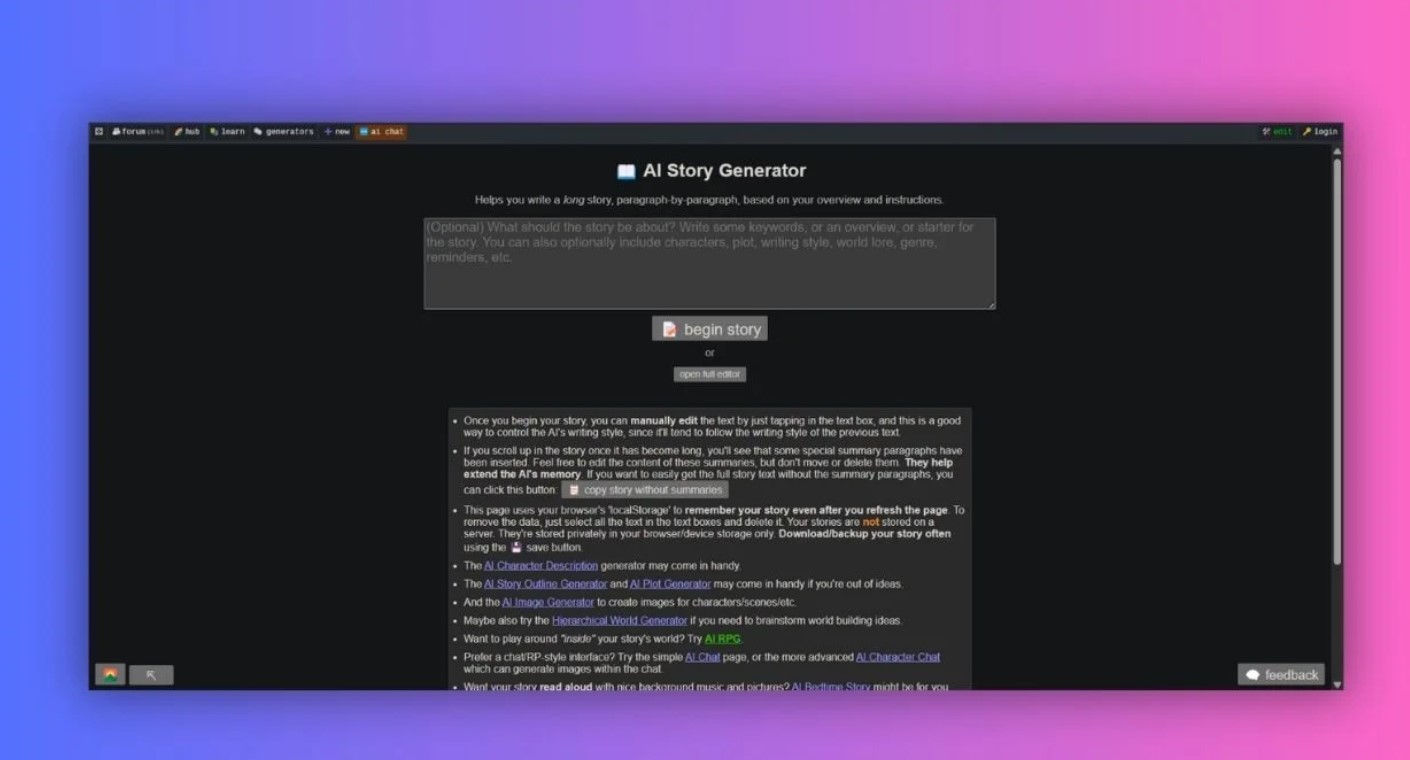
Coming up with fresh and engaging story ideas can be a challenge. Luckily, AI Story Generator Perchance provides an instant solution by offering randomized, AI-driven story prompts.

  • Overcoming Writer’s Block: Simply enter a keyword or theme, and let Perchance.org generate multiple unique story starters.
  • Customizing Prompts: Adjust the settings to refine the style, tone, or genre of the generated content.
  • Mixing & Matching Ideas: Combine multiple AI-generated prompts to create something even more original.

2. Create Full-Length Stories in Minutes

Instead of struggling to develop a full plot, Perchance AI Story Generator helps expand short prompts into complete narratives.

  • Step-by-Step Expansion: Start with a simple prompt, then use AI to build on characters, settings, and conflicts.
  • Editing for a Human Touch: AI-generated content is a great starting point, but you can refine it for better engagement.
  • Adapting AI Stories for Different Mediums: Transform AI-generated plots into screenplays, comics, or even video game narratives.

3. Improve Your Storytelling Skills with AI Feedback

AI isn’t just for generating content—it can also improve your writing skills by providing valuable feedback on structure and style.

  • Analyzing AI-Generated Stories: Review patterns in AI-generated stories to understand effective storytelling techniques.
  • Refining Plots & Characters: Use Perchance Story AI to experiment with different narrative styles and see what works best.
  • Comparing AI vs. Human Writing: Learn from AI-generated content and identify areas where human creativity can enhance the final output.

4. Speed Up Content Creation for Blogs & Social Media

Bloggers and content creators can use AI Story Generator Perchance to streamline their writing process.

  • Repurposing Stories: Turn AI-generated fiction into engaging blog content.
  • Creating Micro-Stories: Generate bite-sized, engaging content for social media posts, helping boost engagement and reach.
  • Enhancing SEO with AI-Generated Stories: Optimize AI content for search engines by including relevant keywords and compelling meta descriptions. Enhancing SEO with AI-Generated Stories: Leverage AI SEO to optimize AI content for search engines by including relevant keywords and compelling meta descriptions.

5. Experiment with Different Writing Styles & Genres

One of the best features of Perchance AI Story Generator is its ability to generate stories in multiple styles and genres.

  • Write Like a Pro: Test different tones, from classic literature to modern thrillers.
  • Explore Different Genres: Whether you’re into sci-fi, fantasy, horror, or romance, Perchance.org provides endless inspiration.
  • Combining Multiple Genres: Blend mystery with fantasy, horror with romance, or sci-fi with drama for a unique storytelling experience.

6. Enhance Your Role-Playing and Gaming Experience

Gamers and RPG enthusiasts can leverage Perchance AI Story Generator to create immersive game narratives. Combined with roleplay AI tools such as DreamGen, players can interact with dynamic characters, expand their adventures, and experience stories that evolve in real time.

  • Build RPG Storylines: Use AI to generate character backstories, world-building details, and side quests.
  • Develop Complex Narratives: AI can help construct layered, compelling plots for tabletop or online role-playing games.
  • Generate Non-Player Character (NPC) Dialogues: AI can craft engaging dialogues for NPCs, making the game world feel more dynamic and real.

7. Brainstorm Marketing Copy and Engaging Advertisements

Storytelling isn’t just for fiction—AI Story Generator Perchance can also enhance marketing content.

  • Engage Your Audience: AI-generated narratives can add a compelling edge to your ads.
  • Product Descriptions & Ads: Use storytelling techniques to make your copy more persuasive and memorable.
  • Personalized Marketing Campaigns: Generate unique ad copy tailored to specific audiences by experimenting with different AI-generated storylines.

Conclusion

Now that you know 7 genius ways to use Perchance AI Story Generator, it’s time to put these strategies into action. Whether you’re crafting fiction, generating marketing copy, or enhancing your gaming experience, Perchance.org is a powerful tool that can elevate your storytelling.

AI-generated storytelling isn’t just a shortcut—it’s a new way to think creatively. Writers, marketers, and gamers alike can benefit from AI Story Generator Perchance to refine their craft, save time, and explore endless creative possibilities. The key is to use AI as a starting point and add your unique touch to bring stories to life.

Start experimenting today and discover the endless possibilities AI storytelling has to offer!

Find More: Boost Your Sales With SEO Services

FAQs

1. Is Perchance AI Story Generator Free to Use?

Yes! Perchance.org offers a free-to-use AI story generator with no sign-up required.

2. How Can I Make AI-Generated Stories Sound More Human?

Edit the AI-generated text, add personal touches, and refine character dialogues to make the story more natural.

3. What Are the Best Prompts for Getting High-Quality Stories?

Use detailed, specific prompts that include settings, character types, and potential conflicts to get better AI-generated results.

4. Can Perchance AI Help with Writing Books or Novels?

Absolutely! You can use Perchance AI Story Generator to outline plots, generate scenes, and explore character arcs.

5. How Does Perchance AI Compare to Other AI Writing Tools?

Unlike some paid AI writing tools, Perchance Story AI is free and user-friendly, making it an excellent choice for beginners and professionals alike.

6. Can Perchance AI Story Generator Be Used for Educational Purposes?

Yes! Teachers and students can use AI-generated stories to practice creative writing, explore different narrative techniques, and analyze literary styles.

Tags:
How AI Is Revolutionizing Web Development Today

How AI Is Revolutionizing Web Development Today

AI Is Revolutionizing Web Development

The way AI is being used in all departments of life is unimaginably great. From health care to the software industry, it is leaving marks that set new trends. 

Artificial Intelligence is now playing its part in web development where it assists developers with automated design tools to highly responsive user interfaces. Moreover, AI chatbots have brought positive impressions to e-commerce sites and other platforms demanding live assistance.

Now, let’s try to unfold the roles of artificial intelligence in web development, by taking you through the perks of AI. 

How AI is Used in Web Development

Let’s move towards the points where AI is used in web development to explain in a better way. 

  1. Content Generation

Content generation is an important part of a website, be it text, video, infographics, or anything. However, AI is widely used to generate text-based content for short blogs, articles, and social media captions, and is not only limited to creative content but technical content too. 

Moreover, AI helps developers in creating SRS documents, case studies, user experience design documentation, etc. 

AI Tools for Content Generation

  • JasperA AI
  • Copy.ai
  • ChatGPT


  1. Coding

With the introduction of ChatGPT, it has become the heaven for developers. Web developers use ChatGPT and other such technologies to generate codes quickly. This not only saves time but also enhances developers’ productivity as dev people will have to use little brain power to think about logic. 

In addition, this assistance of AI enables developers to utilize the saved time to work on the implementation part and deliver the project quickly. Besides project implementation and delivery, AI equips developers to review their written code and get help in debugging. 

Did you Know?

Research shows that the global AI software market revenue is expected to rise from $70 billion to around $135 billion by 2025

source


AI Tools for Coding

  • Github Co-Pilot
  • CodeWP
  • AskCodi


  1. Smart Chatbots

You must have witnessed chatbots on different websites that assist visitors with the site, business, and other related things. Nowadays, the use of AI chatbots is very common as they instantly help the user with their query. Rather than searching for the information manually, you will get it with just a few impressions on the keyboard. 

Moreover, AI chatbots communicate with the user, ask his requirements, and find solutions to problems. 

Meanwhile, to have a better understanding of the role of smart chatbots, read the role of AI in e-commerce. 

AI-Powered Chatbots

  • Chatbot
  • HubSpot Chatbot Builder
  • Tidio


  1. Data Analytics

Artificial intelligence is capable of evaluating large data sets. This feature of AI offers web developers insights and trends while assisting in making informed decisions. 

Additionally, a small to mid-level software development company won’t have to hire a data scientist to analyze data sets, data cleaning, and other processes involved. 

All you have to do is to feed the data to the AI tools and it will complete the job efficiently. Further, this strategy not only enhances the workforce productivity but allows them to focus on the core processes efficiently. 

AI Tools for Data Analytics

  • IBM Watson Analytics
  • Google Cloud Smart Analytics
  • Sisense 


Case Study: Airbnb Utilizes AI Techniques for Categorization

Airbnb faced challenges in automatically tagging and categorizing millions of listing photos to improve search relevance. So, they employed deep-learning neural networks to recognize objects and scenes in images. Hence, this helped them get rid of the challenge as the intelligent image recognition system made the lists more discoverable.

Challenges of Using AI in Web Development

Along with the long list of perks of using AI in web development, some challenges are also on the way. Here are a few: 

  • It is a misconception that AI tools can build a complete website. AI can’t build a site but assist you in many processes involved. 
  • Such tools need to be trained according to your demands. 
  • AI algorithms work on the data you feed. If you provide good quality data, you will get good results like xmap. However, if you feed low-quality or biased data, it may affect the findings. 

Wrapping Up!

Therefore, AI is a companion in building highly responsive and creative websites. It assists web developers in from coding to testing, and in other matters too. However, before using AI tools, one must train the tool according to their needs and requirements.

AI-Powered Training Programs: Helping Businesses Stay Competitive in a Digital Economy

AI-Powered Training Programs: Helping Businesses Stay Competitive in a Digital Economy

AI-Powered Training Programs:

The way businesses train their employees is changing, fast. Traditional training methods, with their rigid schedules and one-size-fits-all approach, are struggling to keep up with today’s rapidly shifting industries. Skills that were relevant just a few years ago can quickly become outdated, leaving businesses scrambling to keep their teams prepared for new challenges. This is where AI-powered training programs come in.

Instead of relying on static training manuals or generic e-learning courses, companies are now turning to AI-driven solutions that adapt to individual learning styles, predict skill gaps, and provide personalized training at scale. AI is making employee education smarter, faster, and more engaging, helping businesses build a workforce that’s ready for whatever comes next. From tailored learning paths to real-time feedback and predictive analytics, AI is transforming corporate training into a dynamic, data-driven experience. Let’s explore how AI-powered training is redefining learning in the workplace and why businesses that embrace it will have the edge in the digital economy.

The Digital Economy and the Need for Continuous Learning

The digital economy is driven by rapid technological advancements, automation, and evolving consumer demands. Traditional skill sets become obsolete faster than ever, and businesses that fail to upskill their workforce risk falling behind. Emerging technologies such as AI, machine learning, blockchain, and cloud computing are reshaping industries, creating new job roles while rendering others redundant. Consequently, employees must constantly update their skills to remain relevant.

“The need for continuous learning has led to a shift away from traditional, static training methods toward dynamic, technology-driven solutions. In the past, corporate training often relied on instructor-led classroom sessions or generic e-learning modules that lacked personalization,” explains Alex L., Founder of StudyX. “These traditional methods struggled to keep pace with the ever-changing skill requirements of the digital economy. AI-powered training programs address this gap by offering real-time learning experiences tailored to each employee’s needs, ensuring that businesses can quickly adapt to technological disruptions and market shifts.”

How AI Is Transforming Corporate Training

“AI is reshaping workplace training in several key ways. The most significant shift is personalization. Traditional training assumes that all employees learn the same way and need the same information, but AI flips this model on its head. By analyzing individual learning patterns, strengths, and weaknesses, AI-powered systems can create customized training plans that adjust in real time.

For example, an AI-driven learning platform might notice that an employee is struggling with data analytics concepts. Instead of forcing them through a full course, it could provide targeted exercises, real-world examples, or even recommend one-on-one coaching sessions. On the other hand, if an employee is excelling, AI can accelerate their learning and introduce more advanced material, keeping them challenged and engaged,” believes Promise Okeke, CEO of NovoPath.

AI-powered training systems can adapt dynamically, offering instant feedback and modifications based on an employee’s progress. This not only improves learning retention but also ensures that employees can acquire skills in a way that aligns with their unique cognitive preferences.

Another game-changing innovation is the use of AI-powered chatbots and virtual assistants. These tools act like on-demand trainers, answering employee questions, guiding them through learning modules, and even providing instant feedback. Employees don’t have to wait for a scheduled workshop to get help, they can simply ask a chatbot and get an immediate response, making learning more interactive and accessible.

“Automation and AI-driven tools have drastically reduced the inefficiencies in corporate training,” notes Steve Morris, Founder & CEO of NEWMEDIA.COM. “By streamlining the learning process, businesses can ensure that their workforce remains ahead of the curve without unnecessary delays.”

AI is also taking training beyond simple assessments and quizzes. With predictive learning analytics, businesses can use AI integration services to forecast future skill gaps and proactively train employees before a problem arises. If a company is planning to adopt a new software tool, AI can identify which employees will need training and recommend relevant courses before the transition even begins.

Key Benefits of AI-Powered Training Programs

Adopting AI in corporate training doesn’t just make learning more engaging, it offers tangible benefits that directly impact business performance. Here’s why companies are making the shift:

1. Training That Feels Personal

Instead of forcing employees through generic courses, AI customizes training to their skill levels, learning speeds, and career goals. This makes learning more relevant, engaging, and effective.

AI’s ability to analyze learning patterns and deliver content accordingly ensures that no two employees have the same learning journey. This level of personalization is what makes AI-driven training significantly more effective than traditional methods.

2. Less Time, Lower Costs

Traditional training can be expensive and time-consuming, requiring workshops, instructors, and printed materials. AI automates much of this process, cutting costs and allowing employees to learn at their own pace, without disrupting their workflow.

3. Real-Time Feedback for Faster Learning

AI-driven training platforms provide instant feedback, helping employees correct mistakes and improve their skills right away. No more waiting for performance reviews or end-of-course evaluations.

“Real-time feedback is a game-changer,” says Stephen Twomey, Founder of MasterMindSEO. “AI enables businesses to address skill gaps the moment they arise, which significantly accelerates the learning curve.”

4. Better Employee Engagement and Retention

Employees want to grow in their careers. Offering AI-powered learning opportunities shows a company is invested in their development, leading to higher job satisfaction and lower turnover rates. When combined with well-structured employee engagement programs, these initiatives create a stronger sense of belonging and commitment, making employees more likely to stay and thrive within the organization.

5. Scalable Learning for Global Teams

AI-powered training platforms can train hundreds or even thousands of employees at once, no matter where they’re located. This makes it easy for multinational companies to provide consistent, high-quality training across all teams.

6. Smarter Decision-Making with Learning Data

AI doesn’t just improve training, it provides insights into workforce development. Businesses can track employee progress, identify knowledge gaps, and refine training strategies based on real data.

As AI-driven training systems collect more data, they become better at predicting what employees need. This allows businesses to be proactive rather than reactive when it comes to upskilling their teams.

Implementing AI-Powered Training in Business Operations

To successfully integrate AI-powered training programs into a business, companies must adopt a structured approach. Implementation involves selecting the right AI-driven learning platforms, defining training goals, and ensuring seamless adoption among employees.

1. Choosing the Right AI-Powered Learning Platform

Businesses should evaluate AI-based training platforms based on factors such as adaptability, user-friendliness, and compatibility with existing learning management systems (LMS). Platforms like Coursera for Business, Udemy for Business, LinkedIn Learning, and AI-driven LMS solutions offer personalized training experiences.

2. Defining Training Goals and Skill Requirements

“Before rolling out AI-powered training, organizations must identify their training objectives. Whether the goal is to enhance technical skills, improve leadership abilities, or familiarize employees with new technologies, defining clear learning outcomes ensures the AI system delivers relevant training content,” says Sumeer Kaur, Founder of Lashkaraa.com.

3. Continuously Monitoring and Optimizing Training Programs

AI-powered training is not a one-time initiative but an ongoing process. Companies must continuously monitor training data, assess learning outcomes, and refine AI algorithms to improve training effectiveness. Regular updates and content enhancements ensure employees stay current with industry trends and emerging skills.

4. Encouraging Employee Adoption and Engagement

“For AI-driven training to be successful, employees must embrace the technology. Businesses can encourage adoption by demonstrating the benefits of AI-powered learning, offering incentives for course completion, and integrating training into employees’ daily workflows. Gamification elements such as leaderboards, badges, and rewards can further boost engagement,” says Doug Coats, Marketing Manager at CodeCorp.

The Future of AI in Corporate Training

As AI technology advances, its role in corporate training will continue to expand. Future developments may include even more sophisticated AI tutors, virtual reality (VR) and augmented reality (AR) integration for immersive learning, and AI-powered mentorship programs that connect employees with virtual career coaches. AI will also play a crucial role in predictive workforce planning, helping businesses anticipate skill shortages and proactively train employees in emerging fields.

“The future of work will be shaped by intelligent, AI-driven training ecosystems that prioritize lifelong learning and adaptability. Companies that embrace AI-powered training today will be better positioned to thrive in the digital economy, ensuring their workforce remains competitive, innovative, and future-ready,” says Adam Fard, Founder & Head of Design at Wireframing with AI.

Final Thoughts

AI-powered training programs are no longer a luxury but a necessity for businesses striving to remain competitive in the digital age. By leveraging AI-driven personalization, automation, and predictive analytics, companies can create dynamic learning environments that foster employee growth and organizational success. The shift toward AI-driven training represents a paradigm change in workforce development, one that prioritizes agility, efficiency, and continuous learning. As businesses navigate the complexities of digital transformation, those that invest in AI-powered training will gain a sustainable competitive advantage, ensuring long-term success in an ever-evolving economy.

Top AI Features to Utilize for Growing Startups

ai features

In the current dynamic environment, startups need to use advanced tools to achieve the desired level of growth and sustain competition. 

Now, AI isn’t a luxury that many businesses can afford; it’s an imperative for established startups that want to implement smart processes, provide customers with the best experience and base their choices on data. 

In the following sections, we discuss some of the most promising AI features that emerging startups can leverage to achieve their goals faster.

Streamlining Customer Support with Chatbots and Virtual Assistants

Start up companies always seek to establish a customer base and this is made possible by offering the best customer service. Freely available chatbots or virtual assistants provide consistent round the clock services to the customers, which are implemented using AI technology. These tools can address simple customer queries, provide instant solutions and, if the problem is complicated, transfer it to a live agent.

With the help of AI-based chatbots, startups can decrease response time and increase customer satisfaction. Such bots are progressive and highly reliant on natural language processing (NLP) and machine learning to deliver improved and more efficient experiences with users over time. Furthermore, virtual assistants are capable of contacting customers directly with suggestions or new details and opportunities, strengthening the relationship.

Predictive Analytics for Smarter Decision-Making

In the contemporary environment where information is key, then for the startupers, the power of predictive analytics must be seen as one of the most effective levers. Startups can also use AI in a process called determinative analytics that involves analyzing data about past occurrences in order to make predictions for the future. From the ability to forecast market needs, the patterns of customer buying behavior, or even the most efficient way of managing supply chain, predictive analytics provides value.

These insights can be useful to startups to know where to invest and where not to in order to avoid certain risks. For instance, an e-commerce startup may apply high-level predictive analytics to synchronize the sort of products it is likely to sell at high levels at a certain time depending on seasonal activity. Such thinking can help startups to be ahead of their counterparts in their respective industries.

Automating Administrative Tasks to Save Time

Some of the most time and resource-consuming activities are administrative for startups. Business intelligence can help reduce communication time through automated scheduling, handling of mails and report generation. These solutions save a lot of time for founders and employees to work on other important activities.

For instance, AI scheduling assistants can help in fixing meeting schedules without going back and forth. Startups can even use AI transcription tools to transcribe Google meetings, making it easier to review discussions and extract actionable insights. These are some of the administrative tasks that when automated can help startups increase productivity and efficiency.

Enhancing Marketing Efforts with Personalization

Marketing is one of the fields where AI can bring a lot of changes. Customer data can be analyzed by the help of AI algorithms, which will help to create very specific marketing campaigns based on customer’s preferences and actions. AI can be used by startups to segment the audience, write personalized messages and improve the overall performance of the campaigns.

AI also helps the startups to forecast the customers’ needs and offer the right content at the right time. For example, an AI-driven email marketing platform can use open rates, click through rates and consumer spending history to suggest product recommendations. Not only do these types of personalizations increase conversion, but they also help to reinforce customer relationships.

Improving Product Development with AI Insights

To come up with a product that will be able to meet the needs of the customers it is important to have adequate knowledge on the customers and the market. From customer feedback, competitors and other industry reports, AI tools are capable of distilling all the information to usable information in the development of products.

For instance, you can feed customer feedback into a tool like Pario, it will analyze the data, and provide recommendations and different options for you to implement to improve your product or service. Moreover, AI can also be applied by startups to experiment with the prototypes and check how they will perform in real life, saving time and money. In this way, the use of AI can help startups to design products that would be interesting for their target audience and would have competitive advantages.

Optimizing Recruitment with AI-Powered Hiring Tools

Recruitment of the right talent is crucial to any startup, but it is a process that can take time and may be quite a hassle. Traditional hiring methods are made easy through the use of AI in that resumes are sorted, potential candidates are selected, and even interviews can be conducted through chatbots.

These tools employ means of using software and quantitative methods to evaluate the competency, productivity and quality of the candidate as well as map the abilities of the candidate to the job description without bias. For instance, AI can review a candidate’s previous work history and estimate how well he or she will work in the company environment. It is important for startups to know that they can automate the recruitment process while at the same time making sure that they get the best talents.

Strengthening Cybersecurity with AI Solutions

When startups start growing, they become vulnerable to cyber threats. Artificial Intelligence has the unique feature of its ability to identify risks in advance and avoid incidents that compromise data security and disrupt business. These tools employ machine learning algorithms to let security teams know what activities should be monitored to prevent the progression of a breach.

AI can also be used to perform routine security assessments and analyze weaknesses in the company’s systems by startups. For instance, a threat detection tool which is driven by Artificial Intelligence can detect certain patterns from the network traffic and notify the team to take necessary action. AI cybersecurity is a way through which startups can safeguard their online properties and gain the trust of users.

Boosting Sales with AI-Powered CRM Systems

Customer relationship management (CRM) systems are crucial tools for managing the interactions with customers and for sales force motivation. Some CRM systems go a step further by integrating modern functionalities like lead scoring, sales prediction, and recommendation services.

For instance, an AI integrated CRM can sort out customer data to determine potential customers and recommend strategies to sell to them. It can also give the sales personnel a true picture of the customer’s behavior and thus adjust their sales pitch to suit this behavior. The use of AI CRM systems can help startups to improve their sales approach and get more effective outcomes.

In the current dynamic environment, startups need to use advanced tools to achieve the desired level of growth and sustain competition. 

Now, AI isn’t a luxury that many businesses can afford; it’s an imperative for established startups that want to implement smart processes, provide customers with the best experience and base their choices on data. 

In the following sections, we discuss some of the most promising AI features that emerging startups can leverage to achieve their goals faster.

Streamlining Customer Support with Chatbots and Virtual Assistants

Start up companies always seek to establish a customer base and this is made possible by offering the best customer service. Freely available chatbots or virtual assistants provide consistent round the clock services to the customers, which are implemented using AI technology. These tools can address simple customer queries, provide instant solutions and, if the problem is complicated, transfer it to a live agent.

With the help of AI-based chatbots, startups can decrease response time and increase customer satisfaction. Such bots are progressive and highly reliant on natural language processing (NLP) and machine learning to deliver improved and more efficient experiences with users over time. Furthermore, virtual assistants are capable of contacting customers directly with suggestions or new details and opportunities, strengthening the relationship.

Predictive Analytics for Smarter Decision-Making

In the contemporary environment where information is key, then for the startupers, the power of predictive analytics must be seen as one of the most effective levers. Startups can also use AI in a process called determinative analytics that involves analyzing data about past occurrences in order to make predictions for the future. From the ability to forecast market needs, the patterns of customer buying behavior, or even the most efficient way of managing supply chain, predictive analytics provides value.

These insights can be useful to startups to know where to invest and where not to in order to avoid certain risks. For instance, an e-commerce startup may apply high-level predictive analytics to synchronize the sort of products it is likely to sell at high levels at a certain time depending on seasonal activity. Such thinking can help startups to be ahead of their counterparts in their respective industries.

Automating Administrative Tasks to Save Time

Some of the most time and resource-consuming activities are administrative for startups. Business intelligence can help reduce communication time through automated scheduling, handling of mails and report generation. These solutions save a lot of time for founders and employees to work on other important activities.

For instance, AI scheduling assistants can help in fixing meeting schedules without going back and forth. Startups can even use AI transcription tools to transcribe Google meetings, making it easier to review discussions and extract actionable insights. These are some of the administrative tasks that when automated can help startups increase productivity and efficiency.

Enhancing Marketing Efforts with Personalization

Marketing is one of the fields where AI can bring a lot of changes. Customer data can be analyzed by the help of AI algorithms, which will help to create very specific marketing campaigns based on customer’s preferences and actions. AI can be used by startups to segment the audience, write personalized messages and improve the overall performance of the campaigns.

AI also helps the startups to forecast the customers’ needs and offer the right content at the right time. For example, an AI-driven email marketing platform can use open rates, click through rates and consumer spending history to suggest product recommendations. Not only do these types of personalizations increase conversion, but they also help to reinforce customer relationships.

Improving Product Development with AI Insights

To come up with a product that will be able to meet the needs of the customers it is important to have adequate knowledge on the customers and the market. From customer feedback, competitors and other industry reports, AI tools are capable of distilling all the information to usable information in the development of products.

For instance, you can feed customer feedback into a tool like Pario, it will analyze the data, and provide recommendations and different options for you to implement to improve your product or service. Moreover, AI can also be applied by startups to experiment with the prototypes and check how they will perform in real life, saving time and money. In this way, the use of AI can help startups to design products that would be interesting for their target audience and would have competitive advantages.

Optimizing Recruitment with AI-Powered Hiring Tools

Recruitment of the right talent is crucial to any startup, but it is a process that can take time and may be quite a hassle. Traditional hiring methods are made easy through the use of AI in that resumes are sorted, potential candidates are selected, and even interviews can be conducted through chatbots.

These tools employ means of using software and quantitative methods to evaluate the competency, productivity and quality of the candidate as well as map the abilities of the candidate to the job description without bias. For instance, AI can review a candidate’s previous work history and estimate how well he or she will work in the company environment. It is important for startups to know that they can automate the recruitment process while at the same time making sure that they get the best talents.

Strengthening Cybersecurity with AI Solutions

When startups start growing, they become vulnerable to cyber threats. Artificial Intelligence has the unique feature of its ability to identify risks in advance and avoid incidents that compromise data security and disrupt business. These tools employ machine learning algorithms to let security teams know what activities should be monitored to prevent the progression of a breach.

AI can also be used to perform routine security assessments and analyze weaknesses in the company’s systems by startups. For instance, a threat detection tool which is driven by Artificial Intelligence can detect certain patterns from the network traffic and notify the team to take necessary action. AI cybersecurity is a way through which startups can safeguard their online properties and gain the trust of users.

Boosting Sales with AI-Powered CRM Systems

Customer relationship management (CRM) systems are crucial tools for managing the interactions with customers and for sales force motivation. Some CRM systems go a step further by integrating modern functionalities like lead scoring, sales prediction, and recommendation services.

For instance, an AI integrated CRM can sort out customer data to determine potential customers and recommend strategies to sell to them. It can also give the sales personnel a true picture of the customer’s behavior and thus adjust their sales pitch to suit this behavior. The use of AI CRM systems can help startups to improve their sales approach and get more effective outcomes.

5 AI Translation Tools You Need to Dominate Global Markets This 2025

5 AI Translation Tools You Need to Dominate Global Markets This 2025

AI Translation Tools

Expanding into global markets is a key goal for digital marketers looking to scale their businesses. Language barriers, however, can prevent your campaigns from reaching their full potential. AI translation tools allow marketers to create multilingual content efficiently, ensuring their brand resonates across borders. 

Here are the 5 must-have AI translation tools to help scale your digital marketing efforts and reach global audiences effectively:

1. MachineTranslation.com

AI Translation Tools

MachineTranslation.com is an AI-powered translation engine aggregator that combines results from the leading AI and Large Language Models (LLMs) to deliver the most precise and contextually accurate translations of the source text. This tool includes unique features, such as the AI Translation Agent that can remember your input to refine future translations, and Key Term Translations, which translates complex terms accurately and consistently.

Key Features:

  • Real-time translation
  • 240+ languages, 28,600+ language pairs
  • AI-Assisted Translation Insights
  • Translate up to 2000 words in one click

Why It Helps Scaling: MachineTranslation.com ensures high-quality translations at scale, enabling marketers to quickly localize campaigns without compromising accuracy. 

2. DeepL

AI Translation Tools

DeepL is a leader in producing natural, human-like translations, especially for European languages. It’s a go-to tool for marketers looking to maintain brand tone and voice across localized content.

Key Features:

  • High-quality translations with tone customization
  • Seamless integration with CAT tools and productivity software
  • Supports translations for documents and text

Why It Helps Scaling: DeepL streamlines the translation process for blog posts, email campaigns, and ad copy, ensuring your marketing content feels authentic in any language.

3. Weglot

AI Translation Tools

Weglot is an intuitive website translation solution designed to make launching multilingual websites quick and efficient. It’s ideal for businesses using platforms like WordPress, Shopify, or Squarespace.

Key Features:

  • Automatic translation with manual editing options
  • SEO-friendly localization for global search rankings
  • Simple integration with CMS platforms

Why It Helps Scaling: Weglot allows you to scale your website to new markets, improving visibility and engagement with global audiences.

4. AITranslator.com

ai translation tools

For tasks like translating press releases, AITranslator.com offers a distinct advantage with its exceptional accuracy, cultural sensitivity, and ease of use. When selecting a tool, prioritize features that align with your objectives—whether that’s multiple regional language support, advanced localization options, or scalability across numerous languages. With AITranslator.com, you can pinpoint the best machine-generated translations and tailor them to meet your unique requirements.

Key Features:

  • Real-time translations 
  • Machine Translation Aggregator
  • Accuracy Rankings
  • Translation History

Why It Helps Scaling: AITranslator.com’s accuracy rankings of its generated translations help marketers determine the best translation based on their context and requirements.

5. Smartling

AI Translation Tools

Smartling is a powerful localization and AI translation platform that combines automation with human expertise, perfect for managing large-scale content translation projects.

Key Features:

  • Automation for translations and localization workflows
  • Analytics and reporting to monitor global campaign performance
  • Translation memory for consistency and cost savings

Why It Helps Scaling: Smartling allows marketers to manage and translate content at scale while ensuring quality, consistency, and cultural relevance.

Why AI Translation Tools Are the Secret Weapon for Global Success

Expanding digital marketing to global markets requires accurate and culturally adapted communication. Tools like these streamline multilingual content creation, helping you connect with diverse audiences without manual bottlenecks. From websites to PPC ads, AI translation tools ensure you can scale your efforts efficiently and effectively.

If you want to dominate global markets, AI translation tools are non-negotiable. Whether you’re localizing websites, translating ads, or connecting with international customers, tools like MachineTranslation.com, Weglot, and Smartling give you the competitive edge you need.

Ready to take your marketing strategy worldwide? Start using AI translation tools today and unlock unstoppable global growth!