...
UK: +44 2038074555 info@atamgo.com
How Criminal Defence Lawyers Can Outrank Big Firms Without Huge Budgets

How Criminal Defence Lawyers Can Outrank Big Firms Without Huge Budgets

Criminal Defence Lawyers

Small or solo defence practices compete with national players who have marketing budgets bigger than entire annual revenues. This David versus Goliath dynamic seems impossible to overcome when you’re handling cases, managing a practice, and trying to grow visibility simultaneously. The resource gap feels insurmountable when competitors flood search results and buy premium ad placements.

Online visibility often becomes the great equalizer that lets skilled attorneys compete regardless of firm size. Search engines don’t care about your marketing budget—they care about relevance, authority, and user experience. A well-executed strategy beats deep pockets when you understand what actually drives rankings and conversions.

Core tactics include authority building through content, strategic local intent targeting, and smart resource allocation. These principles form the foundation of effective digital marketing for law firms, allowing smaller practices to compete strategically rather than financially.

These approaches don’t require massive budgets but do demand consistency and strategic thinking. Here’s how mastering SEO marketing for criminal defense lawyers levels the playing field.

Target Local Intent Before National Keywords

Focus on phrases like “DUI lawyer [city]” and “defence attorney near me” rather than competing for broad terms. National keywords attract searchers from everywhere, most of whom will never become clients. Local intent keywords connect you with people in your service area actively seeking immediate legal help.

Google’s local ranking signals prioritize proximity, reviews, and citations above traditional SEO factors. Your Google Business Profile becomes more valuable than your website for local searches. Maintaining accurate information, collecting genuine reviews, and building local directory listings creates visibility that big firms can’t easily dominate.

Owning your market radius beats fighting for broad generic terms that bring unqualified traffic. Someone searching “criminal defense attorney Boston” is probably ready to hire, while someone searching “criminal defense strategies” might be a law student doing research. Target intent, not just keywords.

Authority Content: Educate, Don’t Advertise

Blog posts, FAQs, and case explainers demonstrate credibility better than marketing copy ever could. Potential clients want to understand their situations and evaluate attorney expertise before making contact. Educational content serves both needs simultaneously while building search visibility through fresh, relevant material.

Writing for human readers first and algorithms second creates content that actually converts. Answer real questions your consultations reveal—people ask similar things repeatedly, making those topics perfect for detailed articles. Clear explanations in plain language prove you understand both the law and client concerns.

Breaking down topics like “plea bargains versus trials” in accessible English shows expertise without intimidation. Clients feel smarter after reading your content, which builds trust that translates to consultations. This approach outperforms generic service pages that just list practice areas and credentials.

Earn Links Through Legal-Resource Collaboration

Partner with bar associations, podcasts, or law blogs to generate authentic backlinks. These connections provide credibility signals that search algorithms value highly. A link from your state bar association or a respected legal publication carries more weight than hundreds of directory listings.

An authentic backlink service can help you secure links that outweigh directory spam. Focus on earning mentions through genuine contributions—write guest articles, participate in legal roundtables, or provide expert commentary for journalists. These activities serve multiple purposes beyond SEO.

Use case summaries or local data as linkable assets that other sites want to reference. Creating original research or helpful resources makes other websites link to you naturally. For example, compiling local arrest statistics or explaining recent legal changes gives journalists and bloggers valuable reference material.

Track and Optimize Like a Big Firm But Smarter

Free or low-cost tools provide tracking for rankings, Google Business Profile insights, and incoming calls. Google Analytics, Google Search Console, and call tracking services offer data that guides optimization decisions. You don’t need enterprise platforms to understand what’s working and what needs adjustment.

Measure conversion quality rather than just traffic volume because not all visitors equal potential clients. A hundred visitors who never contact you mean less than ten who schedule consultations. Track phone calls, form submissions, and actual client conversions to understand true ROI.

Regular audits keep small sites lean and fast, which matters for both user experience and rankings. Check for broken links, outdated information, and technical issues quarterly. Small sites are easier to optimize than sprawling corporate websites, turning size into an advantage rather than a limitation.

Conclusion

Lean, strategic efforts close the gap with larger firms when executed consistently over time. You’re not trying to outspend them—you’re trying to outthink them by focusing resources where they matter most. Local dominance, educational content, and quality backlinks deliver better ROI than scatter-shot paid advertising.

Steady content output and ethical link practices compound results through momentum that becomes self-sustaining. Each article attracts links, each link improves rankings, and each ranking brings more potential clients. This flywheel effect eventually produces visibility that paid ads can’t match.

Mastering SEO marketing for criminal defense lawyers levels the playing field against larger firms who rely on budget rather than strategy. Smart execution beats deep pockets when you understand the fundamentals and commit to consistent improvement. Your expertise deserves visibility regardless of firm size.


The Modern Immigrant Experience: Work, Culture, and Daily Life 

The Modern Immigrant Experience: Work, Culture, and Daily Life 

Moving to the U.S. sounds exciting until you’re actually here. 

Suddenly, everything you thought you knew about work, conversation, and even finding a place to live gets flipped upside down.  

The communication style that worked back home? It confuses people here. Your credentials? They might not count. The job search? It depends entirely on your visa status and who you know. 

But the good thing is that thousands of immigrants figure this out every year. They learn the unspoken rules, build networks from scratch, and carve out successful lives without losing who they are. 

This guide breaks down exactly how they do it—and how you can too. 

Work and Career Challenges 

Finding a job in the U.S. isn’t equally hard for all immigrants. 

Refugees—even highly skilled ones—face the steepest climb. Reports show that their experience is often ignored, landing them in entry-level roles.   

Asylum seekers have it rough, too. They can’t even apply for a work permit until 150 days after filing, and that’s if the system doesn’t stall them any longer. 

So, who has it the easiest?  

Well, green card holders can work pretty much anywhere, or even start a business in the U.S. For instance: 

  • H-1B visa holders in tech are high in demand and can find pretty solid salaries, though changing jobs can be nerve-wracking due to the strict employer tie. Meaning: If you leave your sponsoring company, you typically have only 60 days to land a new role or risk losing your visa status. 
  • Employment-based visas like EB-1 or EB-2 are also solid options for professionals with extraordinary skills or advanced degrees.  

Either way, your best bet is to consult an immigration lawyer and see whether you’re eligible for one. 

And of course, networking is the X-factor: Connecting with mentors, ethnic community groups, or professional organizations can reveal hidden opportunities and teach you the unspoken rules of U.S. workplaces. 

Cultural Adjustment 

Findings show that Mexican, Indian, and Chinese immigrants in the U.S. are often the ones who struggle the most when it comes to adapting to the U.S. culture, and here’s why: 

What’s normal back home suddenly feels…off.  

Take Mexican immigrants, for example. Back home, conversations often dance around the truth to keep harmony. But here? People expect you to say what you mean.  

Say “I’ll think about it” and your boss might hear “I don’t care.” And the workplace hierarchy? In Mexico, you rarely challenge authority. In the U.S., silence can be mistaken for disinterest. 

Indian immigrants feel it too. Meetings can feel like a minefield if you’re used to waiting to speak only when invited. Deadlines sometimes feel more like suggestions back home, but here, missing one can rattle colleagues. And even if English is strong, indirect feedback or “soft” language can be misread as vague or hesitant. 

Then there are Chinese immigrants, for whom language barriers can be the biggest hurdle. Pronunciation, idioms, or technical jargon can trip even highly skilled professionals. On top of that, stereotypes like the “quiet, compliant worker” can make climbing the career ladder tougher than it should be. 

So, what works?  

Adapt, but don’t erase yourself. Practice being direct in professional settings, speak up even when it feels awkward, and invest in English skills. Especially industry-specific stuff.  

Daily Life and Integration 

Life in the U.S. isn’t just about work, and a few smart moves can make daily life and integration way easier.  

Housing is usually the first hurdle. Start online (Craigslist, Zillow), but don’t stop there—walk the neighborhoods. Chatting with locals often reveals hidden gems you won’t find online. 

Health care can feel like a maze, too. Even minor issues get expensive without insurance, so check if you qualify for local or employer-based plans ASAP. 

Oh, and bring your past medical records too—clinics need them to continue care smoothly. 

Next, legal and documentation basics are non-negotiable. Keep your visa or green card handy, update your address if required, and know your city’s rules—from parking to recycling. And insurance? Don’t skip it.  

Car, health, renters—these policies shield you from headaches you didn’t even know existed. 

Small steps like these make the U.S. feel less like an obstacle course and more like a place you can actually call home. 

Why Your Web Hosting Is Killing Your Website Speed

Why Your Web Hosting Is Killing Your Website Speed

Why Your Web Hosting Is Killing Your Website Speed

When it comes to online ventures being successful or struggling, website speed has become one of the major discriminators in the age of digitalization. When users click on a link, they expect the page to load within two seconds; otherwise, they simply move on. With many holding lighter to everything related to website design, plugins, or even visuals, scarcely does one begin to realize that most of the time, the provider of the hosting is actually the biggest determinant of performance.

Slow when loading websites do one thing: annoy the visitors. They have all the negative effects on the rankings of SEO, on conversion rates, and finally, on the trust of the general users. Search engines favor websites that are fast because they provide a good user experience. So when a business endeavors to optimize yet fair lagging on its pages, it is probably, and most times really, an issue with their own hosting infrastructure.

The Hidden Role of Web Hosting in Speed

In the transition from an aspiring to an established business in the online domain, speed of a website has become the major discrimination factor in the digitization era. Ideally, the page should load in about two seconds after a user clicks on a link; else the user moves on. Much of the design activity in various other web development companies is on setting up plugins or the look of the website, with very little realization that the biggest determinant of speed is almost always the hosting company offering the service.

Slow-loading websites do one thing: they irritate their visitors. They also adversely affect SEO rankings, conversions, and user confidence. Search engines favor faster websites because they offer greater user experience. Therefore, when companies collaborate with web development companies and still find their pages slow, despite the optimization measures taken, this signifies that they need to look into their hosting infrastructure.

Why Cheap Hosting Isn’t Always the Best Deal

Businesses with tight budgets often fall into the trap of cheap hosting plans. Everything seems to be going great at the beginning-low monthly bill, simple signup procedure, and 24/7 support claims. When traffic starts to increase, they bump into a few performance issues. Slow loading, intermittent downtime, or poor scalability: these factors will soon make the initial savings look like nothing.

Unbelievably, many do not think of a quality hosting service as an investment strategy. Faster websites hold visitors for longer, induce them to purchase more, and rank higher in search results. Skillfully put, from one year to another, the difference in charges between poor-quality and  top-notch Cloudways laravel hosting amounts to a fraction compared to the lost growth offered by a slow website.

Types of Web Hosting and Their Impact

Below are the main types of hosting one can choose from when deciding which hosting best suits a business:

  • Shared Hosting: Ideal for small websites or a beginner, but it cannot guarantee good performance because resources are shared.
  • VPS Hosting (Virtual Private Server): Shares the hardware but gives isolated resources and thus delivers faster and more reliable performance. Because of this separation, choosing linux vps server hosting can ensure your applications run smoothly without interference from other users.
  • Dedicated Hosting: At this point, one receives a full physical server to his own control, suitable for big websites that need sustained speed and uptime.
  • Cloud Hosting: Being scalable and efficient, a cloud solution disperses load among several servers, ensuring that a good level of speed and security is sustained.

The right balance for what hosting to give may exist in between your budget and performance. Usually, a scalable type like cloud or VPS hosting strikes a perfect balance between cost and speed.

The SEO Connection

The speed is, in fact, one of Google’s ranking factors. When Google went along crawling sites, speed would matter on the desktop or mobile rates. Increasing bounce rates on slow sites and reducing dwell time only diminish search result visibility.

Most digital agencies and SEO practitioners believe that hosting should be given due consideration in the early stages of any web project. You may have speed optimization plugins, cache, and CDNs, but these will magically fail to compensate for weak hosting.

How Businesses Can Identify a Slow Host

Here are some warning signs to indicate a poor hosting service that may be holding back a website:

  • Frequent uptime errors or alerting “server not found.”
  • A good hosting service with excellent compression and caching can speed up a joke, so any delays are not acceptable.
  • Slow when traffic density increases.
  • Inconsistent response times from multiple geographic locations.

Owners of pre-existing websites can always use hosting performance tests like GTmetrix, Google PageSpeed Insights, and Pingdom. These tests show response times and assist in the identification of backend bottlenecks.

The Smart Move Forward

For a budding business ready to scale, it will probably be moving from a better hosting. Many IT solutions consultants recommend SSD storage with hosting, global CDN integration, and strong uptime guarantees to confer consistent performance.

Speed is no more something technical; it now holds paramount importance in defining brand identity in a short attention-span world. Websites that are immediate in loading work very well to give impressions of professionalism, thus improving conversions. With the right web hosting option and guidance from IT solutions providers, every click becomes a chance rather than a missed opportunity.

Final Thoughts

So, a good host is very important in achieving online presence. Businesses that really invest their efforts into their hosting yield better user perceptions, higher search ratings, and revenue results. This is because while the cheapest plan may look pretty attractive, it is a good plan that will actually nurture growth.

Another way of seeing it: The website wants to be fast and the first key to success is good hosting. When the hosting service does its job properly, design works better, and the sales team gets better outcomes.

The Clarity Equation: Unifying Knowledge, Tasks, and Goals

The Clarity Equation: Unifying Knowledge, Tasks, and Goals

clarity equation

A lot of companies miss one key thing: clarity. Their people might be skilled and driven and they might also have good resources, but without clear roles, knowledge, and aims, their energy goes nowhere. Teams end up doing the same work, leaders can’t see if they’re making progress, and projects can go off track. When you have different systems that don’t talk to each other, it makes it even harder. Information lives in one place, tasks in another, and goals are in old reports that aren’t that helpful after a while.

Project management tools can fix this by bringing everything together. Instead of having stuff all over the place, they make one spot where information, tasks, and aims all work together. This is how understanding transforms how things get done, so teams know what to do and can do it well.

Lark Base: Clarity in structured foundations

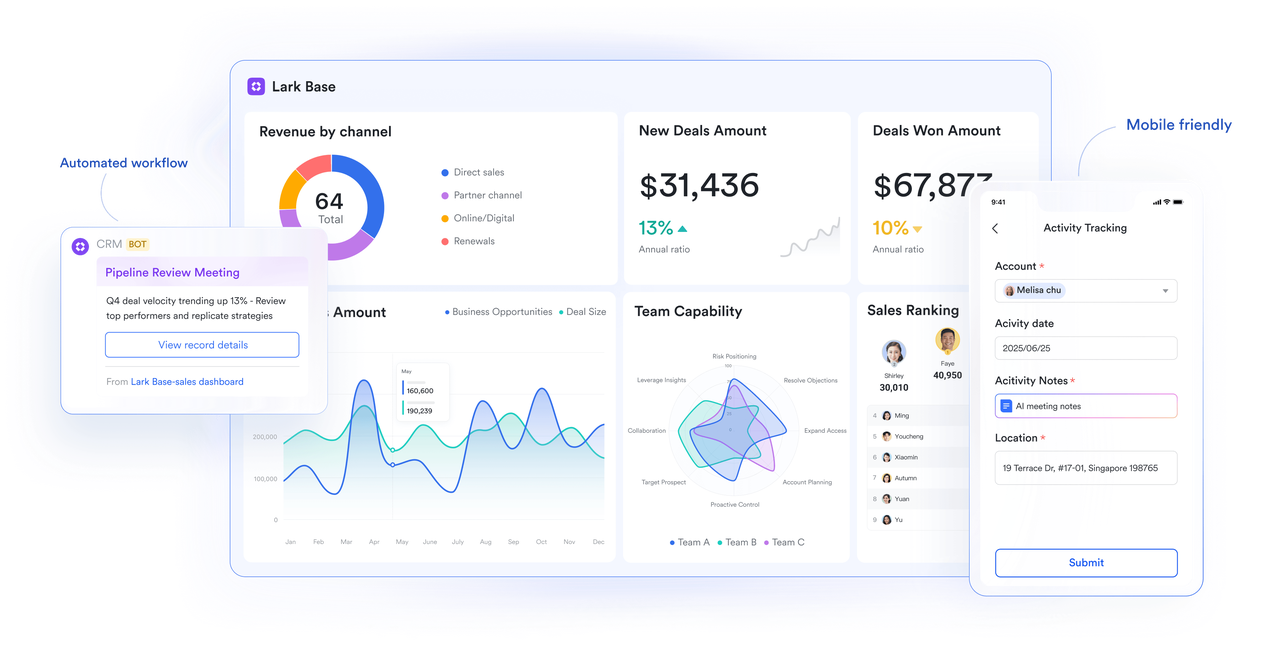
The first thing is to have everything in one spot. If things are on different spreadsheets and apps, nobody sees the whole thing. Lark Base fixes this by keeping your work in one spot that can change to fit your needs.

With the features of Automations, Views, and Fields, Lark Base allows different uses for streamlining and controlling processes. For instance, sales teams can build a CRM app to track leads, check clients’ availability, and link customer information to delivery schedules, ensuring that nothing is lost when items are passed off. Marketing can arrange campaigns on a board, while operations can use timelines to manage resources. No matter what you’re doing, the latest info is always in one place, so every team is on the same page.

When everyone can see the same thing, employees know what they need to do and how their work fits into the big picture. Base makes priorities clear, so there is no confusion.

Lark Wiki: Clarity through shared knowledge

Knowledge is often stuck in separate places, and that causes problems when teams can’t get to it, leading to more errors. Lark Wiki gives you one place to keep everything – policies, handbooks, ideas so everyone can get to it.

This makes it easier to get new people up to speed. Instead of bugging everyone with questions, they can just find the current rules on the Wiki. It is good for those who have been around for a while too, because any updates show up instantly across the business, so everyone is using the most up-to-date info.

Wiki makes knowledge a shared thing, which cuts down on doing things twice and helps teams do their jobs. Keeping things clear isn’t about keeping info secret; it’s about making it easy to see and use across the business.

Lark Docs: Making teamwork clearer

Teamwork can get annoying when you have tons of different drafts of documents floating around. People waste time trying to sort out the changes instead of getting stuff done. Lark Docs fixes this by making documents live, open spaces where teamwork is built-in.

Teams can work on plans or reports together in real-time, and comments and a version history show exactly what changed. Everyone can see the feedback, and no one has to guess which version is the real one.

Docs also links to Base and Tasks, which makes sure that plans turn into action right away. By linking documents to jobs and duties, Docs makes sure that clear teamwork leads to clear results.

Lark Tasks: Clarity in accountability

When it’s not clear who’s in charge, stuff gets messy fast. People might know what to do, but not who should do it. Lark Tasks fixes this by showing who’s responsible and how it fits into the plan.

Bosses can give out tasks with due dates, and people can keep tabs on their own to-do lists. Everyone can see how things are moving, which cuts down on doing the same thing twice and confusion. Since Tasks work with Base and OKRs, what people do is linked to the main goals, not just floating around on their own.

Tasks also have a system such as automated workflow. It sends reminders, bumps things up if needed, and gives updates without anyone having to do it by hand. This keeps everyone on the same page because there’s no question about whether things are moving forward.

Lark Calendar: Clarity in time

Even the best laid plans can go wrong if deadlines are missed. Lark Calendar puts time management right into the workflow, so everyone can see commitments and trust they’ll get done.

When important points are set in Base, they pop up in Calendar right away. For example, a product launch deadline shows up for sales, marketing, and operations. Nobody’s using old schedules or missing key dates.

Calendar also makes meetings work better. Linked Docs and agendas let people know what they’ll be talking about, and follow-up steps connect to Tasks. This makes sure schedules help get things done, instead of getting in the way.

Lark OKR: Clarity in alignment

Goals only work if you see them every day. Usually, bosses talk about targets at the start of the year, and then everyone forgets about them. Lark OKR fixes this by linking what you plan to do with getting it done.

Bosses set targets and how to measure them. Then, updates from Base and Tasks appear on their own. You can see how things are going right away, so bosses can change what’s important fast. Workers just do work – they see how what they do helps the company meet its targets.

When everyone is on the same page, teams know what to do. Instead of working alone, workers know what they are trying to achieve. This makes them feel like they own their work and can focus better.

Conclusion

Knowing what’s going on makes teams successful. When systems are a mess, it’s hard to find info, no one knows who’s in charge, and targets are not linked to what people do. Tools like Lark fix this by adding structure, making things clear, and aligning everyone.

Base makes project structure easier to understand. Wiki provides access to knowledge. Docs make teamwork open. Tasks make sure people are responsible by using automation. Calendar makes time schedules reliable. And OKR connects targets to daily work. Together, these things make it easy to change ideas into action.

For companies that are changing fast, it’s simple: being clear is a must, it’s the base of getting better. If you connect how things work, companies make sure that knowledge, tasks, and targets are all in one place. This gives teams what they need to keep succeeding.

Top 5 Mistakes to Avoid When Choosing a Bail Bondsman

Top 5 Mistakes to Avoid When Choosing a Bail Bondsman

Top 5 Mistakes to Avoid When Choosing a Bail Bondsman

When a loved one is arrested, emotions run high and decisions must be made quickly. One of the most critical choices during this stressful time is selecting the right bail bondsman. A bail bondsman plays a pivotal role in securing a defendant’s release from jail, but not all agents are created equal. Making the wrong choice can lead to financial strain, legal complications, and unnecessary stress. To help you navigate this process with confidence, it’s essential to understand the most common mistakes people make when choosing a bail bondsman—and how to avoid them.

Mistake One: Failing to Verify Licensing and Credentials

One of the most fundamental errors people make is not confirming whether a bail bondsman is properly licensed. Every state has its own regulations governing bail bond agents, and a legitimate bondsman must be licensed to operate legally. Unfortunately, in moments of panic, families may rush into agreements without checking credentials. This oversight can lead to working with unqualified or even fraudulent individuals who may exploit the situation for financial gain.

To avoid this mistake, always ask to see the bondsman’s license and verify it with the appropriate state regulatory agency. A reputable bondsman will have no issue providing this information and will often display their credentials prominently in their office or on their website. Ensuring that the agent is licensed not only protects you legally but also guarantees that they are held to professional standards and oversight.

Mistake Two: Choosing Based on Price Alone

In a time of crisis, it’s natural to seek the most affordable option. However, selecting a bail bondsman solely based on the lowest fee can be a costly mistake. While most states regulate the standard fee for Castle bail bonds —typically around ten percent of the total bail amount—some agents may advertise lower rates to attract clients. These offers often come with hidden fees, poor service, or unethical practices.

A bondsman offering a significantly lower rate than the industry standard may be cutting corners or operating outside legal boundaries. In some cases, they may require excessive collateral or impose unreasonable conditions. Instead of focusing solely on price, consider the overall value, including the agent’s reputation, responsiveness, and willingness to explain the process clearly. A trustworthy bondsman will be transparent about all costs and provide a written agreement outlining the terms.

Mistake Three: Ignoring Reputation and Reviews

Another common misstep is neglecting to research the bondsman’s reputation. In today’s digital age, online reviews and testimonials are valuable tools for assessing a service provider’s reliability. Yet, many people skip this step in their urgency to secure a loved one’s release. This can result in working with an agent who lacks professionalism, fails to communicate effectively, or has a history of complaints.

Before committing to a bail bondsman, take the time to read reviews on platforms like Google, Yelp, or the Better Business Bureau. Look for patterns in feedback, such as consistent praise for prompt service or repeated complaints about hidden fees. Personal recommendations from attorneys or friends who have gone through the process can also be invaluable. A bondsman with a solid reputation is more likely to handle your case with care and integrity.

Mistake Four: Overlooking Availability and Accessibility

Time is of the essence when someone is in jail, and delays can prolong their detention unnecessarily. Choosing a bail bondsman who is not available around the clock or who takes too long to respond can be a serious mistake. Some agents may advertise 24/7 service but fail to answer calls promptly or delay the paperwork process, leaving families frustrated and anxious.

To avoid this pitfall, confirm the bondsman’s availability before signing any agreement. Ask how quickly they can initiate the bail process and whether they have staff on hand to handle emergencies at any hour. A reliable bondsman understands the urgency of the situation and will prioritize swift action to secure the defendant’s release. Accessibility also includes clear communication—choose someone who is easy to reach, answers questions patiently, and keeps you informed throughout the process.

Mistake Five: Not Understanding the Terms of the Agreement

Perhaps the most consequential mistake is signing a bail bond contract without fully understanding its terms. In the rush to get a loved one out of jail, families may overlook important details such as payment schedules, collateral requirements, and the consequences of a missed court date. This lack of understanding can lead to financial hardship, legal complications, or even the forfeiture of property.

Before entering into any agreement, take the time to read the contract carefully. Ask the bondsman to explain any clauses that are unclear and ensure you understand your responsibilities as a co-signer. This includes ensuring the defendant appears in court and complies with all conditions of release. A reputable bondsman will be transparent and patient, guiding you through the paperwork and answering all your questions without pressure or confusion.

Conclusion: Making an Informed Decision

Choosing the right bail bondsman is a critical decision that can significantly impact the outcome of a difficult situation. By avoiding these five common mistakes—failing to verify licensing, focusing solely on price, ignoring reputation, overlooking availability, and not understanding the agreement—you can protect yourself and your loved one from unnecessary complications. A professional, trustworthy bondsman will not only expedite the release process but also provide peace of mind during a challenging time. Taking a few extra moments to research and ask the right questions can make all the difference in navigating the bail process with confidence and clarity.

Top 5 Weighted Vests for Running: Find the Best Fit for Your Workout

Top 5 Weighted Vests for Running: Find the Best Fit for Your Workout

Weighted Vests for Running

Running has always been one of the simplest and most effective ways to stay fit. It builds endurance, burns calories, and clears the mind. But for those who want to take their workouts to the next level, running with a weighted vest has become a popular and proven way to increase strength and boost performance. A weighted vest for running adds resistance to your body, making your muscles work harder and improving your cardiovascular endurance over time. Whether you’re a seasoned runner or just beginning your fitness journey, adding a vest can completely transform your workout routine.

In this guide, we’ll explore the top 5 weighted vests for running, and help you find the right one based on comfort, adjustability, design, and performance. We’ll also discuss how weighted vests for women and weighted vests for men differ, and why this small but powerful piece of gear is worth adding to your fitness arsenal.

Why Running with a Weighted Vest Works

The concept behind using a weighted vest for running is simple: added weight increases resistance. When your body works harder to carry extra mass, your muscles adapt by becoming stronger, and your endurance improves naturally. Over time, running without the vest feels lighter and faster.

A good weighted vest for running doesn’t just make your workout harder—it helps train your body to perform more efficiently. Studies show that even light resistance (5–10% of your body weight) can enhance aerobic capacity, running economy, and bone density. The extra load engages your core muscles more actively, making it a useful tool for anyone who also wants to strengthen their abs or improve posture.

Besides running, these vests are also great for exercises like planks, squats, lunges, and push-ups. Using a weighted vest for planks, for example, can significantly increase the intensity of core training without requiring any extra equipment.

What to Look for in a Weighted Vest

Before diving into our top picks, it’s important to know what makes a weighted running vest worth your money. Here are the main things to consider:

1. Comfort and Fit

Running with extra weight can feel uncomfortable if the vest isn’t designed properly. Look for breathable materials, adjustable straps, and ergonomic cuts that allow natural movement without chafing. A weighted vest for women often has a narrower fit around the shoulders and chest, providing better comfort and stability during motion.

2. Weight Adjustability

A good vest should allow you to customize how much weight you carry. Beginners may start with 4–6 lbs, while experienced runners can increase gradually up to 20 lbs or more. Adjustable models let you add or remove weight plates or sandbags depending on your fitness goals.

3. Balance and Stability

Uneven weight distribution can throw off your form and increase injury risk. Always choose a vest that distributes weight evenly across the torso—this is especially important when running or doing high-intensity workouts.

4. Material and Durability

You’ll be sweating a lot in your vest, so the fabric must be moisture-wicking, easy to clean, and strong enough to handle frequent use. Nylon and neoprene are common materials that balance comfort and durability.

5. Breathability

Look for mesh panels or open designs that let air flow easily. Overheating can make your run unbearable, especially in warmer weather.

Top 5 Weighted Vests for Running

1. RUNMAX Pro Weighted Vest

The RUNMAX Pro is one of the most popular and versatile options on the market. It’s perfect for both men and women who want to start running with a weighted vest safely. Available in several sizes (from 12 to 60 lbs), it allows you to easily adjust the resistance level as you progress.

The vest features evenly distributed weights, a comfortable shoulder design, and a snug fit that minimizes bouncing while you run. For those focusing on planks and strength exercises, the vest stays tight to your body, maintaining balance throughout.

2. Hyperwear Hyper Vest Elite

If you value premium materials and professional design, the Hyperwear Hyper Vest Elite is hard to beat. Made from stretchable fabric and thin steel plates, it’s incredibly slim and breathable. This vest conforms to your body, which makes it ideal for runners who prioritize freedom of movement.

The unisex fit means both men and women can wear it comfortably. It’s also a top choice for cross-training workouts, including weighted planks, push-ups, and HIIT sessions. The compact structure keeps the weight close to your core for better performance and posture.

3. Tone Fitness Weighted Vest for Women

Designed specifically as a weighted vest for women, the Tone Fitness model provides a smaller fit and distributes weight ergonomically for the female body. It’s lightweight (usually 8–12 lbs) and comes in soft, breathable materials.

This vest is perfect for beginners or those who prefer light resistance for cardio, yoga, or walking. The reflective strips on the vest also make it safer for outdoor runs. While it may not suit heavy training, it’s an excellent introduction to resistance workouts.

4. CAP Barbell Adjustable Weighted Vest

The CAP Barbell Adjustable Vest offers outstanding flexibility for runners who want to scale up intensity gradually. It comes with removable steel shot weights, allowing you to start light and work your way up.

This vest fits securely without bouncing, making it great for running, HIIT, or plyometric exercises. The adjustable straps help both men and women find a comfortable fit. Its durable nylon shell ensures long-term use even under tough training conditions.

5. Aduro Sport Weighted Vest

Lightweight, stylish, and affordable, the Aduro Sport Weighted Vest is an excellent entry-level choice for runners and fitness enthusiasts. It’s available in various weights, from 4 to 25 lbs, and comes with an adjustable front strap for a secure fit.

Made from soft neoprene, this vest feels comfortable even during longer runs. It’s perfect for adding extra resistance to daily jogging, home workouts, and core exercises like planks and squats. The back pocket also allows you to carry small essentials such as keys or a phone.

Weighted Vests for Men vs. Women

While both weighted vests for men and weighted vests for women share the same purpose, their design differences matter. Men’s versions typically offer higher weight capacities and broader shoulder widths. Women’s vests, on the other hand, emphasize ergonomic shaping and lightweight materials for better mobility and comfort.

For instance, female runners who want to tone their upper body and improve endurance should start with 6–10 lbs. Male athletes can safely train with 12–20 lbs, depending on fitness levels. Always listen to your body and avoid overloading—gradual progression is key.

Benefits of Running with a Weighted Vest

  1. Increased Calorie Burn: Adding extra resistance means your body expends more energy, helping you burn more calories even during shorter runs.
  2. Improved Cardiovascular Strength: A weighted vest for running challenges your heart and lungs, improving oxygen efficiency.
  3. Enhanced Muscle Endurance: Leg, core, and upper body muscles become stronger due to the added resistance.
  4. Bone Density Support: The extra load puts mild stress on bones, stimulating bone growth and reducing osteoporosis risk.
  5. Better Core Stability: Especially when paired with weighted planks, vests engage stabilizing muscles and promote better posture.

Safety Tips When Running with a Weighted Vest

If you’re new to weighted running, start light—about 5% of your body weight—and increase gradually. Overloading too early can strain your joints and reduce running efficiency. Focus on maintaining good posture, even weight distribution, and shorter distances at first.

Always warm up before your run and cool down afterward. Hydration is important, as carrying weight increases your body’s temperature faster. And if you experience any discomfort or joint pain, remove the vest immediately and reassess your form or load.

Final Thoughts

A weighted vest for running is a simple yet powerful upgrade to your training. It helps runners, fitness enthusiasts, and even beginners improve their endurance, strength, and stability. Whether you’re looking for the best weighted vest for women, a durable weighted vest for men, or something versatile for planks and full-body workouts, there’s a perfect model out there for you.

From the heavy-duty RUNMAX Pro to the sleek Hyperwear Elite, each of these top 5 weighted vests offers unique benefits tailored to different needs. Start light, stay consistent, and watch how your running performance transforms over time.

Running is more than just movement—it’s progress. With the right weighted vest, every step you take brings you closer to a stronger, faster, and more resilient version of yourself.