
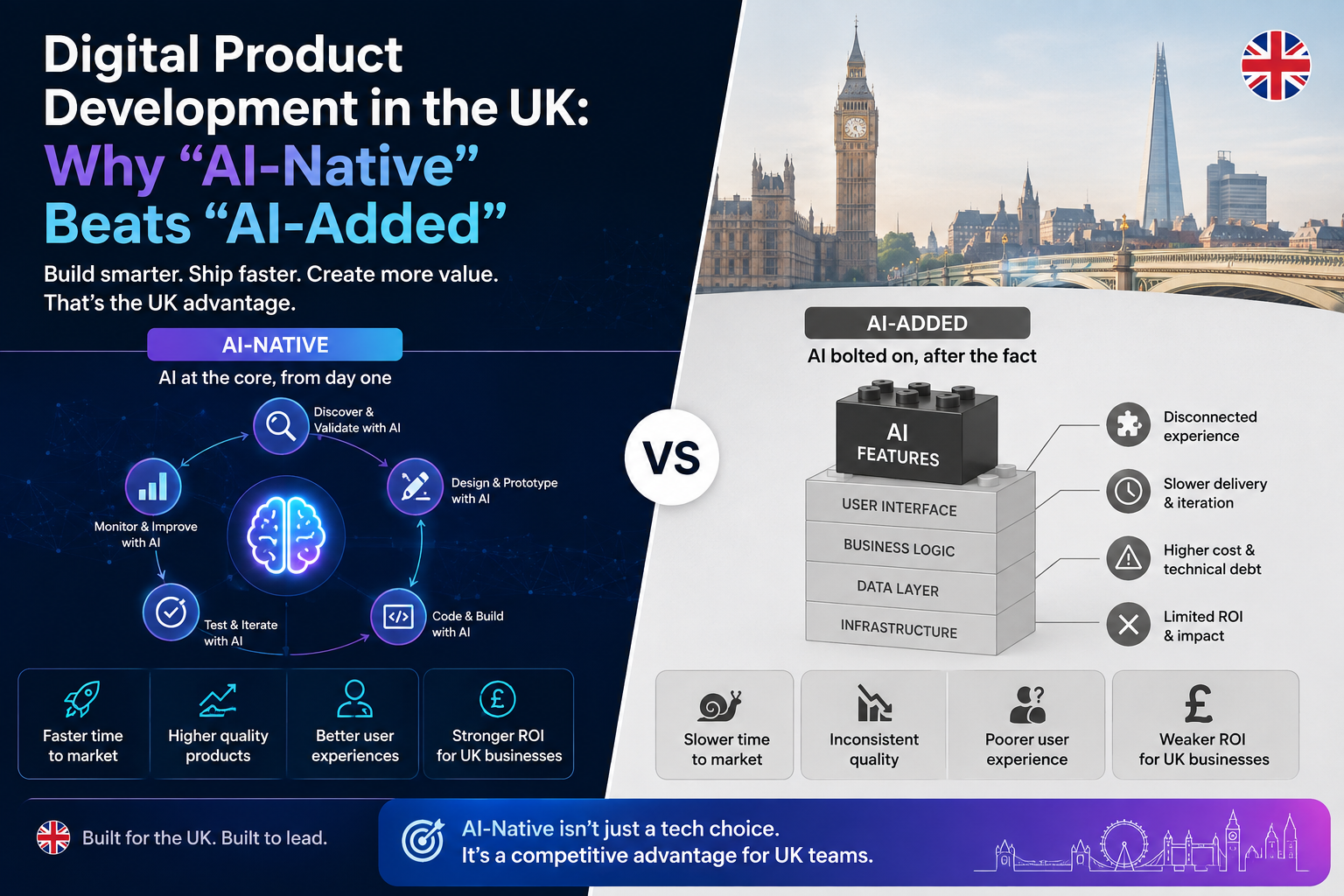
Every pitch deck in the UK claims to be “AI-powered” this year. Walk into ten product reviews and you’ll hear the phrase ten times, and it will mean ten different things. That’s the problem. Underneath the label, there are really two very different approaches to digital product development services, and the gap between them is starting to decide which UK products scale smoothly and which ones need rebuilding a year after launch.
Quick answer: An AI-native product is built with machine learning and LLM logic inside its architecture from the first sprint. It can evaluate its own outputs, fall back gracefully when a model gets something wrong, and get better as real usage data comes in. An AI-added product has AI dropped on top of something that already exists — a chatbot wired onto a CRM, a summary button stitched onto a document tool. The two can look near-identical in a demo. They behave very differently once real users, real data, and UK compliance requirements get involved.
Ask a UK product leader whether their software “uses AI” and the answer is almost always yes. Ask how deeply, and the confidence tends to drop. Some can point to a model sitting inside their core data layer, complete with evaluation logic and a proper fallback plan. Others can point to an API call wired into a button, added last quarter because a competitor announced something similar. Both get called “AI-powered” on the same slide. Only one of them tends to survive real scrutiny from investors, regulators, or just an unusually bad week of user traffic.
That’s the AI-native versus AI-added split, and it’s fast becoming the question that matters most in UK product development right now.
What “AI-Native” Actually Means
Let’s be clear about what this isn’t. AI-native isn’t a rebrand for “we added a chatbot.” It’s a specific approach to engineering where AI is treated as core infrastructure, not a feature slotted in after the fact.
In an AI-native build:
- AI sits in the data layer and shapes requirements, UX and backend design from the discovery stage, not after the wireframes are already signed off
- There’s observability into what the model is doing and why, not just a vague sense that “the output looks right”
- Fallback logic exists for when the model is uncertain, wrong, or simply offline
- Output quality gets measured against a defined standard, rather than eyeballed by whoever happens to be testing that day
- Cost is managed from day one, because AI usage scales very differently to a normal server bill
An AI-added product skips most of this. It works by wiring an existing model’s API into one specific feature — a summary here, a recommendation there — without touching how the rest of the system is designed. That’s not automatically the wrong call, to be fair. For a narrow, low-stakes feature on a mature product, it’s often the sensible, cheaper option. It only becomes a problem when a business bets something important on a feature that was never built to carry that weight.
AI-Native vs AI-Added: The Practical Differences
| Key Takeaway | AI-Added | AI-Native |
|---|---|---|
| Where AI sits | Layered on top of existing architecture | Built into the data layer and core workflows |
| Origin point | Added after launch, usually via an API call | Designed in from discovery and requirements |
| Handling errors | Little to no fallback logic | Fallback logic and confidence thresholds built in |
| Visibility | Output either “looks right” or it doesn’t | Observability into model behaviour and decisions |
| Changing the model | Often means rebuilding the feature | Swappable within the existing architecture |
| Cost pattern | Unpredictable as usage scales | Managed with usage and cost forecasting from day one |
| Best suited to | Narrow, low-risk features on mature products | Core product capability, new builds, regulated use cases |
Why This Matters More for UK Teams in 2026
Three things are converging in the UK market right now, and together they make this distinction hard to ignore.
Regulation isn’t loosening. The Data (Use and Access) Act 2025 reshaped parts of UK GDPR, and any business building something AI-driven — fintech and health tech especially, but really anywhere personal data flows through a model — now has to be able to show its working. An AI-native build with audit trails and observability baked in can answer “why did the system decide that?” without much drama. An AI-added feature, stitched on as an afterthought, often can’t. That’s turning into a real commercial risk, not just a box-ticking exercise for the compliance team.
Investors want proof faster. UK founders are under more pressure than ever to show product-market fit quickly, and a generic “we use AI” no longer moves the needle the way it did two years ago. Gartner’s forecast that four-fifths of large engineering teams will restructure into smaller, AI-augmented units by 2030 tells you where the baseline is heading: AI-native is on track to become the expected standard, not the differentiator it still is today. Build it now, and you get a head start most competitors won’t have for long.
Good AI engineers are hard to find. Architecting an AI-native product takes people who understand data pipelines and model evaluation at a systems level, not just how to write a decent prompt. That kind of specialist is genuinely scarce across the UK market right now, which is a big part of why more founders are turning to established product development services rather than trying to build the capability from scratch in-house.
Quick Self-Check: Is Your Product AI-Added or AI-Native?
Be honest with yourself here. The more of these that sound familiar, the more likely your “AI-powered” product is actually AI-added:
- The AI feature went in as a single sprint or ticket, not as part of the original architecture
- Nobody on the team can really explain how a specific output got generated
- There’s no fallback for when the model is wrong, slow, or simply down
- Swapping the underlying model would mean rebuilding the feature, not just updating a setting
- Output quality gets judged by “does it look right” rather than any real benchmark
- Usage data from the product never makes its way back into improving the AI itself
None of this makes AI-added a bad decision on its own. Plenty of profitable products use it deliberately, for one low-stakes feature, and never think about it again. It only turns into a problem when it’s propping up something the business actually depends on.
What AI-Native Looks Like Across the Product Lifecycle
It shows up differently at every stage, not just in the finished product.
At the discovery stage, AI should be part of the conversation from the beginning, not something added after the roadmap is already set. That’s where Product discovery services make a real difference. They help teams test ideas, understand what users actually need, and figure out where AI can create genuine value before any development starts. This approach is especially useful for new products or major rebuilds, where early decisions have the biggest impact.
Evaluation and observability come next. Every output needs to be measurable against a standard, and someone on the team should be able to trace why a particular decision was made. This is non-negotiable for regulated sectors, and genuinely useful for any product a UK business plans to scale past its first hundred users.
Then there’s governance: clear rules for how much autonomy the AI has before a human needs to sign off. Teams planning to keep adding AI capability over time need this far more than teams shipping a single feature and stopping there.
All of this is a heavier lift than bolting on an API call. That’s exactly why it needs to be a deliberate decision made early, with a product development services partner who actually understands the difference, rather than something discovered halfway through a build when it’s expensive to unwind.
Choosing a Digital Product Development Company for an AI-Native Build
A handful of questions tend to separate genuine AI-native capability from a well-marketed API wrapper:
- Can they show a product where AI shaped the architecture, not just the interface?
- Do they talk about evaluation, observability and fallback logic, or mostly about which model they’ve plugged in?
- Do they have engineers who understand data pipelines and model behaviour, not only prompt design?
- Are they up to speed on UK-specific obligations, including the Data (Use and Access) Act 2025, UK GDPR, and FCA requirements where relevant?
- Can they actually explain how AI usage costs will be managed as the product scales, rather than leaving that conversation for later?
Bytes Technolab, a Product Development Company in the UK built around AI-first engineering, is one example worth knowing about here. The firm positions its MVP, SaaS and AI/ML work around designing intelligence into the product from the discovery stage, rather than adding it once a build is already underway. It’s a useful reference point for what “AI-native by default” looks like in practice among UK digital product development services, not a claim that it’s the only way to do it well.
Key Takeaways
- AI-native means AI is part of the architecture from day one; AI-added means it’s wired into an existing system afterwards
- The difference shows up most in error handling, cost management, and how easily the product adapts to a new model
- UK regulation, including the Data (Use and Access) Act 2025, UK GDPR, and FCA requirements, is making AI-native the safer default for anything AI-driven and consequential
- AI-added is a legitimate choice for narrow, low-risk features. The risk is using it for something the business actually depends on
- When evaluating product development services for an AI-native build, ask about evaluation, observability and fallback logic before asking which model they use
FAQs
What does “AI-native” mean in digital product development?
AI is built into the product’s architecture and data layer from the start, rather than added as a feature once the core system already exists. It shapes requirements, design and decisions throughout the build, not just one screen.
What’s the actual difference between AI-native and AI-added software?
AI-native software is designed around AI from day one, with evaluation, observability and fallback logic built in from the start. AI-added software wires an existing model into one feature of a system that otherwise hasn’t changed. They can look similar to a user. They behave very differently once the model is wrong, unavailable, or needs replacing.
Why are UK teams moving toward AI-native product development now?
Tighter data regulation under the Data (Use and Access) Act 2025, investors wanting faster proof of differentiation, and a real shortage of specialist AI engineering talent are all pushing UK teams to treat AI as core infrastructure rather than something added on later.
Is AI-native development always more expensive than AI-added?
Not necessarily upfront. It really depends on the build. AI-added can be cheaper for one narrow, low-risk feature. Over the product’s lifetime, though, AI-native usually costs less overall, simply because it avoids the rebuild that AI-added features tend to need once a business starts depending on them.
How do I know if a product development partner builds AI-native or AI-added?
Ask what happens if the underlying model changes, how they evaluate output quality, and whether there’s fallback logic for when the model gets it wrong. Vague answers about “using