
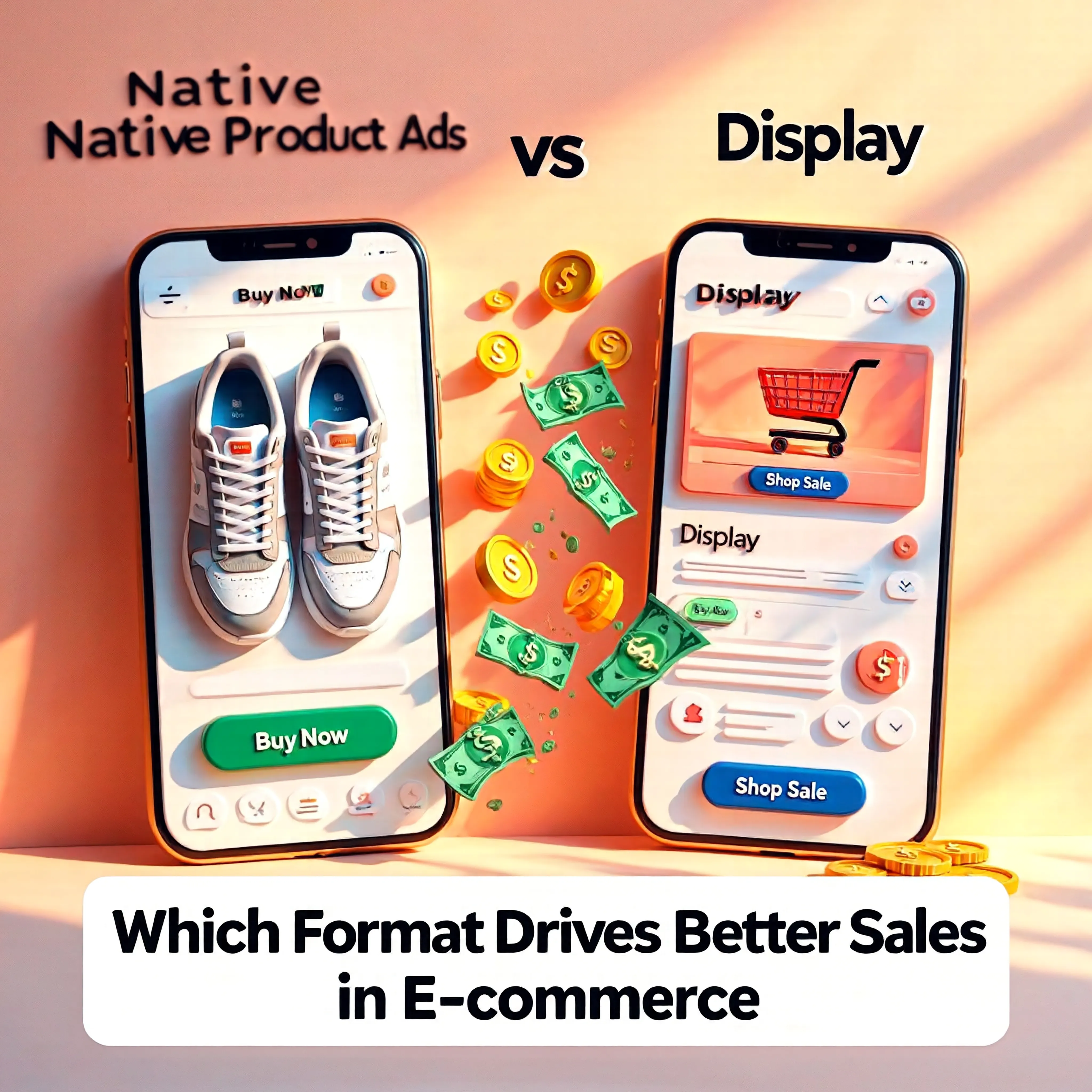
E-commerce advertisers have more format options than ever — and fewer excuses for picking the wrong one. Yet the debate between native product ads and display advertising keeps resurfacing, usually after a campaign underdelivers and someone has to explain why.
The honest answer is that neither format is universally better. They operate on different principles, reach users in different mental states, and produce different outcomes depending on what you’re selling, who you’re selling it to, and where in the purchase journey you’re trying to intervene. Understanding those differences in an e-commerce context is what this article is about.
How Each Format Reaches a Shopper
Display advertising in e-commerce is the familiar rectangle — banners, skyscrapers, medium rectangles — placed in designated ad slots on websites, apps, and platforms. The user is doing something else entirely when the ad appears. Display works by interrupting that activity with a visual message and hoping the message is relevant enough to earn a click.
The format has a structural limitation: users have spent decades learning to ignore things that look like ads. Banner blindness is a documented perceptual phenomenon, not a metaphor. Eye-tracking studies consistently show users routing around standard display placements without consciously deciding to do so. Display advertising still delivers value — particularly for retargeting and brand recall — but it’s fighting against deeply conditioned avoidance behavior.
Native product ads sidestep that problem by design. Instead of occupying a designated ad slot, a native unit appears inside the content stream — as a recommended product, a related article, or a sponsored content card that matches the visual style of its surrounding environment. Users encounter it as part of their browsing experience rather than as an interruption to it. The ad earns its place in the user’s visual field by looking like it belongs there.
That difference in how each format reaches the user shapes everything downstream: click rates, landing page behavior, conversion intent, and ultimately sales.
The Click Quality Problem in E-commerce
E-commerce advertisers are particularly sensitive to click quality because the economics are tight. A high-volume, low-quality click stream produces traffic that bounces fast, inflates session counts without adding value, and distorts attribution data. The channel looks active in the dashboard while the revenue stays flat.
Display clicks in e-commerce have a well-known quality problem. Average click-through rates hover around 0.1% industry-wide, which means the vast majority of impressions generate no engagement at all. Of the clicks that do come through, a significant share are accidental — fat-finger taps on mobile, misclicks on desktop, or clicks generated by fraudulent inventory. The result is a traffic mix where genuine purchase intent is diluted by noise.
Native clicks behave differently. A user who clicks a native product ad has made a deliberate choice to engage with something that appeared in their content environment. The click required more active intent than brushing past a banner. That intent difference shows up in post-click behavior: longer time on site, lower bounce rates, and higher conversion rates relative to display traffic from comparable inventory.
This doesn’t mean native traffic always converts at higher absolute rates — cost, targeting, creative quality, and landing page all intervene. But the underlying click quality, controlling for other variables, tends to favor native in e-commerce contexts where the purchase decision involves any degree of consideration.
Where Display Still Wins in E-commerce
Display advertising has specific use cases in e-commerce where it genuinely outperforms native, and it’s worth being honest about them.
Retargeting is display’s strongest argument. A user who visited your product page, added to cart, and left without purchasing is a warm audience. They know your brand, they’ve shown purchase intent, and they just need a nudge. A retargeting banner showing the exact product they viewed — or a discount on it — can be highly effective because it requires no education, no persuasion, and no content frame. The user is ready; the display ad just has to remind them.
Brand recall across high-reach inventory. If the goal is keeping your brand visible to a broad audience over time — not driving immediate clicks but staying top of mind — display CPMs are typically lower than native, and the format scales to enormous reach. For seasonal e-commerce advertisers building awareness ahead of a campaign period, display can efficiently saturate a target audience with brand impressions at a cost that native can’t match.
Impulse purchase categories. For products that sell on impulse — low consideration, low price point, visually driven — a high-quality display creative with a strong offer can perform competitively. The decision doesn’t require research; it requires a moment of desire and an easy path to purchase. A well-placed banner can create that moment efficiently.
Where Native Product Ads Win in E-commerce
Native advertising’s advantage in e-commerce is concentrated in situations where the purchase requires some degree of consideration before it happens.
Higher ticket products. A user buying a $300 piece of kitchen equipment, a $500 mattress, or a $150 skincare set doesn’t convert from a banner. They research, compare, read reviews, and return multiple times before purchasing. Native advertising fits into that research journey naturally. A sponsored article explaining what to look for in a mattress, or a comparison of kitchen equipment options that happens to feature your brand, earns trust before asking for the sale. That trust is what converts considered purchases.
New or unfamiliar products. If your product category isn’t yet established in the buyer’s mind — a new supplement category, an innovative home product, a niche fashion brand — you need to explain what it is and why it matters before you can sell it. Native advertising gives you the content space to make that case. Display doesn’t.
New customer acquisition. Retargeting warm audiences is display’s territory. Acquiring customers who have never heard of your brand is native’s. A new visitor who encounters your brand through a content-native ad unit — particularly if it leads to useful, informative content about a problem your product solves — is far more likely to engage meaningfully than one who sees a banner for a brand they don’t recognize.
Categories with high research behavior. Health and wellness, electronics, home improvement, outdoor gear, financial products embedded in e-commerce contexts — these are all categories where users habitually research before buying. Native ads integrate into that research process rather than interrupting it, which is why conversion rates from native campaigns in research-heavy categories consistently outperform display.
The Creative Equation Is Different for Each Format
Advertisers who switch from display to native without adjusting their creative approach usually underperform and conclude that native doesn’t work. The creative requirements are genuinely different.
Display creative succeeds through visual impact. A strong image, a clear offer, a contrasting CTA button. The message needs to land in a fraction of a second because that’s all the attention a banner gets. The visual does the work; the copy is minimal and functional.
Native creative succeeds through editorial relevance. The headline is the most important element — it needs to feel like content the user would have clicked on regardless of whether it was sponsored. Images should look contextual and real rather than commercial and polished. The frame is “here’s something interesting” rather than “here’s something to buy.”
For e-commerce specifically, native headlines that lead with the product problem or the category insight consistently outperform headlines that lead with the product or the offer. “Why most running shoes cause knee pain after 30 miles” will outperform “Shop our new running shoe collection” in a native context, even if both eventually lead to the same product page.
The Funnel Position Question
One practical way to decide between formats for any given e-commerce campaign is to ask where in the purchase funnel you’re trying to intervene.
Top of funnel — awareness and discovery — is where native product ads do their most distinctive work. Users who don’t know your brand or your product category can be introduced to both through content-native placements that feel like editorial rather than advertising. This is expensive to accomplish with display because you’re fighting attention competition from every other element on the page.
Mid funnel — consideration and comparison — is shared territory. Native advertorials and product comparison content work well here. Retargeting display also becomes relevant as you reach users who have already had one touchpoint with your brand.
Bottom of funnel — purchase intent, cart abandonment, repeat buyers — is where display retargeting is most efficient. The user knows what they want; the creative just needs to remind them and remove the last friction point.
The e-commerce advertisers who consistently drive the best results don’t choose between native and display. They use native to build the audience that display then converts — treating the formats as complementary stages in a single customer journey rather than competing options for the same budget.
Final Thoughts
The format debate in e-commerce advertising is ultimately a funnel question disguised as a channel question. Display wins at retargeting, brand reach, and impulse categories. Native wins at new customer acquisition, considered purchases, and categories where education precedes the sale.
If your e-commerce revenue is stalling on display campaigns, it’s rarely because display is the wrong channel. It’s usually because you’re using display to do a job it wasn’t designed for — acquiring customers who haven’t yet decided they need what you’re selling. That’s the job native product advertising was built for. Use each format where its mechanics actually match your objective, and the sales numbers will tell you you made the right call.
GTaro helps e-commerce advertisers run native campaigns that reach new customers at the top of the funnel — with AI-optimized placements, precise geo and device targeting, and access to publisher inventory across 230+ markets. If you’re looking to add native to your acquisition mix, gtaroads.com is a practical starting point.