...
UK: +44 2038074555 info@atamgo.com
How Murf Falcon’s Low-Latency Voice API Drives Efficiency in AI-Powered Workflows
How Murf Falcon’s Low-Latency Voice API Drives Efficiency in AI-Powered Workflows

Murf Falcon’s Low-Latency Voice API

In today’s digital-first world, efficiency isn’t just about automation—it’s about real-time performance. Businesses across industries are integrating voice technologies to streamline communication, enhance customer experience, and optimize operational workflows. However, traditional voice APIs often struggle with latency, scalability, and cost-efficiency. That’s where Murf Falcon, a next-generation low-latency voice API, is redefining the game.

Built to handle massive workloads—up to 10,000 concurrent calls—and support 35+ languages at just 1 cent per minute, Murf Falcon enables businesses to create intelligent, multilingual voice agents that operate seamlessly at scale. It’s fast, cost-effective, and designed to integrate easily into existing AI-powered ecosystems.

This blog explores how Murf Falcon’s low-latency architecture transforms AI workflows by delivering speed, scalability, and innovation that business leaders, developers, and product teams can rely on.

1. The Latency Problem in Voice AI: Why It Matters

Latency is the silent killer of productivity in AI-powered workflows. Whether it’s a voicebot engaging customers or an internal voice-driven automation system, even milliseconds of delay can disrupt user experience and workflow continuity.

For developers, latency complicates system design. For businesses, it directly impacts customer satisfaction and efficiency. Consider a real-time customer support system: a 500ms delay between user query and bot response can lead to frustration, call drop-offs, and reduced trust in the brand’s AI capabilities.

Murf Falcon eliminates this bottleneck through ultra-low-latency streaming architecture, ensuring that interactions feel natural, instantaneous, and human-like. It’s not just a technical improvement—it’s a productivity revolution.

2. Inside Murf Falcon: The Architecture of Speed

At the heart of Murf Falcon’s performance lies a high-speed, event-driven API design that prioritizes low-latency communication without compromising audio quality or scalability. Here’s how it achieves that balance:

  • Real-Time Audio Streaming: Murf Falcon supports full-duplex streaming, enabling simultaneous audio input and output for real-time conversation flow.
  • Edge Computing Integration: By processing data closer to the source, it reduces the round-trip time, achieving response speeds under 100 milliseconds.
  • Adaptive Compression: The API intelligently optimizes audio bandwidth based on network conditions, ensuring consistent performance across variable internet speeds.
  • Multi-Region Infrastructure: Distributed global servers ensure that voice interactions remain smooth and responsive regardless of user geography.

These architectural choices allow developers to integrate Falcon into AI workflows that demand real-time performance—be it customer support, voice analytics, or smart assistant solutions.

3. Streamlining AI Workflows Across Industries

Murf Falcon’s design caters to the growing demand for AI-driven efficiency across multiple verticals. Let’s explore a few practical use cases that showcase its versatility.

a. Customer Support Automation

Businesses using voice AI for customer support often struggle with lag and call handling limitations. Murf Falcon’s low-latency performance enables smooth, human-like conversations where voicebots respond instantly, resolving queries faster. With support for 35+ languages, companies can offer truly global customer service, cutting average handling time and increasing satisfaction scores.

b. Voice Analytics in Real-Time

Enterprises analyzing voice data for sentiment, compliance, or quality monitoring need high-fidelity, low-delay audio streams. Falcon’s real-time streaming and multi-call handling capability make it ideal for monitoring thousands of concurrent conversations, providing live insights that enhance decision-making and operational oversight.

c. AI-Powered Virtual Agents

In sectors like healthcare, fintech, and travel, intelligent virtual assistants powered by Murf Falcon can guide users, verify information, or execute tasks via natural, responsive dialogue. The low-latency response ensures the experience remains fluid and lifelike, improving adoption and trust in AI interfaces.

d. Workflow Automation in Enterprises

Internal AI tools—such as meeting summarizers, workflow assistants, or transcription engines—can integrate Murf Falcon to enable seamless voice interactions. Teams save hours by dictating tasks, generating summaries, and initiating workflows through voice commands, all with real-time accuracy.

4. The Efficiency Advantage: Where Murf Falcon Excels

Murf Falcon doesn’t just enhance voice interaction—it redefines efficiency across every stage of AI-driven communication.

a. Real-Time Responsiveness

Its near-instantaneous response capability eliminates downtime in AI-powered systems. Businesses can deliver consistent, on-demand interactions without lag, improving user engagement and conversion rates.

b. Scalable Infrastructure

Handling 10,000 concurrent voice calls simultaneously, Falcon empowers enterprises to scale effortlessly during peak demand—without the need for costly infrastructure upgrades. Whether it’s a seasonal customer service surge or a global product launch, the API adjusts dynamically to load variations.

c. Cost Optimization

At just 1 cent per minute, Murf Falcon’s cost model redefines affordability in voice AI. Startups and enterprises alike can leverage premium-grade voice technology without inflating operational budgets, enabling broader AI adoption.

d. Multilingual Expansion

By supporting 35+ global languages, including major Asian, European, and Middle Eastern dialects, Falcon enables organizations to reach international markets faster. Developers can localize applications with minimal overhead, ensuring global accessibility and inclusivity.

5. Seamless Integration for Developers

Murf Falcon’s API-first design focuses on developer experience. Its lightweight SDKs and comprehensive documentation make integration simple, flexible, and fast.

  • RESTful API and WebSocket Support: Developers can choose between synchronous and streaming modes depending on their workflow requirements.
  • Low Setup Overhead: Minimal configuration ensures teams can deploy test environments in minutes.
  • Cross-Platform Compatibility: Works smoothly across cloud platforms, web apps, and IoT devices.
  • Robust Security: Enterprise-grade encryption ensures voice data remains protected during transmission and processing.

For developers building complex AI workflows, these capabilities mean faster development cycles, reduced debugging time, and predictable performance at scale.

6. Powering the Future of Voice-Driven Automation

Voice is fast becoming the new interface for AI-powered operations—whether it’s customer engagement, enterprise communication, or automation. Murf Falcon empowers this shift by turning latency into leverage.

Its combination of speed, scale, and simplicity allows businesses to build smarter, faster, and more responsive voice experiences that integrate seamlessly with AI-driven ecosystems. Whether paired with NLP engines, CRM systems, or analytics dashboards, Falcon ensures every spoken interaction translates into real-time action.

As organizations continue to automate workflows and expand globally, the demand for low-latency, multilingual, and affordable voice APIs will only grow. Murf Falcon is positioned at the forefront of this evolution—offering a future-proof foundation for next-gen AI solutions.

7. Conclusion: The Competitive Edge of Real-Time Voice

Efficiency in AI workflows isn’t achieved through automation alone—it’s achieved through real-time intelligence. Murf Falcon’s low-latency architecture transforms how businesses use voice, bridging the gap between human-like interaction and machine precision.

By combining performance, scalability, and affordability, Murf Falcon enables enterprises and developers to unlock a new level of operational agility. It’s more than a voice API—it’s a platform for AI-driven growth, empowering businesses to operate faster, smarter, and more efficiently in an increasingly connected world.

In essence:
Murf Falcon doesn’t just power voice—it powers momentum.

The Rise of  AI Computing Power Assets: DLMining Reshapes Wall Street’s New Anti-Inflation Investment Paradigm

The Rise of  AI Computing Power Assets: DLMining Reshapes Wall Street’s New Anti-Inflation Investment Paradigm

DLMining

As gold stagnates after suffering its largest single-day drop in more than a decade, and Bitcoin continues to come under pressure amid a strong U.S. dollar, AI computing power investment is emerging as a new asset class. DLMining, with its innovative computing power assetization model, breaks the boundaries of traditional investments, offering a new anti-inflation option for Wall Street and global investors, and leading a new round of asset allocation transformation.

Market Transformation: AI Computing Power Becomes a New Favorite for Risk Hedging

The latest analysis report from UBS points out that the current intensification of macroeconomic volatility and the strong performance of the U.S. dollar are profoundly reshaping the logic of global asset allocation. The artificial intelligence computing infrastructure once monopolized by tech giants has now broken through technical barriers and transformed into a stable, high-yield, and low-threshold financial investment tool.

The sharp fluctuations in traditional commodities and cryptocurrencies have made investors’ demand for “steady appreciation” increasingly urgent. DLMining accurately grasps this trend, converting AI computing power into U.S. dollar-denominated returns supported by actual productivity through a unique business model. It jumps out of the ups and downs cycle of traditional assets, opening up a third investment track for investors independent of stocks, cryptocurrencies, and commodities.

Minimalist Participation: Unlock AI Computing Power Passive Income in Three Steps

DLMining has created a low-threshold and efficient investment process, allowing ordinary investors to easily share the dividends of computing power:

DLMining

1. Fast Registration with Benefits

The official website registration process can be completed in just 60 seconds. New users automatically receive 15 US dollars in free computing power points. After activation, they can stably enjoy a starting return of at least 0.6 US dollars per day without additional operations.

2. Diversified Contracts to Meet Needs

The platform launches tiered computing power contracts covering different investment scales and risk preferences:

  • Basic Contract: 100 US dollars investment, 2-day cycle, total return 108 US dollars
  • Classic Contract: 1,000 US dollars investment, 10-day cycle, total return 1,160 US dollars
  • Advanced Contract: 10,000 US dollars investment, 35-day cycle, total return 17,525 US dollars
  • Professional Contract: 50,000 US dollars investment, 45-day cycle, total return 119,080 US dollars

3. Intelligent Operation with Full Custody

The system relies on AI algorithms to dynamically dispatch global computing power nodes, operating 24/7. It adopts an automatic daily settlement mechanism, with returns credited in real time. Investors do not need to monitor the market, truly realizing “passive income” with minimal effort.

Core Advantages: Dual Protection of Technology and Compliance

DLMining stands out in the computing power investment track due to its comprehensive competitive barriers:

  • Compliance Foundation: Officially registered in the UK, strictly adhering to global financial regulatory requirements, with transparent and traceable operations
  • Green Computing Power: Layout of more than 120 renewable energy data centers worldwide, achieving low-carbon and efficient operation
  • AI Empowerment: Real-time optimization algorithms to dynamically adjust computing power allocation, ensuring stable returns
  • Security Guarantee: Adoption of bank-level multi-signature cold storage technology to fully protect users’ assets
  • Multi-Currency Compatibility: Supports the access of mainstream digital assets such as BTC, ETH, and USDT, making investment more flexible

User Testimonials: From Volatility Anxiety to Stable Peace of Mind

“In the past, I had to stare at the K-line chart every day, fearing to miss the buying and selling points, which was physically and mentally exhausting,” shared Mark, an investor from Chicago. “Now, by transferring part of my assets to DLMining, the AI computing power system generates returns automatically every day. It’s like building a digital financial safety net for myself, and I no longer have to worry about market volatility.”

On investment communities such as Reddit and Twitter, more and more users have shared similar experiences. DLMining is not only an investment platform but also a “financial stabilizer” for investors to resist risks and achieve steady asset appreciation in an uncertain market environment.

Future Outlook: The Era of Computing Power Assetization Leads New Investment Trends

As investors from mainstream exchanges such as Coinbase and Kraken have successively converted their idle crypto assets into AI computing power income streams, DLMining’s global user base is expanding rapidly. This innovative model of converting computing power into an independent asset class has its value growth no longer constrained by market sentiment, hardware updates, or fluctuations in electricity costs, showing a strong anti-cyclical nature.

At a time when the effectiveness of traditional hedging tools is weakening and inflationary pressures persist, AI computing power investment, with its unique value preservation and appreciation capabilities, is reshaping the global investment landscape. As a leader in the track, DLMining is enabling more investors to enjoy the dividends of the computing power revolution through technological innovation and compliant operations, providing a practical and new solution to combat currency depreciation and inflation.


Why AI-Generated Videos Are Essential for E-Commerce Stores

Why AI-Generated Videos Are Essential for E-Commerce Stores

AI-Generated Videos

In 2025, e-commerce businesses will need to evolve quickly to meet the changing demands of consumers, and one of the most powerful tools to help them stay ahead of the curve is AI-generated videos. With the rise of artificial intelligence, businesses are now able to create high-quality video content at a fraction of the cost and time of traditional video production. For e-commerce stores, this technological breakthrough is not just a luxury—it’s essential to boost customer engagement, improve conversions, and maintain a competitive edge.

The Power of Video in E-Commerce

Video has become the dominant form of content across the web, and for good reason. Studies show that 80% of online traffic will come from video by 2025, and viewers are 64% more likely to purchase a product after watching a product video. Videos are more engaging than static images or text because they offer a dynamic and immersive experience that can quickly grab attention and hold it.

For e-commerce stores, this means that incorporating video content into your marketing strategy is no longer optional; it’s a necessity. But producing high-quality videos traditionally is time-consuming, expensive, and often requires specialized skills. Here’s where AI-generated videos come into play—revolutionizing the way e-commerce businesses approach video production.

How AI-Generated Videos Help E-Commerce Stores

  1. Affordable and Time-Saving Content Creation

Traditional video production involves hiring a production team, renting equipment, scripting, shooting, and editing, which can be a significant financial and time investment. For many e-commerce businesses, especially smaller ones, these resources are not always available. With AI-generated videos, the entire production process is automated, significantly reducing the cost and time needed to create high-quality video content.

ImagineArt’s AI Video Generator, for example, allows businesses to create professional videos in minutes, not days. Whether it’s product demos, customer testimonials, or promotional videos, AI makes the video creation process efficient and affordable for businesses of all sizes.

  1. Scalable Video Production

Another key advantage of AI-generated videos is scalability. E-commerce businesses often need to create multiple videos for different products, categories, or marketing campaigns. Creating this amount of video content manually would be overwhelming. With AI, businesses can easily generate videos at scale, ensuring they maintain a consistent and fresh presence across their website, social media, email campaigns, and more.

For example, with AI tools like ImagineArt’s AI Video Generator, e-commerce businesses can create videos for different products, seasonal promotions, or marketing events all at once, without overburdening their team. This scalability makes it easier to keep content updated and relevant, an essential factor for maintaining customer engagement.

  1. Personalization at Scale

Personalization is a powerful tool in e-commerce marketing. Consumers today expect tailored experiences that speak directly to their needs and preferences. AI-generated videos allow businesses to personalize their video content for different customer segments.

ImagineArt’s AI tools enable e-commerce businesses to create personalized product videos based on customer preferences, location, or browsing behavior. By adding personalized touches, such as specific product recommendations or location-based promotions, businesses can improve engagement and conversion rates. AI-driven personalization makes it possible to address each customer individually, which is key for building long-lasting customer relationships.

  1. Boosting SEO and Organic Traffic

Search engines, especially Google, love video content. In fact, pages with video are 53 times more likely to rank on the first page of search results. For e-commerce businesses, this means that adding videos to product pages or blog posts can significantly improve SEO performance.

AI-generated videos are SEO-friendly by design. Tools like ImagineArt’s AI Video Generator automatically optimize videos for search engines by including relevant keywords, descriptions, and metadata, making it easier for potential customers to find your products via organic search. This means more visibility, more clicks, and ultimately, more sales.

  1. Improved Customer Engagement and Conversions

Engagement is key to driving conversions, and videos are one of the best ways to increase it. Videos allow businesses to showcase their products in a more dynamic way, making it easier for customers to understand how they work, how they look, and why they’re worth purchasing.

Research shows that e-commerce websites with video content have higher engagement rates and better conversion rates than those without. AI-generated videos provide a low-cost, high-impact way to keep visitors on your site longer, which in turn can lead to higher conversion rates. For example, showing a customer how a product works in a short, engaging video can convince them to add the product to their cart.

  1. Enhancing Social Media Strategy

Social media is one of the most effective platforms for e-commerce marketing, but to stand out, businesses need to create attention-grabbing content. AI-generated videos are perfect for social media platforms like Instagram, TikTok, and Facebook, where short, engaging videos tend to perform the best.

Using AI tools, businesses can quickly create video ads or posts that align with the platform’s trends, helping them stay relevant and visible. With AI, e-commerce stores can generate multiple videos tailored to different social media platforms, ensuring they’re using the best content format for each one.

Real-World Success: How E-Commerce Brands Are Winning with AI Video Tools

Many e-commerce businesses are already seeing the benefits of using AI-generated videos in their marketing strategies:

  • A fashion retailer used AI-generated product videos and saw a 30% increase in conversion rates on their product pages.
  • A beauty brand leveraged AI-generated videos for social media campaigns, leading to a 50% increase in engagement and a 20% boost in sales.
  • An electronics company used AI videos for customer tutorials, resulting in a 40% increase in customer retention.

These success stories show how AI-generated videos are a game-changer for businesses looking to scale their marketing efforts, engage customers, and drive sales.

The Future of AI-Generated Videos in E-Commerce

As AI technology continues to improve, we can expect even more sophisticated video creation features in the future. From real-time video editing to more advanced personalization options, AI video tools will continue to evolve, making it easier for businesses to create high-quality, engaging content.

E-commerce businesses that adopt AI-generated videos today will be well-positioned for success in the future. The ability to create personalized, SEO-optimized, and engaging video content quickly and affordably will be crucial for staying competitive in a fast-evolving digital marketplace.

Conclusion: Let AI-Generated Videos Drive Your E-Commerce Success

In 2025, AI-generated videos are not just a luxury—they are a must-have for any e-commerce business looking to stay competitive. With ImagineArt’s AI Video Generator, you can create professional, high-quality videos quickly and affordably, driving engagement, improving SEO, and increasing conversions.

Whether you’re a small business just starting out or a large enterprise looking to scale, AI video tools can help you create compelling content that resonates with your audience and drives growth. Don’t get left behind—embrace AI-generated videos and start reaping the benefits today.

The Problem With Face ID, and the Palm Technology Solving It

The Problem With Face ID, and the Palm Technology Solving It

Every day, billions of people unlock their phones, enter buildings, or make payments using their faces. What once felt futuristic is now routine. But as facial recognition spreads, so does the concern: How much of your identity are you giving away—and to whom?

Biometric authentication is reshaping security and convenience across industries, but not all biometrics are created equal. Consumers and businesses alike should keep their eyes open. Knowledge is power when it comes to understanding the risks involved in allowing your face to be scanned, stored, and potentially shared.

Facial recognition has been the poster child of the biometric boom, yet beneath its convenience lie deep flaws: bias, privacy exposure, and growing vulnerability in the AI era. Palm recognition, meanwhile, has emerged as a safer, more inclusive, and privacy-forward evolution of biometric identity—built for a world that demands both security and consent.

Here are five reasons that palm biometric technology could emerge as the new leader in biometric security for payments, ID, and access control in 2026 and beyond.

1. Accuracy Without Bias

Facial recognition systems rely on visible features. That dependency introduces bias. Studies consistently show that these systems are less accurate for women, older adults, and people of color. Even in ideal conditions, facial recognition struggles with lighting, angles, and changes in appearance.

Palm recognition works differently. By combining surface features with a unique map of the veins beneath the skin, it provides consistent accuracy across all demographics and environments. Because it looks beneath the surface, it identifies who you are, not just what you look like.

2. Privacy by Design

Your face is public. It can be photographed, shared, and stored without your knowledge. That makes facial recognition both powerful and problematic.

Palm recognition flips this model entirely. A palm can’t be captured at a distance or without your consent. Every scan requires an intentional, physical gesture. This gives users full control over when and how their identity is used. It’s privacy by design: a biometric system that empowers participation instead of passive observation.

3. Security That Goes Beneath the Surface

As AI-generated images and deepfakes grow more sophisticated, spoofing facial recognition has never been easier. Palm scanning, on the other hand, uses near-infrared imaging to capture the vein patterns beneath the skin. These internal markers are impossible to see, duplicate, or fake, providing a level of protection that goes far beyond what’s visible.

This subdermal approach not only strengthens security but also enhances user trust, which is the foundation of any identity system.

4. Consistency That Lasts

Facial recognition is dynamic by nature, as it is affected by factors such as age, expressions, masks, or glasses. Palms remain remarkably stable over time. The internal vein pattern of a palm doesn’t change, making it an ideal long-term anchor for identity across systems and generations.

This reliability creates the foundation for scalable, future-proof identity infrastructures that don’t degrade in accuracy as populations evolve.

5. Built for the Real World

In real-world conditions — from bright airports to dim stores — facial recognition often struggles with placement, lighting, and angle requirements. Palm scanning devices are more adaptable: small, intuitive, and designed for seamless integration into any environment.

Keyo, one of the world’s leading palm-based identity platforms, has built its technology for this reality. The company’s hardware is already operating across North America, Africa, and Europe — enabling everything from secure payments to patient identification and ticketing.

Each Keyo device is built with flexibility in mind: compact, countertop-ready, and capable of running offline with cellular and NFC connectivity. It’s a design philosophy that merges innovation with practicality — a hallmark of true scalability.

A More Human Approach to Identity

Technology should protect people, not just recognize them. The future of identity won’t be defined by what can be seen, but by what can be trusted.

For businesses seeking to integrate biometric authentication into their products or services, whether for payments, access control, ticketing, or identity verification, Keyo provides the platform, hardware, and expertise to make it a reality.

The future of identity belongs to technologies that both protect and empower. Palm recognition is leading the future, and Keyo is building it.

Turn Your Lyrics Into Songs with AISong

Turn Your Lyrics Into Songs with AISong

aisong

Have you ever written a set of lyrics that you were proud of, only to feel stuck when it came to turning them into a full-fledged song? You’re not alone. For many lyricists, the jump from words on a page to a captivating melody feels like an impossible leap. Whether it’s the lack of musical training, time constraints, or simply not knowing where to start, these challenges can leave your creative ideas unrealized. 

But what if there was a way to transform your lyrics into professional-quality songs without the hassle?

Enter AISong, the ultimate AI-powered tool that makes music creation accessible to everyone. 

The Common Struggles of Turning Lyrics into Songs 

Writing lyrics is an art form in itself, but pairing those words with the right melody and arrangement can feel overwhelming. Here are some common challenges lyricists face when trying to create songs: 

  • No Musical Background: You might have the words, but composing a melody or understanding music theory can feel out of reach.

  • Overwhelming Tools: Music production software is often complicated, requiring hours of tutorials and practice.

  • Time-Consuming Process: Writing lyrics is just the beginning—composing, arranging, and producing a song can take weeks or even months.

  • Creative Blocks: Even if you have some musical knowledge, finding the right melody to match your lyrics can be frustrating and time-consuming.  

These hurdles can leave you feeling stuck, with your lyrics gathering dust instead of being shared with the world. But what if there was a way to bypass these barriers and bring your words to life effortlessly? 

Introducing AISong: The Easiest Way to Turn Lyrics into Songs 

AISong is a groundbreaking AI-powered platform that bridges the gap between lyric writing and music creation. It’s designed for anyone—whether you’re a complete beginner or a seasoned lyricist—to transform your words into fully produced songs in just a few simple steps. 

How Does AISong Work? 

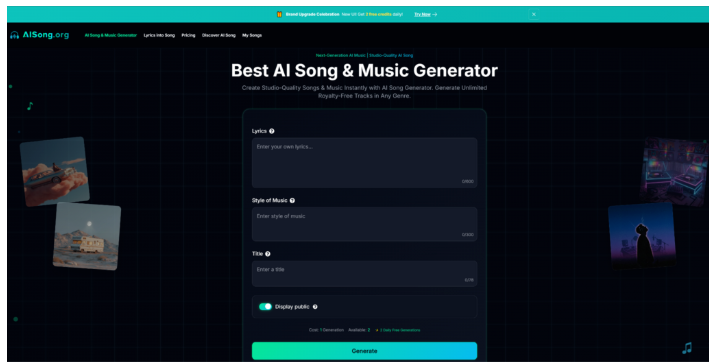
  1. Input Your Lyrics: Paste your lyrics into the platform.

  2. Choose Your Style: Select your desired genre, mood, or instruments.

  3. Generate Your Song: Watch as AISong creates a melody, harmony, and arrangement that perfectly matches your lyrics.

  4. Refine and Customize: Fine-tune the tempo, key, or instrumentation to make the song truly yours.  

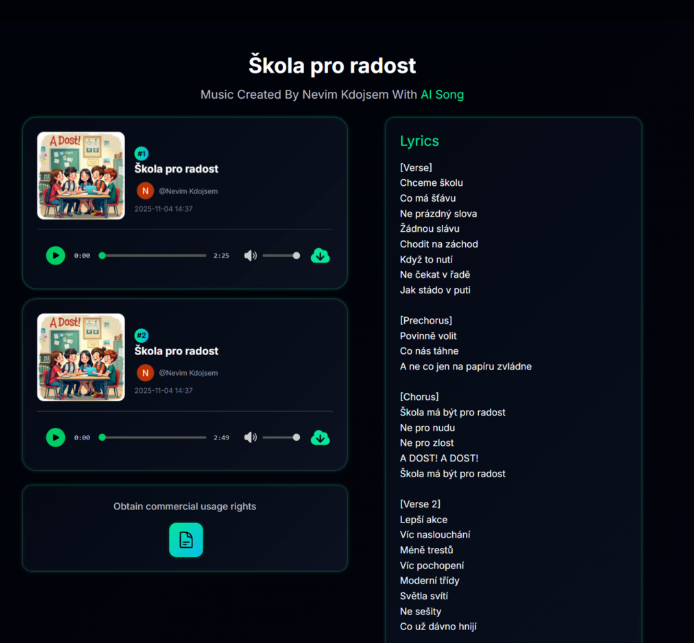
In minutes, your lyrics are transformed into a polished song, ready to share with the world. 

Why Choose AISong? 

AISong isn’t just another tool—it’s a revolution in music creation. Here’s how it stacks up against traditional methods of turning lyrics into songs: 

Feature

AISong

Traditional Songwriting

Ease of Use

No music knowledge required

Requires advanced skills in composition

Speed

Songs ready in minutes

Weeks or months of work

Cost

Free to start

Expensive tools, studios, and training

Creative Freedom

Supports multiple genres and moods

Limited by personal expertise

Accessibility

Available online anytime, anywhere

Requires specialized equipment or spaces

With AISong, you don’t need to be a trained musician or spend thousands of dollars on production. Everything you need to create a song is just a few clicks away. 

AISong

Who Can Benefit from AISong? 

AISong is perfect for anyone who wants to bring their lyrics to life, no matter their skill level or background. Here’s who can benefit the most: 

  • Lyricists: Turn your poetry or lyrics into professional songs without needing to compose music.

  • Content Creators: Add original music to your videos, podcasts, or social media posts.

  • Aspiring Musicians: Start creating songs even if you’ve never touched an instrument.

  • Educators and Students: Use AISong as a tool to learn about songwriting and music production. 

Real Success Stories 

AISong has already helped countless users turn their lyrics into stunning songs. Here are just a few examples:


  • Mark, a beginner lyricist: “I’ve always loved writing lyrics, but I had no idea how to turn them into songs. AISong made it so easy—I created my first song in under 10 minutes!”

  • Sarah, a content creator: “AISong has been a lifesaver for my YouTube channel. I can now create custom music for my videos without spending a fortune.”

  • James, a professional songwriter: “AISong has streamlined my process and given me new ways to experiment with my lyrics. It’s like having a co-writer who’s always available.” 

Transform Your Words into Music Today 

Imagine the possibilities: the lyrics you’ve written could become the next viral hit, a heartfelt ballad, or the perfect soundtrack for your content. With AISong, you have the power to bring your creative vision to life, no matter your musical background. 

Why Wait? Start Your Musical Journey Now 

Don’t let your lyrics sit idle on the page. With AISong, you can turn your words into fully produced songs and share them with the world. Whether you’re creating for personal enjoyment, professional projects, or social media, AISong makes it easy to unleash your creativity.

How to Win Position Zero in the Age of AI Overviews

How to Win Position Zero in the Age of AI Overviews

How to Win Position Zero in the Age of AI Overviews

By Joyce Isidro

For more than a decade, SEO professionals and content marketers have chased one goal: the number one spot on Google. 

That elusive number one search result signaled authority, trust, and most importantly, visibility. 

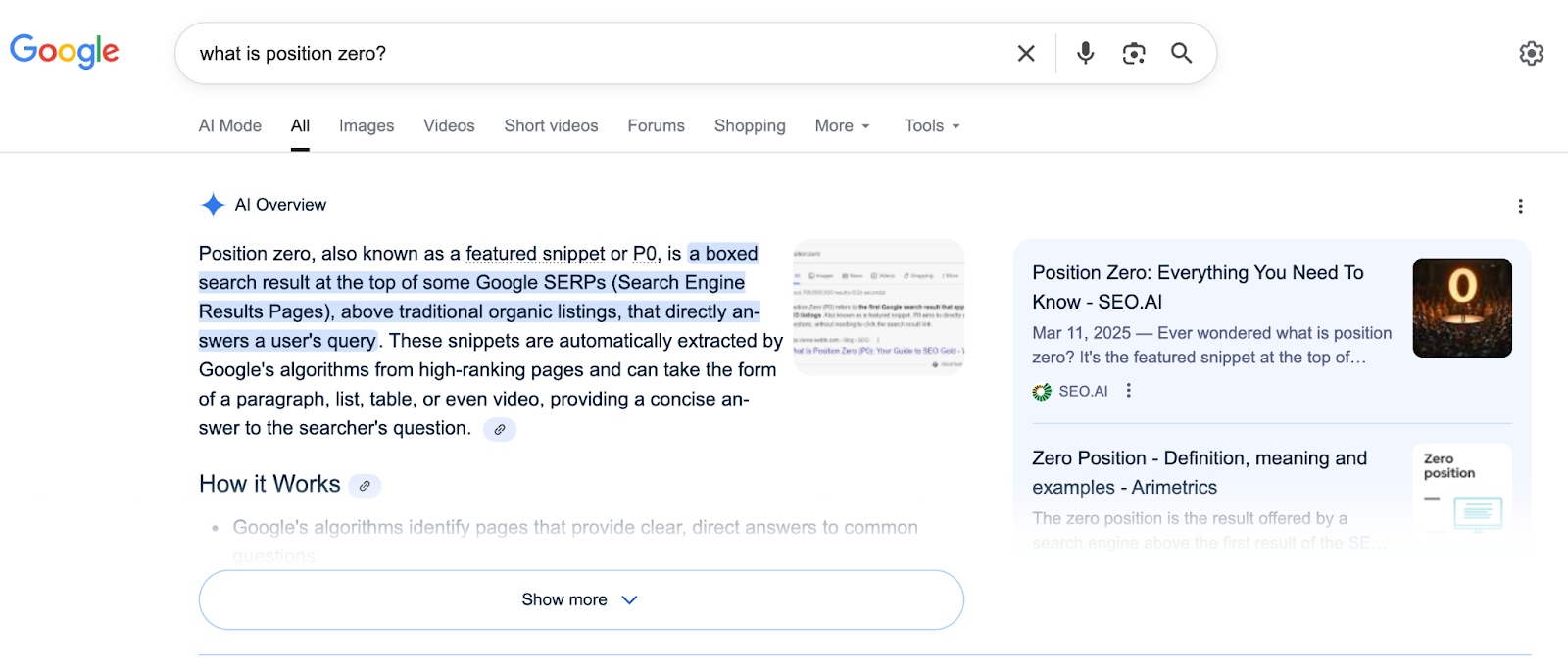
Then came something even more powerful: Position Zero.

Position Zero places your content above every other link, put in a distinct box that draws the user’s eye and often earns their valued click. 

In 2025, with the arrival of AI Overviews, the rules have changed once again. We’ve entered an era where the search engine has become an answer engine. 

So, how can brands, creators, and marketers adapt? 

How do you “rank” in an environment where Google—and increasingly, other AI-driven search platforms—write the answer for you? 

Here’s how to win Position Zero in the age of AI Overviews.

1. Understand the meaning and value of Position Zero

To understand how to win that highly coveted spot, we need to understand what Position Zero used to mean. 

When Google first introduced featured snippets, they were designed to provide quick answers pulled directly from websites for questions like “How to clean white sneakers” or “Why is the sky blue?” 

These snippets rewarded clarity, structure, and authority. The best-performing content gave concise answers in a paragraph, list, or table.

Then came voice assistants and mobile search, where snippets became the spoken responses of Alexa, Siri, and Google Assistant. 

That was the first major shift in how we consumed search results: we started reading less and listening more.

Now, with AI Overviews, Google doesn’t just pull one snippet from a single source; it creates a synthesized response based on multiple sources.

In other words, Google’s AI writes the answer for you. 

It might cite your site. It might not. It might quote your paragraph directly, or it might paraphrase it beyond recognition. 

This is the new Position Zero: where visibility is earned through semantic relevance, authority signals, and machine interpretability.

2. Learn how AI Overviews work

AI Overviews are part of Google’s broader move toward the Search Generative Experience (SGE)

Instead of showing a list of links, SGE presents a generated overview that summarizes key points from multiple sources. 

postion zero

What this means is these summaries don’t only rely on the number one search result. They come from other top-ranking content, structured data, and authority and trust indicators (such as Google’s E-E-A-T framework) among others.

And because AI Overviews draw information from several sources, your content might also constitute part of an answer even if you’re not the top result. 

To appear in an AI Overview, your content needs to be accurate and well-sourced. In other words, it needs to be of good quality.

Perhaps most importantly, in the age of AI overviews, your content needs to be formatted in a way AI can easily parse. 

This is precisely why it’s important to optimize not just for human readability, but for AI readability as well.

3. Optimize for AI readability, not just human readability

Search has evolved from keyword recognition to semantic understanding. Unlike typical search, AI Overviews don’t look for exact phrases; they look for relationships between ideas. 

This means your writing style matters more than ever, because AI doesn’t read nuance or fluff well, so you need to focus on creating content that is simple and structured so that it can easily quote you or summarize the information you provide.

If you’re a writer or marketer, the challenge here is making sure that your content is both human-friendly and machine-friendly. 

One way to optimize for AI readability is by using schema markup, as it gives AI clear signals about your content type.

Another way is through consistent formatting—giving your content clear subheadings, numbers, or defined sections make your content easier to parse. 

Also, defining important terms in your content improves machine comprehension. So when you include specific data, examples, or statistics, you’re giving AI information that it can easily read. 

Think of your content as teaching material for a machine. It needs to be structured clearly enough for a computer to understand and give it priority ranking, so that it can be easily found by the people looking for it.

4. Target questions, not just keywords

Keyword-based SEO is no longer enough. AI Overviews are built on natural language queries: full questions that reflect how people actually talk. 

In traditional SEO, we target keywords such as “best coffee machine.” But for AI overviews, those that get featured are results for full queries, like “what’s the best coffee machine?” 

This means that if you’re aiming for position zero, you need to optimize for questions, not just phrases or keywords, as is usually determined by traditional SEO . 

The good news is, if you’re an SEO or keyword researcher, the process for finding these queries is easy to learn if you already know how to conduct keyword research.

Now that we’re learning about AI Overviews, you already know that instead of looking for keywords, you need to look for questions. 

But the same concept applies: you still need to have a good understanding of search intent.

Once you know the questions, structure your content around them. The answers should be direct and factual (of course), with relevant supporting data and, if necessary, some expert opinion.

Let’s take an example.

If the question is: Can AI-generated content hurt SEO?

Your answer should immediately address the concern: Yes—if it’s low-quality or lacks originality 

As you can see, the answer above is very straightforward. Obviously, there should still be a detailed explanation for people reading your article, but to optimize for AI, this direct question-and-answer format works best.

And as SEO specialists and marketers, if you work in a specific niche, you also need to build authority over your field of expertise to get cited.

5. Build topical authority, not just individual posts

AI Overviews rely heavily on authority signals. The algorithm needs to trust that your content is part of a credible knowledge ecosystem, not a one-off post. 

This is why you need to build topical authority over your niche.

Topical authority is built when you consistently write in-depth content over your field of expertise. In technical terms, you don’t simply publish isolated articles. Instead, you build interconnected “topic clusters.” 

For instance, a brand focusing on AI marketing might have pillar pages about “AI in SEO” or “AI in video,” supported by subtopics such as AI ethics, AI tools, and AI content generation. 

Internal linking between these articles also reinforces the semantic connections that AI looks for.

Authority also depends on the human element — your author credentials, experience, and citations. 

This is why it’s important to include expert bios, list qualifications, and link to reliable sources (such as government databases or academic research) to solidify authority. 

Over time, this establishes trust in your brand. Consequently, when AI Overviews scan for reliable sources, they’ll recognize your site as a consistent, expert voice in your field.

6. Utilize structured data and semantic SEO

Structured data, also called schema markup, is the code that helps search engines understand the meaning of your content. 

This is your passport into AI Overviews. 

By adding schema markup, you’re allowing AI systems to interpret your page precisely. 

An FAQ schema can be particularly useful because of the question-and-answer nature of AI overviews. 

Other schema types, such as Product, Article, and BlogPosting, help AI distinguish between reviews, insights, and informational pages.

Semantic SEO complements this by focusing on the relationships between topics rather than isolated keywords. 

A comprehensive piece about “AI Overviews” should also explore related terms such as “Search Generative Experience,” “featured snippets,” “semantic search,” and “E-E-A-T.” 

Covering a topic holistically helps AI understand your site’s thematic expertise. The broader your coverage, the more likely you will get cited by Google’s AI.

7. Treat AI Overviews as discovery, not competition

When Google rolled out AI Overviews in the US in 2024, many website owners reported a significant loss in traffic, with their click-through rates dropping to as low as 89%. 

This makes it easy to view AI Overviews as competition, especially because they have already significantly reduced clicks by answering user queries directly. 

But this perspective misses the bigger opportunity. Instead of viewing it as the enemy, AI Overviews can actually serve as a new form of top-of-funnel discovery. 

How?

Well, when your brand or content is cited in these summaries, you gain massive visibility even if users don’t immediately visit your site.

In the short term, it does reduce clicks. But AI Overviews is the new position zero, which means that every mention of your brand in an AI Overview builds recognition and credibility. 

Over time, this exposure helps establish expertise in your niche. 

Think of AI Overviews as a form of “ambient branding” — you may not get the click, but being placed in an “everyday” setting helps establish your brand in the mind of users.

8. Create what AI can’t replace

In the age of AI, it’s scary to think that human creativity might be getting replaced. 

There are already useful tools like AI text-to-video, which can help businesses turn textual material into training videos, and AI translators, which can help you reach diverse audiences by translating your content at the speed of light.

But these tools are just that—tools. 

AI can’t replicate firsthand experience, human emotion, or nuanced judgment. It doesn’t produce genuine storytelling, contrarian insight, or proprietary data. Those are your differentiators.

If AI Overviews summarize existing knowledge, your job is to produce what can’t be summarized—original, experiential, and emotional content. 

To stand out, focus on original research, authentic opinions, and human perspective. A generic article titled “10 AI SEO Tactics” can be summarized by AI. 

But a piece like “How I Used AI Overviews to Double Organic Traffic in Three Months” cannot.

That’s unique, lived expertise. Including case studies, interviews, and visual content such as original charts or videos adds credibility that AI can’t fabricate. 

Maybe AI can create false, hallucinated content, but even if this type of content can get clicks, it won’t build customer loyalty and engagement. In the end, it’s still real, human stories that win them over.

Remember that getting Position Zero is important, but it’s not the end-all-be-all. It’s also just as important to be cited by human writers, and nothing makes you more authoritative than a fellow expert treating your content as a source worth citing.

9. Measure success beyond clicks

The traditional SEO metrics of impressions and click-through rates are becoming less reliable indicators of success. 

AI Overviews are designed to reduce friction for users, which means they also reduce clicks. 

That doesn’t mean SEO is dead; it just compels us to measure success beyond traditional metrics (like click-through rates).

So instead of getting tunnel-visioned solely on traffic, it might be better to track how often your brand or domain appears in AI Overviews or generative results. Visibility in “People Also Ask” or related sections also remains a signal of relevance. 

Most importantly, monitor growth in branded searches and returning visitors, because both of these show that brand awareness is getting converted into brand trust. Even if AI provides the first answer, your brand can still be the authority behind it.

10. Future-proof your SEO for the era of AI

AI Overviews might still be evolving, but the direction is clear: it’s here to stay.

To future-proof your SEO, start by investing in quality over quantity. Produce fewer but deeper and better-sourced pieces of content. 

Because thin or generic AI-generated content will not make it into Overviews. Content that considers machine readability, structured data, and human expertise will.

So focus on a strategy that strengthens your reputation signals, like mentions and backlinks from other authoritative sources.

Experimenting with emerging tools such as AI video can also be productive as AI is learning to summarize multimodal content, too. 

Regularly auditing your site’s presence within AI systems like SGE, Bing Copilot, and Perplexity can help you see how well you’re being represented. 

Finally, and perhaps most importantly, incorporate SEO with AI literacy: understand not only how algorithms rank content, but how language models interpret and synthesize your work.

Because writing for search engines today means writing for both humans and machines. 

11. The human advantage

As AI automates surface-level information, the human advantage becomes clearer because users don’t trust data alone; they trust people with something to say. 

Your voice, expertise, and perspective are what sets your content apart from every generative summary on the web.

The brands that thrive in the AI era will be those that combine algorithmic precision with human warmth. 

AI can surface useful content, but it’s notoriously bad at building trust all on its own. It can be useful for discoverability, but you still need to do the legwork to gain customer loyalty.

In this sense, AI isn’t replacing human writers and marketers; it’s boosting those who bring something valuable to the table.