UK: +44 2038074555 info@atamgo.com
Ecommerce SEO and GEO Optimization: Your 2026 Guide

Ecommerce SEO and GEO Optimization: Your 2026 Guide
GEO Optimization

If you’re running an ecommerce store in 2026 and only optimizing for Google, you’re already playing catch-up. Knowing how to optimize ecommerce product pages for AI search is now just as critical as ranking on page one – because a growing share of your potential customers are getting product recommendations from ChatGPT, Perplexity, and Google AI Overviews before they ever click a search result. This guide breaks down what ecommerce SEO and GEO (Generative Engine Optimization) mean together, why both matter for your revenue, and how to execute a dual-track strategy that wins visibility across every channel where shoppers are discovering products today.

Quick Summary

  • AI answer engines are intercepting product discovery before users ever reach a search results page
  • A dual-track strategy combining traditional SEO and GEO is now required for full ecommerce search visibility
  • Structured data, entity optimization, and answer-ready content are the three GEO pillars every ecommerce brand needs
  • Addlly AI’s AI agents automate SEO and GEO content production at scale – no prompt engineering required

What Is Ecommerce SEO and GEO Optimization?

Ecommerce SEO is the practice of optimizing product and category pages to rank in traditional search engines like Google. GEO – Generative Engine Optimization – is the practice of structuring your content so AI answer engines like ChatGPT, Perplexity, and Google AI Overviews cite your brand when generating product recommendations. In 2026, these are not competing disciplines. They are complementary, and ecommerce brands need both.


Here’s how the two approaches compare across the metrics that matter most:

Dimension

Traditional SEO

GEO (Generative Engine Optimization)

Best For

Primary Platform

Google, Bing

ChatGPT, Perplexity, Google AI Overviews

SEO for transactional clicks; GEO for consideration-stage discovery

Core Tactic

Keywords, backlinks, on-page optimization

Entity coverage, structured data, answer-ready content

Both required for full ecommerce search visibility

Content Format

Ranked pages, product descriptions, category copy

Conversational answers, cited sources, structured FAQs

GEO for upper-funnel; SEO for lower-funnel conversion

Key Metric

Organic rankings and click-through rate

Share of Voice in AI-generated answers

Track both to measure full organic channel performance

Why Ecommerce Brands Can’t Ignore AI Search

Google AI Overviews now appear for a significant and growing proportion of commercial queries – including product categories, comparisons, and buying guides – and they’re intercepting clicks before users ever reach your organic rankings. For ecommerce brands, that’s not an SEO problem. It’s a revenue problem.

Understanding how to optimize ecommerce product pages for AI search has moved from an experimental tactic to a core growth discipline. Shoppers aren’t just Googling anymore – they’re asking AI assistants which running shoe is best for flat feet, which protein powder has the cleanest label, or which air fryer fits a family of four. If your brand isn’t being cited in those answers, you’re missing the moment purchase intent is formed.

  • Google AI Overviews are appearing for a growing proportion of product category and comparison queries, intercepting clicks before users reach organic results
  • Shoppers are using ChatGPT and Perplexity to ask for product recommendations and buying guides, forming purchase intent inside AI answer engines
  • Ecommerce brands not cited in AI-generated answers are losing upper-funnel brand exposure even if they maintain strong Google rankings

Pro Tip: Search your top product category on Perplexity or ChatGPT right now. If your brand isn’t cited in the answer, you have a GEO visibility gap that traditional SEO cannot fix alone.


How to Optimize Product Pages for SEO and GEO

Winning ecommerce visibility in 2026 requires the same product page to serve both Google’s ranking algorithm and AI answer engine citation logic at the same time. That’s not as complicated as it sounds – the tactics that make content more useful for humans also make it more citable by AI systems. Here’s a practical four-step framework your team can start executing now.

Quick Stat: Ecommerce brands that implement structured data, entity optimization, and answer-ready content see measurably higher citation rates in AI-generated product recommendations compared to those relying on traditional SEO alone. (Search Engine Journal, 2025-2026)

4 Tactics That Work for Both SEO and GEO

  1. Add Schema Markup to Every Product Page. Implement Product, Review, and BreadcrumbList schema so AI systems can extract accurate product names, prices, ratings, and availability when generating answers. Use Google’s Rich Results Test to validate your schema before publishing.
  2. Build Entity Coverage Around Your Products. Structure content around named entities: brand name, product attributes, category terms, and use cases. AI answer engines rely on entity graphs to decide which brands to cite. Include your brand name, product category, and key differentiators in every product description – not just the page title.
  3. Write Answer-Ready Product Descriptions. Format descriptions to directly answer common shopper questions: What is it? Who is it for? Why is it better? AI engines prioritize content that mirrors how consumers ask questions. Add a short FAQ block to high-priority product and category pages targeting comparison and consideration queries.
  4. Audit for Thin Content Across Your Catalog. Google’s Helpful Content Updates have penalized templated, thin product content. Identify your lowest-performing pages and prioritize rewrites that add depth, brand differentiation, and structured formatting. Focus first on your top 20% of revenue-driving product and category pages before scaling to the full catalog.


How Addlly AI Automates Ecommerce SEO and GEO

Addlly AI is built specifically for ecommerce brands that need the best AI tools for ecommerce SEO content creation – not a generic writer, but a brand-trained agent that knows your products, your voice, and your strategy before it writes a single word. That distinction matters because generic AI tools produce averaged output that requires heavy editing, which eliminates the speed advantage entirely. Addlly’s agents are custom-trained on your brand’s existing content, product catalog, and messaging guidelines, so outputs are publication-ready with minimal review cycles.

The platform handles the full content lifecycle – audits, content creation, and distribution – in a zero-prompt, zero-code workflow any marketing team member can operate. For ecommerce teams, three agents do the heavy lifting:

  • SEO Agent: Runs automated audits across product and category pages, identifies underperforming content, and delivers a prioritized fix list with specific recommendations
  • GEO Agent: Analyzes your brand’s Share of Voice in AI-generated answers, maps entity coverage gaps, and generates structured, citation-ready content updates
  • Shopify Agent: Optimizes product descriptions, category copy, and blog content directly within your Shopify storefront workflow without disrupting existing processes
  • Brand-Trained Output: Every agent is custom-trained on your brand’s voice, product catalog, and messaging strategy – so content is publication-ready with minimal review cycles

The measurable impact: up to 90% faster execution and approximately 50% cost savings compared to traditional agency models. Addlly AI is backed by Microsoft, AWS, and NVIDIA, and built for enterprise teams that can’t afford brand risk or slow turnarounds.

Key Takeaways

Ecommerce search visibility in 2026 requires both traditional SEO for Google rankings and GEO for AI answer engine citations. Structured data, entity coverage, and answer-ready content are the three tactics that improve performance across both channels simultaneously – and they reinforce each other rather than competing for resources. Waiting on GEO is no longer a viable option: AI search behavior is mainstream, and citation authority takes time to build.

See a GEO audit on your own domain – book a 20-minute workflow mapping session with the Addlly AI team today and find out exactly where your brand stands in AI-generated answers for your top product categories. 

Frequently Asked Questions

What is the difference between SEO and GEO for ecommerce?

SEO targets traditional Google rankings through keywords, backlinks, and on-page optimization. GEO targets AI answer engines like ChatGPT and Perplexity through entity coverage, structured data, and answer-ready content formats. Ecommerce brands need both in 2026.

Is Addlly AI a good fit for Shopify ecommerce stores?

Yes. Addlly AI includes a dedicated Shopify Agent that optimizes product descriptions, category copy, and blog content directly within your Shopify workflow. It is brand-trained on your catalog and voice, so output is publication-ready without heavy editing cycles.

Why is GEO important for ecommerce brands?

More shoppers are using AI assistants to research products before making a purchase. A strong GEO strategy helps your products and brand appear in AI-generated recommendations, increasing visibility, trust, and potential sales across AI search platforms.

How can ecommerce brands measure GEO performance?

Track metrics such as AI brand mentions, product recommendation frequency, citation sources, share of voice, sentiment, and visibility across platforms like ChatGPT, Gemini, Google AI Overviews, Perplexity, Claude, and Microsoft Copilot.

How often should an ecommerce website update its GEO strategy?

Review and update your GEO strategy at least once every quarter. Regular audits help ensure your product information, structured data, and content stay aligned with evolving AI search algorithms and changing customer search behavior.

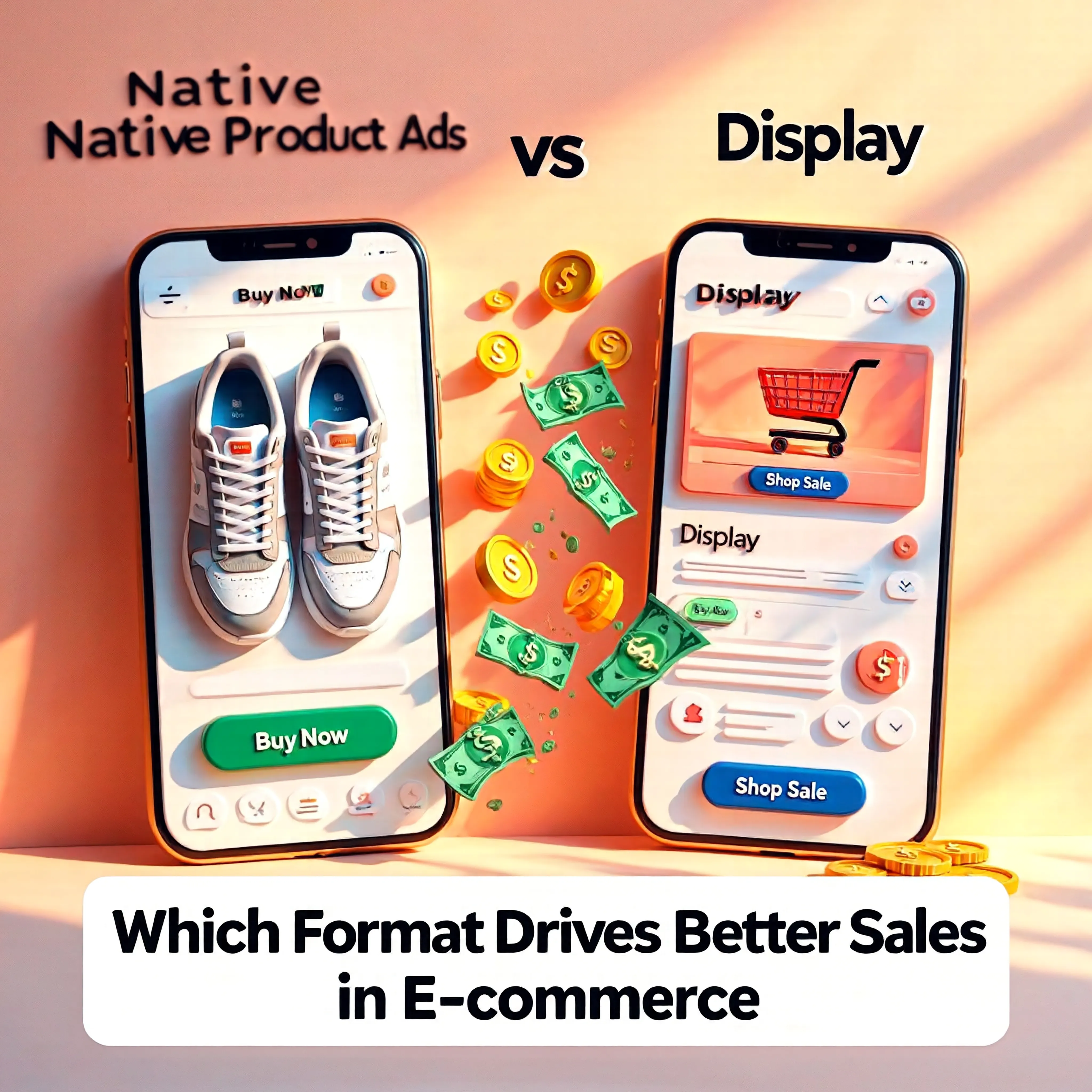
Native Product Ads vs Display Ads for Ecommerce

Native Product Ads vs Display Ads for Ecommerce

Native Product Ads vs Display

E-commerce advertisers have more format options than ever — and fewer excuses for picking the wrong one. Yet the debate between native product ads and display advertising keeps resurfacing, usually after a campaign underdelivers and someone has to explain why.

The honest answer is that neither format is universally better. They operate on different principles, reach users in different mental states, and produce different outcomes depending on what you’re selling, who you’re selling it to, and where in the purchase journey you’re trying to intervene. Understanding those differences in an e-commerce context is what this article is about.

How Each Format Reaches a Shopper

Display advertising in e-commerce is the familiar rectangle — banners, skyscrapers, medium rectangles — placed in designated ad slots on websites, apps, and platforms. The user is doing something else entirely when the ad appears. Display works by interrupting that activity with a visual message and hoping the message is relevant enough to earn a click.

The format has a structural limitation: users have spent decades learning to ignore things that look like ads. Banner blindness is a documented perceptual phenomenon, not a metaphor. Eye-tracking studies consistently show users routing around standard display placements without consciously deciding to do so. Display advertising still delivers value — particularly for retargeting and brand recall — but it’s fighting against deeply conditioned avoidance behavior.

Native product ads sidestep that problem by design. Instead of occupying a designated ad slot, a native unit appears inside the content stream — as a recommended product, a related article, or a sponsored content card that matches the visual style of its surrounding environment. Users encounter it as part of their browsing experience rather than as an interruption to it. The ad earns its place in the user’s visual field by looking like it belongs there.

That difference in how each format reaches the user shapes everything downstream: click rates, landing page behavior, conversion intent, and ultimately sales.

The Click Quality Problem in E-commerce

E-commerce advertisers are particularly sensitive to click quality because the economics are tight. A high-volume, low-quality click stream produces traffic that bounces fast, inflates session counts without adding value, and distorts attribution data. The channel looks active in the dashboard while the revenue stays flat.

Display clicks in e-commerce have a well-known quality problem. Average click-through rates hover around 0.1% industry-wide, which means the vast majority of impressions generate no engagement at all. Of the clicks that do come through, a significant share are accidental — fat-finger taps on mobile, misclicks on desktop, or clicks generated by fraudulent inventory. The result is a traffic mix where genuine purchase intent is diluted by noise.

Native clicks behave differently. A user who clicks a native product ad has made a deliberate choice to engage with something that appeared in their content environment. The click required more active intent than brushing past a banner. That intent difference shows up in post-click behavior: longer time on site, lower bounce rates, and higher conversion rates relative to display traffic from comparable inventory.

This doesn’t mean native traffic always converts at higher absolute rates — cost, targeting, creative quality, and landing page all intervene. But the underlying click quality, controlling for other variables, tends to favor native in e-commerce contexts where the purchase decision involves any degree of consideration.

Where Display Still Wins in E-commerce

Display advertising has specific use cases in e-commerce where it genuinely outperforms native, and it’s worth being honest about them.

Retargeting is display’s strongest argument. A user who visited your product page, added to cart, and left without purchasing is a warm audience. They know your brand, they’ve shown purchase intent, and they just need a nudge. A retargeting banner showing the exact product they viewed — or a discount on it — can be highly effective because it requires no education, no persuasion, and no content frame. The user is ready; the display ad just has to remind them.

Brand recall across high-reach inventory. If the goal is keeping your brand visible to a broad audience over time — not driving immediate clicks but staying top of mind — display CPMs are typically lower than native, and the format scales to enormous reach. For seasonal e-commerce advertisers building awareness ahead of a campaign period, display can efficiently saturate a target audience with brand impressions at a cost that native can’t match.

Impulse purchase categories. For products that sell on impulse — low consideration, low price point, visually driven — a high-quality display creative with a strong offer can perform competitively. The decision doesn’t require research; it requires a moment of desire and an easy path to purchase. A well-placed banner can create that moment efficiently.

Where Native Product Ads Win in E-commerce

Native advertising’s advantage in e-commerce is concentrated in situations where the purchase requires some degree of consideration before it happens.

Higher ticket products. A user buying a $300 piece of kitchen equipment, a $500 mattress, or a $150 skincare set doesn’t convert from a banner. They research, compare, read reviews, and return multiple times before purchasing. Native advertising fits into that research journey naturally. A sponsored article explaining what to look for in a mattress, or a comparison of kitchen equipment options that happens to feature your brand, earns trust before asking for the sale. That trust is what converts considered purchases.

New or unfamiliar products. If your product category isn’t yet established in the buyer’s mind — a new supplement category, an innovative home product, a niche fashion brand — you need to explain what it is and why it matters before you can sell it. Native advertising gives you the content space to make that case. Display doesn’t.

New customer acquisition. Retargeting warm audiences is display’s territory. Acquiring customers who have never heard of your brand is native’s. A new visitor who encounters your brand through a content-native ad unit — particularly if it leads to useful, informative content about a problem your product solves — is far more likely to engage meaningfully than one who sees a banner for a brand they don’t recognize.

Categories with high research behavior. Health and wellness, electronics, home improvement, outdoor gear, financial products embedded in e-commerce contexts — these are all categories where users habitually research before buying. Native ads integrate into that research process rather than interrupting it, which is why conversion rates from native campaigns in research-heavy categories consistently outperform display.

The Creative Equation Is Different for Each Format

Advertisers who switch from display to native without adjusting their creative approach usually underperform and conclude that native doesn’t work. The creative requirements are genuinely different.

Display creative succeeds through visual impact. A strong image, a clear offer, a contrasting CTA button. The message needs to land in a fraction of a second because that’s all the attention a banner gets. The visual does the work; the copy is minimal and functional.

Native creative succeeds through editorial relevance. The headline is the most important element — it needs to feel like content the user would have clicked on regardless of whether it was sponsored. Images should look contextual and real rather than commercial and polished. The frame is “here’s something interesting” rather than “here’s something to buy.”

For e-commerce specifically, native headlines that lead with the product problem or the category insight consistently outperform headlines that lead with the product or the offer. “Why most running shoes cause knee pain after 30 miles” will outperform “Shop our new running shoe collection” in a native context, even if both eventually lead to the same product page.

The Funnel Position Question

One practical way to decide between formats for any given e-commerce campaign is to ask where in the purchase funnel you’re trying to intervene.

Top of funnel — awareness and discovery — is where native product ads do their most distinctive work. Users who don’t know your brand or your product category can be introduced to both through content-native placements that feel like editorial rather than advertising. This is expensive to accomplish with display because you’re fighting attention competition from every other element on the page.

Mid funnel — consideration and comparison — is shared territory. Native advertorials and product comparison content work well here. Retargeting display also becomes relevant as you reach users who have already had one touchpoint with your brand.

Bottom of funnel — purchase intent, cart abandonment, repeat buyers — is where display retargeting is most efficient. The user knows what they want; the creative just needs to remind them and remove the last friction point.

The e-commerce advertisers who consistently drive the best results don’t choose between native and display. They use native to build the audience that display then converts — treating the formats as complementary stages in a single customer journey rather than competing options for the same budget.

Final Thoughts

The format debate in e-commerce advertising is ultimately a funnel question disguised as a channel question. Display wins at retargeting, brand reach, and impulse categories. Native wins at new customer acquisition, considered purchases, and categories where education precedes the sale.

If your e-commerce revenue is stalling on display campaigns, it’s rarely because display is the wrong channel. It’s usually because you’re using display to do a job it wasn’t designed for — acquiring customers who haven’t yet decided they need what you’re selling. That’s the job native product advertising was built for. Use each format where its mechanics actually match your objective, and the sales numbers will tell you you made the right call.

GTaro helps e-commerce advertisers run native campaigns that reach new customers at the top of the funnel — with AI-optimized placements, precise geo and device targeting, and access to publisher inventory across 230+ markets. If you’re looking to add native to your acquisition mix, gtaroads.com is a practical starting point.

Cross-Border Payments: Payment Gateway Guide

Cross-Border Payments: Payment Gateway Guide

cross border payments

The global cross-border payments market is projected to grow from $397.37 billion in 2026 to $727.74 billion by 2034. This explosive growth reflects how global commerce has evolved into a seamless, always-on network where businesses are no longer confined by geography.

Customers today expect cross border payments to be as simple and seamless as domestic transactions, allowing them to shop from international brands with minimal friction at checkout. For organisations, this shift presents both an opportunity and a challenge: how to deliver consistent, secure and efficient payment experiences across borders?

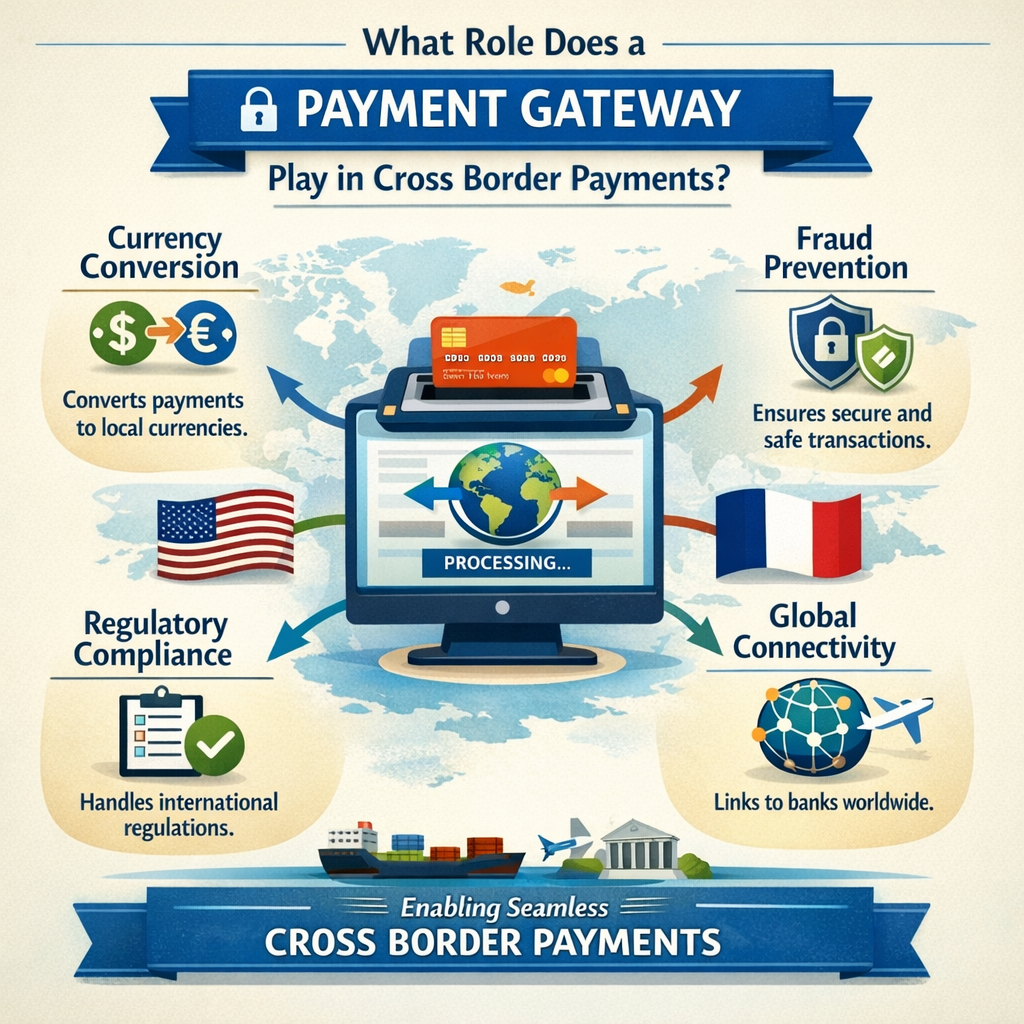
At the heart of enabling smooth cross border payments is the payment gateway. Acting as a digital bridge between merchants, customers and financial institutions, it ensures transactions are processed, authorised and settled efficiently across borders.

Let’s explore how a payment gateway simplifies and strengthens cross border payments.

Key capabilities enabling efficient cross border payments

From transaction processing and security to insights and scalability, a payment gateway integrates essential functions that ensure cross border payments are seamless and optimised for growth.

1. Enabling seamless transaction processing across borders

A payment gateway simplifies the complexity of cross border payments by managing the entire transaction flow in real time. When a customer makes a purchase, the gateway securely captures payment details, routes them through the appropriate financial networks and facilitates authorisation.

This streamlined process eliminates delays and reduces the likelihood of failed transactions. For businesses, it means fewer disruptions at checkout and a smoother path to revenue realisation, regardless of the customer’s location.

  1. Supporting multiple payment methods

One of the defining aspects of successful cross border payments is the ability to cater to diverse payment preferences. Customers in different regions rely on different payment instruments, ranging from international cards to digital wallets.

A strong payment gateway enables businesses to accept a wide range of payment methods through a single integration. This flexibility ensures that customers can pay using their preferred option, enhancing convenience and improving conversion rates across global markets.

2. Real-time authorisation and faster settlements

Speed is critical in global transactions. A payment gateway facilitates real-time authorisation, ensuring that payments are approved or declined instantly. This immediacy improves the customer experience and provides businesses with clarity and confidence in every transaction.

In addition, efficient settlement processes help businesses access their funds faster. By reducing the time between transaction and settlement, the gateway supports better cash flow management, an essential factor in scaling international operations.

3. Enhancing security and compliance

Security is a cornerstone of cross border payments, where transactions often involve multiple jurisdictions and regulatory frameworks. A payment gateway incorporates advanced security protocols, including encryption and secure authentication mechanisms, to protect sensitive customer data.

Beyond security, it also helps businesses explore compliance requirements by ensuring that transactions adhere to industry standards and regulations. This dual focus on protection and compliance builds trust with customers while safeguarding business operations.

4. Improving transaction success rates

Failed transactions can significantly impact revenue, especially in international markets where multiple variables come into play. A payment gateway optimises routing and processing to improve transaction success rates.

By intelligently handling payment flows and reducing friction points, it increases the likelihood of successful authorisation. This optimisation directly contributes to higher conversions and a more reliable checkout experience for global customers.

5. Delivering unified payment experiences

Consistency is key when operating across multiple regions. Customers expect the same level of ease and reliability regardless of where they transact.

A payment gateway enables businesses to deliver a unified payment experience by standardising processes across markets. From checkout to confirmation, every interaction is designed to be intuitive and consistent, reinforcing brand credibility and customer confidence.

  1. Providing actionable insights and reporting

Beyond transaction processing, a payment gateway serves as a valuable source of data. It captures detailed information on payment behaviour, transaction volumes and performance metrics across regions.

These insights allow businesses to identify trends, optimise strategies and make informed decisions. Whether it’s refining pricing models or understanding regional preferences, access to reliable data enhances strategic planning for cross border payments.

6. Simplifying integration and scalability

Expanding into international markets often requires significant technological investment. A payment gateway reduces this complexity by offering a streamlined integration process that connects businesses to global payment networks.

As operations grow, the same infrastructure can scale to handle increased transaction volumes and additional markets. This scalability ensures that businesses can expand confidently without the need for constant system overhauls.

Powering global growth through smarter payments

Cross border payments are a fundamental driver of global growth. A payment gateway plays a central role in making these transactions seamless, secure and efficient, bridging the gap between businesses and customers across geographies.

From enabling real-time processing and supporting diverse payment methods to improving security and delivering actionable insights, it transforms the way businesses approach international commerce.

For organisations aiming to scale globally, investing in the right payment infrastructure is essential. Payment gateway providers like Pine Labs bring these capabilities together, enabling businesses to manage cross border payments with confidence while delivering a premium payment experience.

As global commerce continues to expand, the ability to execute cross border payments efficiently will define long-term competitiveness and growth.

How to Choose the Right Full-Service Amazon Agency for Your Brand

How to Choose the Right Full-Service Amazon Agency for Your Brand

Amazon Agency

Whether you’re launching your first product or scaling an established catalog, one decision can define your Amazon trajectory: whether to manage everything in-house or partner with a full-service Amazon agency.

In this guide, we break down what to look for, what to avoid, and why the right agency partner can be the fastest path to sustainable growth on the world’s largest marketplace.


What Is a Full-Service Amazon Agency?

A full-service Amazon agency manages every dimension of your Amazon presence under one roof. That means advertising (Sponsored Products, Sponsored Brands, DSP), listing optimization, A+ Content, brand protection, account health monitoring, inventory planning, and data analytics — all coordinated as a single system rather than disconnected services.

The contrast with a specialist agency is significant. A PPC-only agency might optimize your campaigns without ever touching the listings those ads land on. A content-only agency might polish your A+ Content without knowing your conversion rates by traffic source. When these functions are siloed, opportunities fall through the cracks and problems take longer to diagnose.

A true full-service partner eliminates the silos entirely.


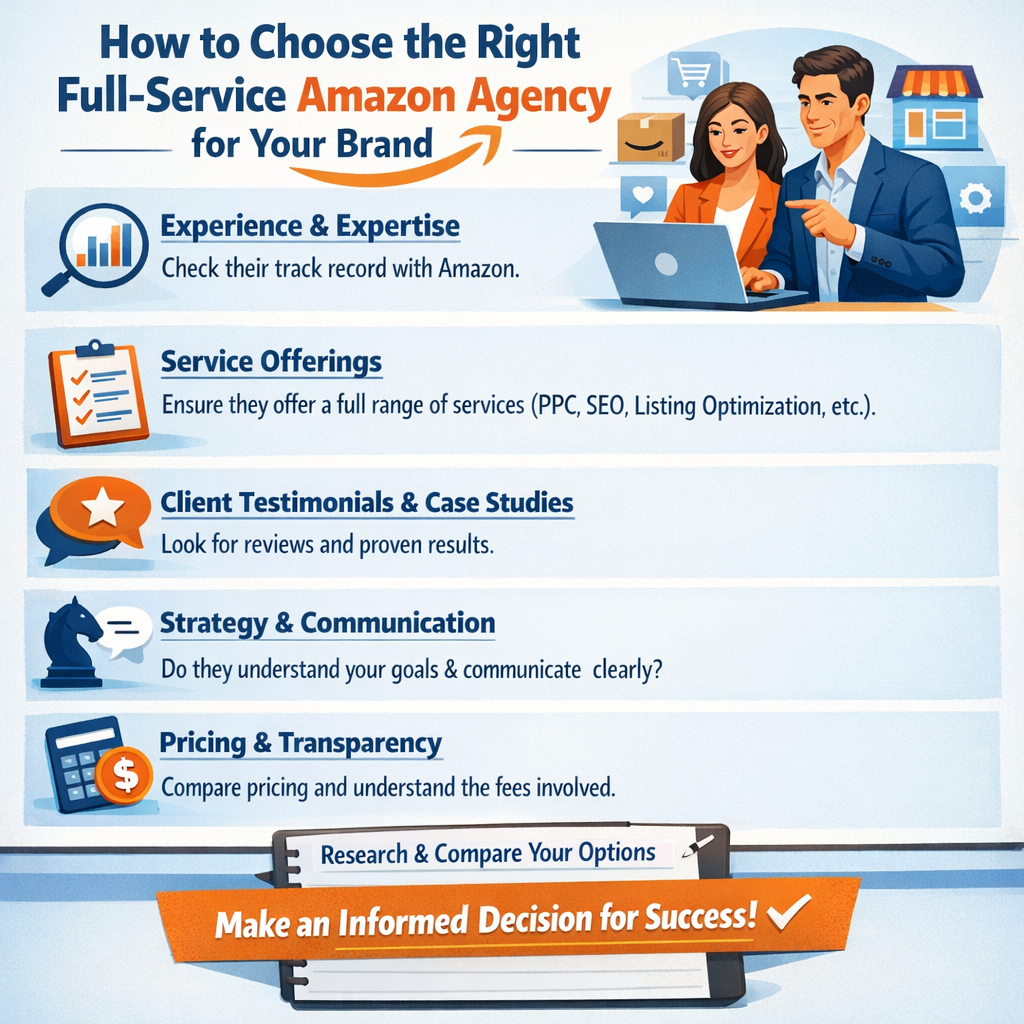
5 Things to Look for in a Full-Service Amazon Agency

1. Integrated Advertising and Listing Management

Your listing conversion rate directly determines how far your ad budget stretches. An agency that manages both advertising and listing optimization together can run a continuous feedback loop: ad performance data informs listing copy tests, and listing improvements feed back into bidding strategy.

Ask any prospective agency how their PPC team and content team collaborate. If the answer is “they send each other reports,” you’re looking at a siloed operation.

2. Amazon Marketing Cloud (AMC) Capabilities

AMC is one of the most powerful data tools available to Amazon sellers in 2025, and most brands are not using it. It allows agencies to build custom audience segments from first-party data, measure the full customer journey across multiple ad touchpoints, and apply those insights to sharpen campaign targeting.

A full-service Amazon agency with genuine AMC capabilities can help you understand not just which ads converted, but which combination of ad exposures led to a purchase weeks or months later — and optimize accordingly.

3. Brand Protection Workflows

For any brand that has invested in building a reputation, unauthorized sellers, listing hijackers, and counterfeit products are recurring risks. A strong full-service agency monitors the Buy Box continuously, documents violations, and has a clear process for resolving them through Amazon’s enforcement channels.

Brand protection is often described as “reactive” — you deal with problems when they arise. The best agencies make it proactive, catching threats before they damage revenue or reviews.

4. Transparent, Actionable Reporting

Monthly reports that summarize last month’s ACOS without context or recommendations are not useful. They’re noise.

The reporting you should expect from a full-service Amazon agency includes competitive benchmarking, profitability analysis that accounts for FBA fees and return rates, and a clear set of recommended actions with reasoning. If an agency cannot explain what the data means for your business and what they plan to do about it, the data is not working for you.

5. Scalability and International Reach

If your brand has any ambition to grow beyond a single marketplace, your agency should have demonstrated experience in international Amazon expansion. Expanding to Amazon UK, Germany, Canada, or Japan involves far more than translating listings — it requires localized keyword research, market-specific advertising strategies, compliance knowledge, and currency/VAT considerations.


Common Mistakes Brands Make When Hiring an Amazon Agency

Hiring on price alone. The cheapest agency is rarely the best value. A low-cost partner that underperforms wastes not just the management fee, but the ad spend, the product inventory, and the market opportunity — all of which are far more expensive than the agency itself.

Focusing only on ACOS. Advertising Cost of Sale is one metric among many. An agency that optimizes purely for low ACOS might be pulling back on campaigns that would drive profitable incremental sales if evaluated on a full-funnel or lifetime-value basis. Ask prospective agencies how they define success beyond ACOS.

Not asking about onboarding. The first 90 days with a new agency are critical. Ask specifically what the onboarding process looks like, what data and access they need, what the first milestone is, and what you should expect to see in the first monthly report. Vague answers here often predict vague execution.

Treating the agency as a vendor, not a partner. The brands that get the most from a full-service Amazon agency are the ones that share context freely — product launches, inventory constraints, margin changes, competitive shifts — and treat the agency’s account team as an extension of their own team. Information asymmetry is one of the biggest hidden causes of underperformance.


What Full Service Actually Looks Like in Practice

Here is a real-world example of how a full-service operation differs from a fragmented one.

A brand selling in a competitive health and wellness category notices their conversion rate dropping over three months despite stable ad traffic. In a fragmented setup, the PPC agency reports stable impression share and clicks. The listing agency says the content looks fine. No one owns the problem.

In a full-service setup, the account team pulls conversion rate by traffic source, compares against category benchmarks, checks recent competitor listing changes, reviews the review velocity and rating trend, and identifies that a competitor launched a new main image strategy that is outperforming in split tests. The full-service agency recommends a creative refresh, runs a Manage Your Experiments A/B test on the main image, and within six weeks the conversion rate recovers.

That kind of integrated diagnosis only happens when one team owns the whole picture.


How to Evaluate Agencies Before Signing

Before committing to any agency, run through this checklist:

  • Ask for two or three case studies in your category with specific metrics (not just “we grew revenue by X%”)
  • Ask how their PPC, creative, and analytics teams collaborate week to week
  • Ask what tools they use for bid management, keyword research, and reporting
  • Ask what their brand protection workflow looks like and how often they report on it
  • Ask what a typical onboarding looks like and what milestones to expect in the first 90 days
  • Ask what happens when performance drops — who owns the diagnosis and what is the escalation path

Agencies that answer these questions with specifics have processes. Agencies that answer with generalities are selling a pitch.


Why This Decision Matters More in 2025

The Amazon marketplace in 2025 is more competitive, more data-driven, and more technically demanding than it has ever been. Brands relying on manual bid management and basic Seller Central reporting are competing at a structural disadvantage against brands working with agencies that use AI-powered automation, AMC audience targeting, and integrated full-funnel analytics.

The gap between brands with sophisticated agency support and brands without it is widening — not narrowing.

If your current approach to Amazon is not producing the results your product quality deserves, the right full-service Amazon agency can change that trajectory significantly.


Final Thoughts

Choosing a full service Amazon agency is one of the highest-leverage decisions a product brand can make. The right partner brings integrated expertise, advanced tooling, and a genuine investment in your brand’s long-term performance on the platform.

The wrong one costs you time, money, and market position that is increasingly difficult to recover.

Go in with the right questions, evaluate on specifics not promises, and look for a partner whose service model reflects how Amazon actually works in 2025 – not how it worked three years ago.


*Looking for an agency with all of the above? Enso Brands manages over $250M in Amazon sales across 200+ brands, with full-service capabilities across advertising, listing optimization, creative, brand protection, and analytics. Learn more at ensobrands.com.

10 Brutal Ecommerce SEO Audit Mistakes Killing Your Sales (And How to Fix Them)

10 Brutal Ecommerce SEO Audit Mistakes Killing Your Sales (And How to Fix Them)

E-commerce SEO Audit is one of those things everyone knows they should do, but very few actually do properly — or consistently. Most store owners only think about an e-commerce SEO audit when traffic suddenly drops, sales slow down for no obvious reason, or paid ads start eating their entire profit margin. By that point, the store has usually been bleeding opportunities for months.

The uncomfortable truth is this: an e-commerce SEO audit isn’t about chasing rankings or pleasing Google. It’s about uncovering the silent, invisible problems that block qualified traffic, frustrate users, and quietly kill conversions without you noticing. These issues don’t always scream for attention — they just slowly drain revenue.

In this article, I’ll walk you through the most brutal mistakes I see during real ecommerce SEO audits, explain why they hurt your sales, and show you exactly how to fix them. This isn’t theory or recycled SEO advice. This is what consistently appears in real-world e-commerce SEO site audits across Shopify, WooCommerce, Magento, and custom platforms.

Find More: 7 Powerful Reasons You Need a Shopify SEO Expert

What Is an Ecommerce SEO Audit (And Why Most Stores Get It Wrong)

An e-commerce SEO audit is a full health check of your online store from both a search engine and a human perspective. It looks at technical SEO, site architecture, content quality, keyword targeting, internal linking, UX, performance, and tracking — all together, not as separate silos.

Where most stores go wrong is treating an e-commerce SEO audit like a one-time checklist. They run a tool, skim a report, fix a few obvious errors, and move on. SEO doesn’t work like that, especially in e-commerce, where sites constantly change.

The Real Goal of an E-commerce SEO Audit

The real goal isn’t “better SEO” or higher keyword ranking. It’s more qualified traffic that actually buys. A proper audit SEO ecommerce process should answer hard questions like: Why aren’t my category pages ranking even though products are selling well? Why do users land on product pages but leave without buying? Where exactly is Google getting confused about my site?

When done correctly, ecommerce SEO audits connect SEO decisions directly to revenue, rather than relying on vanity metrics.

E-commerce SEO Audit vs Regular SEO Audit

Regular SEO audits are usually blog-focused and content-heavy. E-commerce SEO audits are a completely different beast. They deal with thousands — sometimes tens of thousands — of URLs, filters, faceted navigation, pagination, product variants, duplicate content, and internal linking complexity.

What works for a blog often fails badly for e-commerce. That’s why generic SEO advice rarely moves the needle for online stores.

When You Should Perform an E-commerce SEO Audit

Ideally, e-commerce SEO audits should be done at least twice a year. You should immediately run one if you redesign your store, migrate platforms, change themes, add large numbers of products, or notice unexplained drops in traffic, rankings, or revenue.

Mistake #1 – Ignoring Technical SEO Issues That Block Crawling

ecommerce

This is where many e-commerce stores lose before the game even starts. If search engines can’t crawl, render, and understand your site properly, nothing else matters — not content, not links, not brand.

Crawl Budget Waste on E-commerce Sites

Large ecommerce sites often waste crawl budget on filtered URLs, internal search pages, session-based URLs, or endless parameter variations. During an e-commerce SEO audit, this usually shows up as thousands of low-value pages being indexed while important category or product pages are barely crawled.

Broken Links, Redirect Chains, and Indexing Errors

Broken internal links, long redirect chains, 404 product pages, and pages accidentally marked as noindex are extremely common findings in e-commerce SEO site audits. Each issue adds friction for users and sends confusing signals to search engines.

How to Fix Technical Issues in an E-commerce SEO Audit

Start with a proper crawl using tools like Screaming Frog or Sitebulb. Clean up redirects, fix broken links, block useless URLs, handle out-of-stock products correctly, and make sure your most valuable pages are indexable and accessible. Technical fixes often produce the fastest SEO wins.

Mistake #2 – Poor Site Architecture That Confuses Users and Search Engines

If your site structure doesn’t make sense to humans, it won’t make sense to Google either. Architecture problems are one of the most overlooked issues in audit SEO ecommerce projects.

Why Flat Architecture Matters for E-commerce SEO

A flatter site architecture helps authority flow naturally to important pages. If your best category pages are buried four or five clicks deep, they’ll struggle to rank, no matter how good the content is.

Category and Subcategory Structure Problems

Common e-commerce SEO audit issues include overlapping categories, unclear naming, duplicate category paths, and categories created for internal reasons rather than search intent.

Fixing Navigation Issues During an E-commerce SEO Audit

Your navigation should reflect how people actually search. Simplify categories, reduce unnecessary depth, and ensure your most profitable pages are reachable within a few clicks.

Mistake #3 – Targeting the Wrong Keywords (Or No Keywords at All)

Ranking for the wrong keywords is sometimes worse than not ranking at all. It brings traffic that never converts.

Informational vs Commercial vs Transactional Keywords

Many e-commerce stores mistakenly target informational keywords on category pages. A proper e-commerce SEO audit separates educational content from commercial and transactional intent.

Common E-commerce Keyword Mapping Mistakes

Multiple pages targeting the same keyword, or one page trying to rank for too many keywords, is a classic problem uncovered in e-commerce SEO audits.

How to Correct Keyword Strategy in an E-commerce SEO Audit

Assign one primary keyword per important page, supported by closely related terms. Category pages should target buyer intent, while blogs and guides handle informational queries.

Mistake #4 – Thin or Duplicate Product and Category Content

ecommerce

Google doesn’t reward copy-paste stores, even if the products are great.

Why Duplicate Content Is an E-commerce SEO Killer

Using manufacturer descriptions across hundreds of products creates massive duplication. During e-commerce SEO audit services, this is one of the most damaging issues we see.

Manufacturer Descriptions and Copy-Paste Risks

If your product pages look the same as dozens of competitors, Google has no reason to favor yours.

How to Optimize Content During an E-commerce SEO Audit

Write unique category introductions, improve product descriptions, answer buyer objections, and focus on benefits and use cases — not just technical specs.

Mistake #5 – Neglecting On-Page SEO Fundamentals

On-page SEO is boring, repetitive, and easy to ignore — which is exactly why it works when done properly.

Title Tags and Meta Descriptions That Don’t Convert

Auto-generated titles, keyword stuffing, or missing metadata are common e-commerce SEO site audit findings. Even small improvements here can dramatically increase click-through rates.

Header Structure (H1–H3) Mistakes

Multiple H1s, missing H1s, or headers used purely for styling confuse search engines and users alike.

On-Page Fixes Identified in an E-Commerce SEO Audit

Each important page should have one clear H1, logical H2s, and metadata written for humans first — search engines second.

Mistake #6 – Slow Page Speed and Poor Core Web Vitals

Speed isn’t just technical — it’s emotional. Slow sites feel untrustworthy and frustrating.

How Page Speed Directly Impacts E-commerce Sales

Even a one-second delay can reduce conversions significantly. E-commerce SEO audits consistently show speed as a revenue problem, not just an SEO issue.

Common Speed Issues Found in E-commerce SEO Audits

Heavy themes, bloated apps, unoptimized images, poor hosting, and excessive scripts are usual culprits.

Practical Speed Optimization Fixes

Compress images, remove unused apps, simplify themes, and upgrade hosting when needed. Speed improvements compound over time.

Mistake #7 – Ignoring Mobile SEO and UX Signals

Most e-commerce traffic is mobile, yet many stores are still designed desktop-first.

Mobile-First Indexing Explained

Google evaluates your site based on its mobile version. If mobile UX is weak, rankings and sales will suffer.

UX Issues That Kill Mobile Conversions

Small buttons, intrusive popups, hard-to-use menus, and slow checkouts appear constantly in e-commerce SEO audits.

Mobile Improvements to Prioritize in an E-commerce SEO Audit

Focus on simplicity. Improve navigation, increase tap targets, reduce friction, and test on real devices.

Mistake #8 – Weak Internal Linking Strategy

Internal linking is one of the most underrated levers in e-commerce SEO.

How Internal Links Pass Authority in E-commerce Stores

Strategic internal links help distribute authority from strong pages to revenue-driving ones.

Orphan Pages and Overlinked Pages

E-commerce SEO site audits often reveal important pages with no internal links or pages overloaded with hundreds.

Internal Linking Fixes Found in an E-commerce SEO Audit

Add contextual links, connect related categories, and clean up unnecessary footer links.

Mistake #9 – Overlooking Structured Data and Rich Results

Schema markup is no longer optional for e-commerce.

Why Schema Markup Matters for E-commerce SEO

Product schema helps search engines understand pricing, availability, reviews, and variations — and helps your listings stand out.

Common Schema Errors and Missing Markups

Missing required fields, invalid markup, or outdated data are frequent ecommerce SEO audit findings.

How to Implement Structured Data Correctly

Use a validated schema, test regularly, and keep data accurate and up to date.

Mistake #10 – Not Tracking the Right SEO Metrics After the Audit

An e-commerce SEO audit without execution and tracking is just a document collecting dust.

Vanity Metrics vs Revenue-Driven Metrics

Rankings and impressions feel good. Revenue, profit, and conversion rate matter more.

Essential KPIs After an E-commerce SEO Audit

Track organic revenue, conversion rate, indexed pages, crawl efficiency, and category-level performance.

How to Turn Audit Insights Into Ongoing Growth

Create a prioritized roadmap, assign responsibilities, and review progress monthly.

How to Perform an E-Commerce SEO Audit Step by Step

Whether you DIY or hire ecommerce SEO audit services, the process itself matters.

Tools You Need for a Professional E-commerce SEO Audit

Crawlers, analytics platforms, Search Console, speed tools, keyword research tools, and log file analysis, where possible.

Audit Checklist for E-commerce Stores

Technical SEO, site architecture, keyword mapping, content quality, UX, speed, internal linking, structured data, and tracking.

DIY vs Professional E-commerce SEO Audit

DIY audits save money but cost time and missed opportunities. Professional e-commerce SEO audits save time and help avoid expensive mistakes.

Conclusion: Turn Your E-commerce SEO Audit Into More Sales

An e-commerce SEO audit isn’t about perfection. It’s about clarity and focus. When you fix the right problems in the right order, traffic grows, UX improves, and sales follow naturally. If your store feels stuck or plateaued, chances are the answers are already there — you just haven’t uncovered them yet.

Find More: Boost Your Sales With SEO Services

FAQs

1. How often should I run an e-commerce SEO audit?

At least twice a year, and after any major site changes like redesigns or migrations.

2. How long does an e-commerce SEO audit take?

It can take anywhere from a few days to several weeks, depending on site size and complexity.

3. Can I do an e-commerce SEO audit myself?

Yes, but expect a learning curve and the risk of missing high-impact issues.

4. What tools are best for an e-commerce SEO audit?

Crawling tools, analytics platforms, keyword research tools, speed testing tools, and Search Console.

5. How soon can I see results after an e-commerce SEO audit?

Technical fixes can show results within weeks, while content and structural improvements take longer but deliver lasting gains.

Tags:

How to Choose the Right Magento Development Agency in the UK in 2026

How to Choose the Right Magento Development Agency in the UK in 2026

Magento Development

The UK is experiencing a boom in its eCommerce sector and, with it, consumers are looking more for personalized, sustainable, and smooth shopping experiences. Venerable and the ever-more-powerful platforms, Magento, or now Adobe Commerce, has been raising the online commerce quotient. The stage is still very high above all in the world: with over 130,000 live sites and over 88,000 functioning on Magento 2 all over the world, mid-to-large-scale e-commerce has been truly dominated by it.

For UK merchants, selecting a Magento Development Agency UK is not just a matter of technical skills; instead, they are now encoding their thought to be beyond that-one that grasps AI-driven commerce, headless architecture, sustainability and compliance. This present chapter will introduce important factors that should be kept in mind while actually settling down for the right agency in 2026-keeping in mind some of the top Magento e-commerce trends that are taking the UK market by storm.

Why Selection of Appropriate Agency is Important

More than just a website, your Magento Store is the backbone of your digital business. The right agency means:

Scalability for future growth;

Safe keeping and complying with UK norms;

Integration with AI and other that are Omni-channel tools;

Doing sustainably, in keeping with consumer demands.

Selecting the wrong agencies will lead to hidden costs, low and weak backup, and will miss opportunities in the fast-moving UK market.

Let’s review some key 2026 parameters.

1. Certified Magento developers UK

Agencies holding Adobe Commerce certifications and with proven experience in UK sectors such as retail, fashion, and B2B are preferred. It’s not everyone who has such credentials which will ensure the sites are on global standards.

2. AI & Personalisation Capabilities

By 2026, AI is very much a necessary part of the game. Here is what agencies should be offering:

AI-driven product recommendations.

Dynamic pricing models.

Predictive analytics on customer behaviour.

These are now included in the top Magento e-commerce trends occurring in the UK.

3. Headless Commerce & Omnichannel Integration

UK customers are expecting smoother experiences between the web, mobile, social, and even IoT. The agencies must provide:

Progressive Web Apps (PWAs).

API-driven headless commerce solutions.

Omnichannel strategies that integrate online and offline retail.

4. Cyber Security and Compliance

With GDPR and the UK’s specific data protection laws in place, it is up to the agencies to provide:

Retina DN to prevent unauthorized access.

Tiered solutions and fraud detection.

PCI DSS compliance with secure transaction needs.

5. Sustainability & Eco-Friendly Development

Currently, citizens prefer any eco brands throughout the UK. Put down:

Green hosting solutions.

Energy-efficient coding solutions.

Full carbon-neutral development.

6. Transparent Price & Continuous Support for Long Term

Do not go to companies that sign off with low-grade projects; you will find out that nothing else is left. The trend through which top agencies of 2026 work is:

Service-level agreements(SLA) that should be pronounced and transparent.

24-7 Monitoring and updates automatically taking place.

A professional support team that you could communicate with based on the UK.

Major E-commerce Trends in Magento of the UK in 2026

What industry word says:

Artificial Intelligence-driven Commerce: Conversions are spun up with tools in this area.

Voice Commerce: UK speakers are likely to be purchasing for their shopping.

Sustainable Shopping: Surfing and shopping styles are dependent on energy efficiency nowadays.

More streamlined, supple store fronts are gradually becoming the norm.

Cross-Border Expansion: UK Retailers are Using Magento to Go Global and Enter the EU after Brexit.

Risks & Challenges

Agencies That Over-promise: Claiming to be ‘full-service’ but outsourcing critical tasks.

Hidden Costs: Uncertain pricing models will affect your budget.

Lack of UK Market Insight: Not many agencies understand the complexities of the VAT laws, consumer behavior, or retail trends in the UK.

Action Points for UK Businesses

Assess Certifications: Make sure it’s Adobe Commerce certified.

Examine Case Studies: Concentrate upon their UK-centred activities.

Request a Pilot Project: Experiment for full capability exposure prior to a full commitment.

Consider This Partnership for the Long Term: The ideal agency will keep things optimised down the line.

Prioritise UK Presence: Compliance and customer understanding from the local agencies.

Conclusion

Making the way in 2026, appreciating the best Magento Development Agency UK always involves more than just portfolio scanning; it’s about going in line with the trends of the future. Certified magento developers uk who are equally adept with AI, headless commerce, sustainability, and compliance will guarantee the success of your eCommerce brand.

As the top UK Magento E-commerce Trends start to take form, the agency should act as a strategic partner rather than just a service vendor. The right choice assures that your Magento store shall be serving UK customers according to the year 2026 and beyond.

Author Bio : – 

Pritesh is the Director of Sales at Magneto It Solutions UK Agency. He advises clients on their technology strategy, providing insights into digital transformation, product engineering, and AI & ML solutions. He has significant experience in the jewellery and luxury goods industry and enjoys advising clients on various B2C and B2B projects. He has over 15 years of experience performing a wide variety of roles, from consulting through to delivery.