
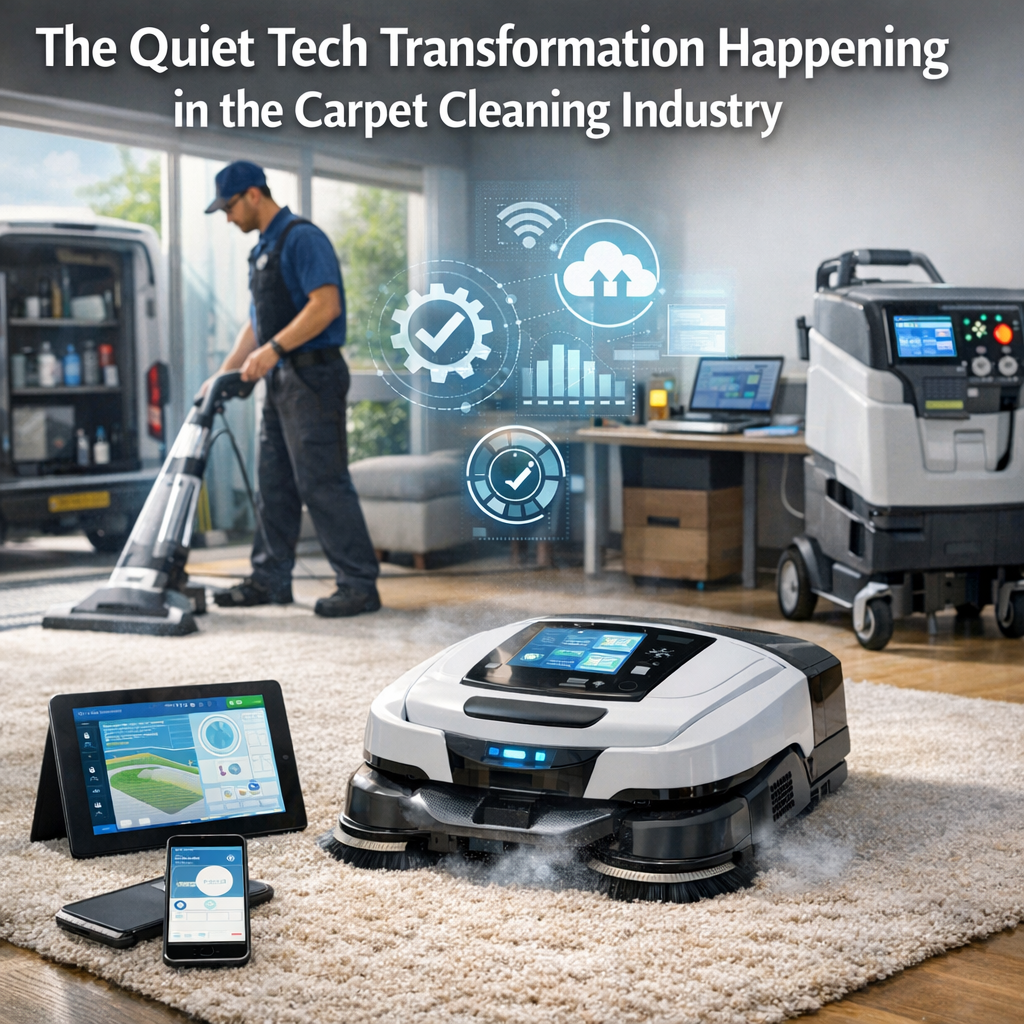
Carpet cleaning still looks like an old school service from the outside. A van pulls up, a technician unloads equipment, and the customer judges the result with one glance at the floor. That part has not changed. What has changed is everything wrapped around the job. The strongest carpet cleaning companies are not just cleaning better. They are booking faster, quoting with less friction, collecting payment sooner, and bringing customers back before another company gets the call.
That is why the transformation in this industry feels quiet. It is not driven by flashy machines or big headlines. It is happening in the office, on the phone, inside the calendar, and in the gap between one completed job and the next one. If we look at current data from IBISWorld, PwC, BrightLocal, and Mordor Intelligence, the pattern is easy to spot. The market is crowded, customer patience is thin, reviews carry real weight, and service businesses are moving toward stronger scheduling and workflow systems.
A Big Market With a Very Small-Business Feel
The carpet cleaning industry is large enough to stay competitive, but small enough that many companies still run with lean teams and owner-led operations. That combination creates a very specific kind of pressure. Owners are not managing a giant corporate structure. They are juggling calls, estimates, technician schedules, customer issues, and cash flow at the same time. When the business grows even a little, the admin side can become messy fast. IBISWorld shows just how fragmented the market still is.
| Industry metric | 2025 | 2026 | What it tells us |
|---|---|---|---|
| Number of carpet cleaning businesses in the U.S. | 40,945 | 41,611 | Competition is still rising |
| People employed in the U.S. carpet cleaning industry | 70,455 | 71,250 | The workforce is growing with demand |
| Average employees per carpet cleaning business | 1.7 | 1.7 | Many operators are still very small teams |
| Industry market size growth, 2021 to 2026 CAGR | N/A | 0.2% | Growth is steady, not explosive |
These numbers matter because they explain why “good enough” operations are starting to fail. When the average business is still tiny, every missed call, delayed invoice, or forgotten follow up hits harder. A larger company can absorb sloppiness for a while. A two person or three person operation usually cannot. That is why the quiet transformation in carpet cleaning is less about replacing labor and more about protecting time. When a business has this many moving parts and this little slack, cleaner systems become a serious advantage.
Scheduling Is Where the Change Starts
If we want to understand where this shift becomes real, we should start with scheduling. Most carpet cleaning companies do not lose momentum because they forgot how to clean. They lose momentum because the day gets scrambled. A call comes in during a job. Someone promises a window that does not actually fit the route. A technician finishes early on one side of town while another job is running behind on the other side. Then the office starts texting, calling, and patching things together on the fly.
That old system can survive when the volume is low. It breaks down when the business becomes even moderately busy. Customers now expect fast answers and clear windows. Owners need to see who is available, what job is next, and what still has room on the calendar. The field service software market is growing because service businesses in every category are trying to solve exactly that problem.
| Field service software trend | Checked data | Why it matters for carpet cleaners |
|---|---|---|
| Global field service management market in 2025 | $5.64 billion | Scheduling and dispatch software is no longer niche |
| Projected market size by 2030 | $9.68 billion | More service companies are building operations around software |
| Forecast CAGR, 2025 to 2030 | 11.39% | Adoption is growing fast, not slowly |
That growth tells us something simple. Service businesses are tired of running on memory. In carpet cleaning, scheduling is not just a calendar issue. It shapes route efficiency, customer confidence, technician productivity, and same day revenue. Once scheduling gets tighter, the rest of the business gets easier to control. The owner stops guessing. The office stops improvising. The customer gets better communication without hearing excuses.
Quoting and Follow Up Are Becoming Part of the Same System
Another major shift is happening in how carpet cleaning companies handle estimates and repeat work. Many operators still treat these as separate tasks. First they quote the job. Then they complete the work. Then, months later, they hope the customer remembers them. That gap is where a lot of money disappears.
The better model is much tighter. A quote should connect directly to a scheduled job. The completed job should connect directly to the invoice. The invoice should connect to the customer record. And that customer record should support a smart follow up later, based on when the service was done and what kind of client it was. That is not overbuilt. It is just cleaner.
This is exactly why tools built for service businesses are getting more attention. Smarfle CRM for carpet cleaning keeps quoting, scheduling, invoicing, and client history in one place. That is a practical upgrade, not a trendy one. For a carpet cleaning company, the real win is not that the software looks modern. The real win is that it removes the tiny admin gaps that slowly kill repeat business.
Customer Experience Is Now a Retention Problem
This is where many service businesses still underestimate the change. They assume customer experience is mostly a retail or ecommerce issue. It is not. Carpet cleaning is a trust based service. We are entering someone’s home, business, rental property, or office. That trust starts before the technician arrives — companies that run thorough background screening on every hire signal to customers that safety is built into the operation, not left to chance. The actual cleaning result matters, of course, but so does the way the experience feels from start to finish . Was the quote clear? Did the company confirm the appointment? Did the technician show up with context? Did the invoice arrive quickly? Was it easy to rebook later?
PwC’s 2025 customer experience data makes that point hard to ignore. More than half of consumers said they stopped buying from a brand after a bad experience with its products or services, and 29% said they stopped because of poor customer experience. For carpet cleaning companies, that means operational friction is not just annoying. It directly affects retention.
| Customer behavior signal | Checked data | Practical meaning for carpet cleaning companies |
|---|---|---|
| Consumers who stopped buying from a brand after a bad product or service experience | 52% | One poor job experience can cost future revenue |
| Consumers who stopped buying because of poor customer experience | 29% | Bad communication can hurt as much as bad cleaning |
| Consumers who read online reviews | 97% | Nearly everyone checks trust signals |
| Consumers who always read reviews when browsing for businesses | 41% | Reviews are now part of the buying process, not an afterthought |
This matters because most carpet cleaning companies do not lose a customer in some dramatic way. They lose them quietly. A late arrival without context. A job note that never made it to the next technician. An invoice that took too long. No reminder when the customer needed service again. A stronger back office does not just make the owner’s life easier. It protects the customer relationship while it is still warm.
Reviews Have Become Part of Operations
Reviews used to sit in the marketing bucket. Now they belong in operations too. That shift is easy to miss, but it changes how smart carpet cleaning companies run the business. If a company consistently delivers a smooth experience, it earns more reviews. If it earns more recent, credible reviews, it becomes easier to trust. If it becomes easier to trust, more leads convert before the first phone call even ends.
BrightLocal’s 2026 review data shows just how normal this behavior has become. Almost everyone reads reviews, and a surprisingly large share of people read them every single time they browse for a business. For carpet cleaners, that means trust is visible now. It is not just built through referrals or long local history. It is built in public, one review at a time.
That also changes how we should think about follow up. A completed job is no longer the end of the workflow. It should trigger two things. First, a clean invoice and customer record. Second, a simple review request while the result is still fresh. That is another reason a second mention of Smarfle feels natural here. When one platform helps a service business keep jobs, invoices, client history, and reputation activity connected, the owner is less likely to let a good job disappear into silence.
The Winners Will Not Look Like Tech Companies
Here is the part that matters most. We do not think the future of carpet cleaning belongs to whoever sounds the most technical. It belongs to the companies that feel easiest to hire and easiest to hire again. Customers still want a real person. They still care about trust, speed, cleanliness, and professionalism. None of that goes away. What changes is the system supporting it.
The quiet transformation in this industry is not about turning carpet cleaners into software brands. It is about giving service businesses enough structure to stop leaking time and revenue through avoidable friction. When the market has more than 41,000 businesses and the average company is still very small, those small improvements stack up fast. Better scheduling protects the day. Better records protect the customer relationship. Faster invoicing protects cash flow. Better follow up protects the next job.
That is why this shift matters now. Carpet cleaning is still a hands on business, but the companies that grow in 2026 will not just be the ones with good equipment. They will be the ones with a cleaner operating system behind the work. And from where we stand, that is not a side trend anymore. It is the new baseline.