...
UK: +44 2038074555 info@atamgo.com
How Blockchain Works For Smart Water Management
How Blockchain Works For Smart Water Management

Smart Water Management

Introduction: The Water Crisis Meets Blockchain Innovation

Let’s not sugarcoat it: the global water crisis is getting worse—fast.

By 2030, global water demand is expected to exceed supply by 40%, according to the World Resources Institute. Cities are running dry, agriculture is over-extracting, and utility infrastructures are aging by the day. In short: our current water systems aren’t just inefficient—they’re unsustainable.

And here’s the kicker…

Most traditional water management systems rely on centralized control, siloed data, and delayed responses. That means leaks go undetected, billing errors pile up, and policymakers make critical decisions without real-time insight. The result? Wasted resources, rising costs, and communities left vulnerable.

Enter Blockchain.

Blockchain isn’t just about Bitcoin anymore. It’s a decentralized, tamper-proof, transparent ledger that can completely rewire how we manage water—from source to treatment, and from utility to user.

At Webgen Technologies USA, we believe the future of water infrastructure must be:

  • Transparent (every drop accounted for),
  • Decentralized (data shared across all stakeholders),
  • Automated (rules enforced by smart contracts), and
  • Secure (no data manipulation, ever).

Blockchain delivers exactly that.

This isn’t hypothetical. We’re already seeing pilot projects around the world using blockchain to:

  • Track water quality from source to tap
  • Automate billing and consumption reporting
  • Create digital water markets to trade usage rights
  • Enhance compliance with real-time regulatory tracking

In this comprehensive guide, I’ll show you:

  • Why smart water management needs a blockchain backbone
  • How blockchain integrates with IoT and SCADA systems
  • Real-world use cases that prove the ROI
  • How Webgen’s Water Chain Framework turns theory into practice

If you’re a city planner, water utility leader, engineer, or just someone who cares about the future of water—you’re in the right place.

Let’s get started.

1. Understanding Smart Water Management Fundamentals

Before we talk blockchain, let’s get crystal clear on the backbone of the system: Smart Water Management (SWM).

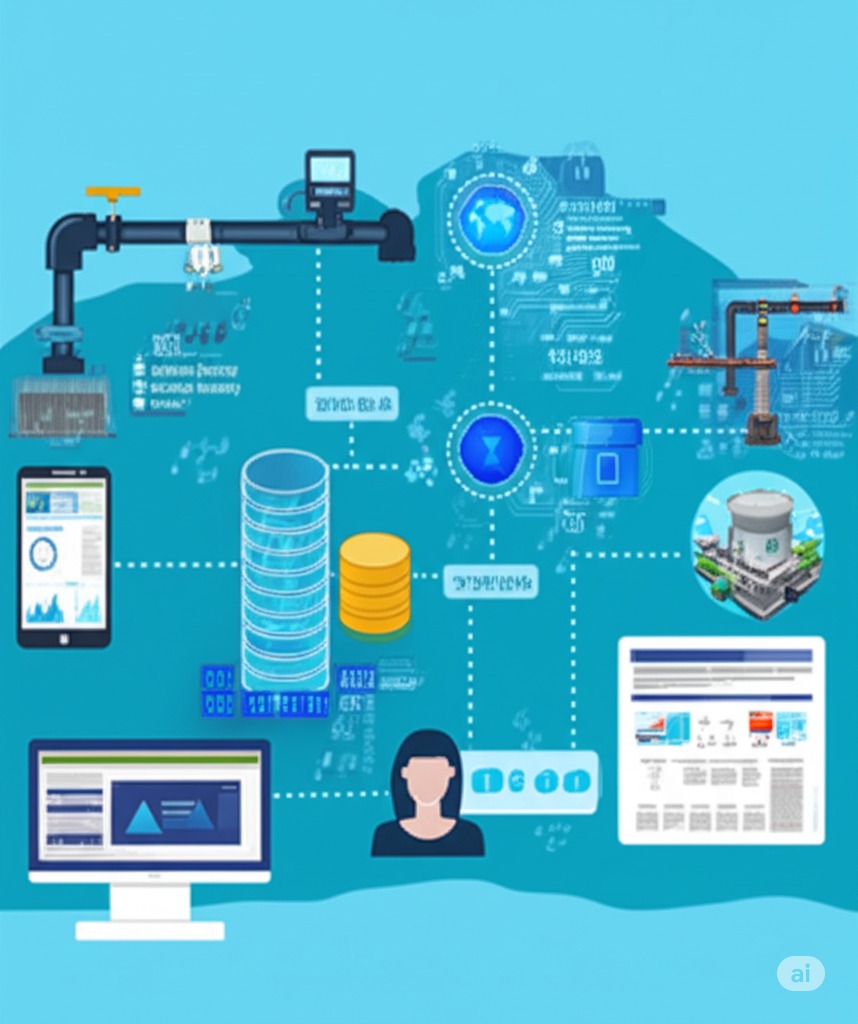
If traditional water utilities are stuck in the 20th century, SWM is their digital twin for the 21st. It’s the fusion of IoT, AI, big data, and now blockchain, designed to modernize how we source, move, treat, and distribute water.

What Is Smart Water Management?

Smart Water Management refers to the use of real-time monitoring, automated decision-making, and predictive analytics to optimize water operations—at scale.

Here’s the simple formula:

Smart Sensors + Connected Infrastructure + Real-Time Data = Smart Water Decisions

Whether you’re managing a municipal pipeline or an agricultural reservoir, the goal is always the same: deliver clean water efficiently and sustainably. In irrigated agriculture, irrigation management software translates sensor data and forecasts into precise scheduling that cuts waste.

Key Components of Modern Water Infrastructure

A next-gen SWM system includes:

  • IoT Sensors: Embedded in pipelines, treatment plants, and meters to measure flow, pressure, leakage, temperature, and contaminants.
  • Edge Devices: Collect and transmit data in real time to reduce latency.
  • Cloud-Based Analytics Platforms: Process massive amounts of data for performance optimization and predictive maintenance.
  • SCADA Systems (Supervisory Control and Data Acquisition): The command center for real-time operational control.
  • Mobile and Web Dashboards: For utilities, operators, and even consumers to monitor usage and get alerts.

The Role of IoT Sensors and Real-Time Monitoring

Let’s zoom in on this. IoT sensors are the eyes and ears of any smart water grid.

They provide real-time insights like:

  • Sudden drops in pressure → Possible leak detected
  • Spike in nitrate levels → Contamination warning
  • Overflow prediction → Preemptive reservoir adjustments

But here’s the catch: raw data alone doesn’t solve the problem. The power lies in turning that data into action—and that’s where automation and blockchain come in.

Current Pain Points in Water Distribution Networks

Despite digital upgrades, most water systems still face:

  • Water Loss (Non-Revenue Water): 30% of treated water globally is lost due to leaks or theft.
  • Inaccurate Billing: Manual readings and delayed data cause revenue leakage.
  • Lack of Data Transparency: Stakeholders—from regulators to citizens—can’t verify claims.
  • Siloed Systems: Legacy software can’t talk to modern IoT devices.

In short, utilities are collecting data—but they’re not leveraging it to its full potential.

What’s missing? A decentralized layer that ensures data accuracy, enables automation, and builds trust between parties.

That’s exactly what blockchain brings to the table. 

III. Blockchain Technology Deep Dive for Water Applications

You’ve heard the buzz: blockchain is going to “change everything.” But let’s cut through the noise.

What does blockchain really bring to the world of water?
Short answer: Trust, automation, and traceability at scale.

And that’s exactly what smart water management has been missing.

Blockchain Basics: Beyond Cryptocurrency

At its core, blockchain is a distributed digital ledger that records transactions across multiple nodes in a network. Every transaction is verified by consensus, sealed with cryptography, and time-stamped.

But here’s where it gets interesting for water systems:

  • Tamper-proof: Once data is on the blockchain, no one—not even the system admin—can alter it.
  • Decentralized: No single entity controls the data, making it more secure and trustworthy.
  • Transparent: Every stakeholder—from utility operators to regulators—sees the same truth.

Forget Bitcoin. Blockchain’s real power lies in how it tracks and automates data-heavy systems, like global water distribution.

Distributed Ledger Technology in Water Systems

Think about this…

Every drop of water used, every leak reported, and every gallon billed—logged immutably on a distributed ledger.

What that means in practice:

  • Leak detection records can’t be disputed
  • Maintenance schedules can be automated and verified
  • Water quality audits are traceable from source to tap
  • Regulatory compliance is validated with zero manual overhead

In short, blockchain removes the guesswork.

Smart Contracts for Automated Water Management

Now here’s where things get futuristic.

A smart contract is a self-executing code stored on the blockchain that automatically performs actions when specific conditions are met.

Imagine this:

  • If contamination > threshold → automatic alert + water shutoff
  • If payment not received → supply limited automatically
  • If reservoir levels drop below X → trigger secondary source activation

No middlemen. No paperwork. Just real-time action based on pre-defined logic.

This is a total game-changer for operational efficiency.

Consensus Mechanisms for Water Data Validation

Blockchain doesn’t just store data. It validates it.

Every new record (like a sensor reading or transaction) is approved by consensus across the network. That could be:

  • Proof of Stake (PoS) for energy-efficient blockchain platforms
  • Practical Byzantine Fault Tolerance (PBFT) for high-speed, permissioned systems
  • Proof of Authority (PoA) for private utility networks

Why does this matter?

Because when you’re managing a city’s water supply, data accuracy is life-or-death. Consensus ensures that only verified, authentic data makes it onto the chain.

IV. The Perfect Storm: Why Blockchain + Water Management = Game Changer

When you fuse two powerful technologies—blockchain and smart water infrastructure—you don’t just get incremental improvement. You get a paradigm shift.

Water utilities face a unique challenge: deliver a finite, life-sustaining resource through aging infrastructure while balancing environmental impact, user demand, and regulatory pressure.

Traditional systems are buckling under this weight. But when blockchain enters the scene, everything changes.

Here’s exactly how:


1. Transparency in Water Usage and Distribution

Imagine this: every drop of water tracked on a public or permissioned ledger—accessible in real-time to all authorized stakeholders.

This means:

  • No hidden consumption
  • No billing disputes
  • No opaque reporting

Blockchain creates a shared, synchronized view of water use—whether it’s across a city, a utility, or an entire country.

And that transparency unlocks real benefits:

  • Accurate usage tracking
  • Fairer billing models
  • Improved public trust in utilities

2. Immutable Records for Regulatory Compliance

Let’s be honest—regulatory compliance in water systems is a nightmare.

Spreadsheets. Reports. Manual logs. Delays. Errors.

With blockchain? All of that goes away.

You get time-stamped, tamper-proof logs for:

  • Water quality tests
  • Distribution events
  • Usage anomalies
  • Leak or contamination alerts

Auditors and environmental regulators can instantly verify data—with zero chance of manipulation.

This isn’t just convenient. It’s essential for:

  • EPA compliance
  • Water safety certifications
  • International water trade agreements

3. Decentralized Water Trading and Allocation

Here’s where blockchain truly disrupts the game.

Using smart contracts and digital tokens, blockchain enables real-time water rights trading between stakeholders:

  • Farmers can lease unused quotas to neighbors.
  • Municipalities can allocate based on supply-demand dynamics.
  • Industries can auto-purchase based on production thresholds.

This is water as a tradable asset, with full traceability and instant settlement.

And it’s already being tested in drought-prone regions like Australia and California.

The result? More flexible, efficient, and fair water distribution markets.

4. Trust Building Among Stakeholders

Water governance often breaks down because of mistrust—between municipalities, private utilities, agricultural users, and the public.

Blockchain builds trust not through contracts, but through code and consensus.

When everyone sees the same data:

  • Disputes disappear
  • Accountability rises
  • Cooperation increases

That’s why blockchain isn’t just a tech upgrade. It’s a governance upgrade. The same principle applies to beef cattle management software. When integrated with blockchain, it ensures that every liter of water consumed by cattle is monitored, recorded, and verified, supporting compliance, sustainability goals, and ethical farming practices.  

So why is blockchain + water the “perfect storm”? Because each technology solves the other’s weakness:

  • IoT gives us the data.
  • Blockchain ensures we can trust that data.
  • Smart contracts make that data actionable.

Together, they form the foundation for a self-regulating, transparent, and resilient water future.

V. Real-World Blockchain Water Management Use Cases

Now that we’ve explored the “why,” let’s talk about the “how.”
Because here’s the truth:

Blockchain-powered water solutions are already working—right now—in real cities, regions, and industries around the world.

These aren’t theories or whitepapers. They’re real-world deployments solving real-world water problems. Here are four use cases that prove it:

1. Water Quality Tracking from Source to Tap

Problem: Water contamination events are often detected too late—and accountability is blurry.

Solution: With blockchain and IoT sensors working together, water quality data can be captured in real-time and immutably stored from the source to the end user.

  • Turbidity, pH, chlorine, and nitrate levels logged on-chain
  • Public dashboards for full visibility
  • Automatic alerts if contamination exceeds thresholds

Example: In Canada, a blockchain-based water safety pilot tracked municipal water from treatment to household, enabling early detection of bacterial outbreaks—weeks faster than traditional methods.

  1. Automated Billing and Payment Systems

Problem: Manual billing leads to errors, delays, and lost revenue. Consumers don’t always trust their bills.

Solution: Smart contracts on blockchain allow for automated, usage-based billing tied directly to real-time consumption.

  • No manual meter readings
  •  No estimated bills
  • Real-time payments via stablecoins or tokens

Example: A pilot in South Asia used Ethereum-based contracts to bill rural users per liter—directly linked to sensor data. Payment triggers were built into mobile wallets, reducing non-payment by 42%.

3. Cross-Border Water Rights Management

Problem: Water sources often span multiple regions or countries—creating tension over access and usage.

Solution: Blockchain enables neutral, immutable logging of water usage and allocations across borders.

  • Transparent tracking of international withdrawals
  • Auditable smart contracts for compliance
  •  Real-time dispute resolution via shared ledgers

Example: In Africa, a consortium tested blockchain to monitor and enforce shared river basin treaties between two countries—ensuring equitable water distribution during dry seasons.

4. Drought Response and Emergency Allocation

Problem: During droughts, it’s hard to coordinate fast, fair allocation of limited water.

Solution: Smart contracts can execute emergency protocols automatically, based on sensor input and pre-agreed thresholds.

  • Smart valves activated by blockchain events
  • Priority supply to hospitals, fire departments, etc.
  • Transparent decision-making process

Example: California’s Central Valley is exploring blockchain for emergency drought plans—where smart contracts trigger water flow restrictions and reallocation during high-risk events.

VI. Technical Implementation: Building Blockchain Water Solutions

You’ve seen the potential. You’ve seen the proof.

Now, let’s roll up our sleeves and get tactical.
Because blockchain isn’t plug-and-play—it requires strategic integration into existing water infrastructure.

Here’s exactly how we build scalable, secure, and smart blockchain water solutions at Webgen Technologies USA.

1. Architecture Design for Water Management DApps

First, you need the right architecture.

A blockchain-powered water system typically includes:

  • Blockchain Layer: Ethereum, Hyperledger Fabric, or Polygon for faster settlement.
  • Smart Contracts: Automate billing, alerts, leak detection protocols.
  • IoT Data Pipeline: Secure transmission of sensor data (flow, pressure, contamination).
  • Frontend Dashboard: Web/mobile interface for real-time monitoring, usage reports, and control.

Key considerations:

  • Public vs. Permissioned Chains:
    • Public = transparency for citizens
    • Permissioned = security for enterprise-grade utility systems
  • Layer 2 Scaling: For real-time microtransactions without congestion

Pro Tip: At Webgen, we use modular architecture, so utilities can scale features without rebuilding the core system. 

2. Integration with Existing SCADA Systems

This is a big one. Most utilities already use SCADA (Supervisory Control and Data Acquisition) to monitor and control their networks.

But SCADA wasn’t built for decentralization or trustless automation.

To integrate blockchain:

  • Use middleware APIs to bridge SCADA data with blockchain
  • Encrypt and timestamp SCADA event logs before pushing to chain
  • Trigger smart contract events (e.g., pressure drops, overflow alerts) directly from SCADA signals

This ensures blockchain doesn’t replace SCADA—it enhances it. 

3. Smart Contract Development for Water Utilities

Smart contracts are where the real magic happens.

They’re coded logic that automates tasks like:

  • Usage-based billing
  • Leak response workflows
  • Emergency allocation rules
  • Compliance report generation

At Webgen, we follow this process:

  1. Identify workflows that can be automated (e.g., shut-off on payment default)
  2. Write contracts in Solidity or Chaincode
  3. Test under real-world conditions using simulated sensor input
  4. Deploy to a staging chain, then production

Security is non-negotiable here. We always perform:

  • Static and dynamic analysis
  • Gas optimization
  • Auditing with industry-standard tools (Slither, MythX)

4. Data Privacy and Security Considerations

Water data includes personal information, utility records, and even geo-sensitive infrastructure data.

So how do you stay secure and transparent?

 On-chain/off-chain hybrid models
– Only critical summaries and hash proofs go on-chain
– Sensitive data remains encrypted off-chain in a secure cloud

Zero-Knowledge Proofs (ZKPs)
– Enable verification without exposing actual data (e.g., “user paid” without showing amount)

 Role-Based Access Control (RBAC)
– Regulators, admins, operators, and end-users get custom permissions

Blockchain enhances transparency—but it never compromises security. 

VII. Webgen’s Blockchain Water Management Framework

Let’s face it: deploying blockchain in critical infrastructure like water management isn’t something you want to wing.

That’s why at Webgen Technologies USA, we’ve developed a battle-tested, proprietary framework—purpose-built for the complexities of municipal and industrial water systems.

We call it the Water Chain Protocol™.

It’s fast. It’s modular. It’s regulatory-ready.
And it’s already transforming how water utilities think about transparency, automation, and sustainability.

Here’s how it works.

1. Our Proprietary Water Chain Protocol™

At the heart of our framework is the Water Chain Protocol™, a permissioned blockchain network designed to:

  • Log sensor data in real time
  • Trigger smart contracts based on defined thresholds
  • Track water usage, quality, and billing immutably
  • Integrate seamlessly with legacy systems (like SCADA)

We’ve baked in:

  • Low-latency consensus (PBFT) for real-time automation
  • Multi-tenant support for municipalities and private operators
  • Off-chain storage integration (IPFS + encrypted cloud) for large data sets
  • Tokenization-ready infrastructure for future water credit systems

2. Step-by-Step Implementation Methodology

We don’t just drop in code and walk away. Here’s our proven process:

Step 1: Discovery & Assessment

  • Map existing infrastructure
  • Identify inefficiencies, leak points, and billing errors
  • Define compliance requirements and user roles

Step 2: Architecture Blueprint

  • Select appropriate blockchain layer
  • Plan IoT integration, smart contract logic, and data flow
  • Design access control and dashboard interfaces

Step 3: Prototype & Simulate

  • Build a working DApp with test data
  • Simulate leak detection, billing, or emergency events
  • Stakeholder testing and refinement

Step 4: Full Deployment

  • Go live in parallel with existing systems
  • Train internal teams
  • Begin phased migration of billing, reporting, and response automation

Step 5: Monitor & Optimize

  • Real-time dashboard + alerts
  • Performance audits
  • Continuous smart contract updates based on system behavior

VIII. Overcoming Implementation Challenges

Let’s get real:
Deploying blockchain in water infrastructure isn’t a walk in the park.

Between legacy systems, tight budgets, and regulatory red tape, most utility companies face serious roadblocks.

But here’s the good news:
Every challenge has a solution—and at Webgen Technologies USA, we’ve engineered our Water Chain Protocol™ to overcome these exact hurdles.

Let’s break down the big four. 

1. Scalability Solutions for Large Water Networks

The Challenge:
Water systems span thousands of miles, with millions of data points per hour. Public blockchains can buckle under this load.

Our Fix:
We use Layer 2 solutions like sidechains or rollups for micro-transactions, combined with permissioned blockchains for operational control.

  • Event-heavy data stays off-chain (IPFS or cloud)
  • On-chain hashes ensure data integrity
  • Modular smart contracts support parallel processing

Result?
High throughput without clogging the chain—or draining the budget.

2. Interoperability with Legacy Systems

The Challenge:
Most utilities use outdated SCADA systems or closed-source software that doesn’t “speak blockchain.”

Our Fix:
We build custom middleware APIs to connect:

  • SCADA alerts to smart contracts
  • Legacy billing databases to real-time DApp dashboards
  • IoT edge devices to decentralized ledgers

This allows a non-destructive rollout—blockchain enhances what’s already there rather than replacing it all.

3. Regulatory Compliance and Legal Frameworks

The Challenge:
Water is heavily regulated, and governments don’t move fast on tech.

Our Fix:
Our platform is built with compliance in mind—not as an afterthought.

  • Every transaction is auditable and time-stamped
  • Smart contracts align with existing billing laws and EPA standards
  • Custom access control ensures data privacy laws (like GDPR, CCPA) are respected

We also work directly with legal teams and local authorities to ensure zero friction during audits and inspections.

4. Cost-Benefit Analysis for Water Utilities

The Challenge:
Executives worry about upfront investment—and rightly so.

Our Fix:
We make the business case clear and data-backed with:

  • Payback projections (usually under 12 months)
  • Operational savings from leak detection, billing accuracy, and automation
  • Long-term value from digital water trading, compliance, and public trust

Plus, our modular approach allows phased implementation—start small (e.g., automated billing), then scale.

IX. The Future of Blockchain-Powered Water Management

Let’s fast-forward.

We’ve seen what blockchain can do for water systems today—but where is it going next?

If you’re thinking about long-term impact, sustainability, and global transformation, this is the part you need to pay close attention to.

Because we’re not just heading into smarter water management.
We’re heading into a future where water becomes programmable, tradable, and AI-optimized.

Here’s what’s on the horizon. 

1. Emerging Technologies: AI + Blockchain Integration

Imagine a system that not only tracks every liter of water but also predicts and prevents failures before they happen.

That’s where AI + Blockchain create exponential value.

Blockchain provides the trusted data backbone.
AI reads that data to detect patterns, anomalies, and inefficiencies.

Combined, they enable:

  • Predictive leak detection
  • Automated pipeline optimization
  • Consumption forecasting
  • Real-time decision-making with zero human intervention

Example: AI detects a potential pipe burst 48 hours in advance based on pressure trends. Blockchain logs the alert, and a smart contract auto-dispatches maintenance.

Result?
No damage, no downtime, no human error.


2. Tokenization of Water Resources

Here’s a bold prediction:
Water will be tokenized.

Just like carbon credits, we’re moving toward a world where water becomes a digital asset—tracked, exchanged, and valued on blockchain networks.

  • Tokenized water rights for farmers
  • Incentive programs for conservation
  • Tradable “Water Credits” across utilities or countries

With Webgen’s Water Chain Protocol™, utilities can prepare today for this shift—by building on a tokenization-ready infrastructure.

3. Global Water Markets and Trading Platforms

In the next 5–10 years, we’ll see the rise of decentralized global water markets, where:

  • Municipalities buy water rights via smart contracts
  • Countries trade surplus during droughts
  • NGOs fund water distribution with blockchain-based donation tracking

Think: a global eBay for water, but trustless and programmable.

These platforms will allow for:

  • Cross-border transparency
  • Conflict resolution via coded agreements
  • Real-time, automated enforcement

Blockchain won’t just support local utilities—it’ll redefine global water diplomacy.


4. Sustainability and Environmental Impact

Here’s the real win:
Blockchain helps us move from water exploitation to water stewardship.

When every transaction is traceable and every action is accountable:

  • Overuse gets penalized
  • Conservation gets rewarded
  • Environmental policies are enforceable—not just aspirational

Combined with carbon tracking and ESG reporting, blockchain will help create climate-aligned water ecosystems.

Cities of the future won’t just be smart—they’ll be self-regulating, regenerative, and equitable.

X. Getting Started: Your Water Management Blockchain Journey

If you’ve made it this far, here’s the good news:

You don’t need to be a blockchain developer to start transforming your water system.

What you do need is a clear roadmap. And that’s exactly what this section delivers.

At Webgen Technologies USA, we’ve helped utilities, governments, and enterprises move from outdated infrastructure to blockchain-powered ecosystems—with real savings and long-term impact.

Here’s how you get started.


1. Assessment Checklist for Water Utilities

Before you write a single line of code, you need to audit your current system.

Here’s a quick checklist:

  • Do you have IoT sensors in place (or plans to deploy them)?
  • Is your current billing system digital and API-friendly?
  • Are you tracking water loss, quality, and user consumption in real-time?
  • Do you face frequent compliance or audit challenges?
  • Do your stakeholders trust your data?

If you answered “no” to 2 or more—blockchain isn’t optional. It’s urgent.


2. Pilot Program Development Strategy

Start small. Think big.

The most successful projects begin with targeted pilots. These typically focus on:

  • One geographic zone
  • A specific use case (e.g., billing automation, leak detection, compliance tracking)
  • A small group of stakeholders (internal teams, select customers, local regulators)

Pro tip:
At Webgen, we recommend a 90-day pilot with clearly defined metrics (e.g., billing accuracy %, leak response time, audit readiness).

If it works in one zone, you can scale across your entire system.

3. Partner Selection and Technology Stack

Blockchain isn’t a one-size-fits-all solution. The wrong tech stack can cost you time, trust, and money.

You need a partner that brings:

  • Deep blockchain development expertise
  • Water system domain knowledge
  • Experience integrating SCADA, IoT, and cloud platforms
  • Cybersecurity best practices
  • Compliance-readiness baked into every line of code

That’s where Webgen Technologies USA comes in.

We provide:

  • Our proprietary Water Chain Protocol™
  • Full-stack development (frontend, backend, smart contracts)
  • Training and change management
  • End-to-end technical support

We don’t just build DApps. We build digital water ecosystems.

4. Next Steps with Webgen Technologies USA

Here’s what to do if you’re ready to move: 

  • Step 1: Schedule a no-obligation discovery session
  • Step 2: Receive a custom implementation roadmap within 7 days
  • Step 3: Deploy your first blockchain-powered water pilot in 90 days or less
  • Step 4: Monitor performance, scale system-wide, and start seeing ROI

Whether you’re a utility provider, municipality, or industrial water user—we help you go from fragmented to future-proof.

XI. Conclusion: Securing Our Water Future Through Blockchain

Let’s be honest…

The global water crisis isn’t coming. It’s already here.

From droughts in California to floods in Southeast Asia, the pressure on water systems is intensifying. And traditional infrastructure simply can’t keep up.

But here’s the opportunity:

Blockchain isn’t just a tech upgrade. It’s a strategic advantage.

It turns fragmented data into verified truth, turns water into a trackable asset, and turns utilities into future-ready digital networks.

So, if you’re asking…

“Can blockchain really solve my water management problems?”

The answer is: Yes—when done right.

Key Takeaways and Action Items

Let’s recap the most important insights from this guide:

  • Smart Water Management requires transparency, automation, and real-time data.
  • Blockchain delivers secure, tamper-proof, and decentralized control.
  • Smart Contracts enable rule-based water flow, billing, and emergency responses.
  •  Real-world use cases already show improvements in leak detection, billing, and compliance.
  • Webgen’s Water Chain Protocol™ provides an end-to-end, scalable framework.
  • You can start small with a pilot, then scale based on real ROI.

You don’t need to overhaul everything overnight.
But you do need to start somewhere—now.

The Competitive Advantage of Early Adoption

Here’s something most utilities and municipalities miss:

Early adopters of blockchain-powered water management gain first-mover advantage.

What does that look like?

  • Lower long-term costs through automation
  • Regulatory leadership in transparency and compliance
  • New revenue streams from water credit trading
  • Increased citizen trust and ESG alignment
  • Technology infrastructure that’s built to last

While others wait and watch, you’ll be leading—with data-backed governance and smart, sustainable operations.

Contact Webgen for Your Custom Solution

Ready to move from insight to action?

As a trusted blockchain development company, Webgen Technologies USA specializes in designing, developing, and deploying turnkey blockchain water systems that deliver real-world results.

Water is life. Blockchain is trust. Webgen is the bridge.

Let’s secure your water future—together.

ChatGPT vs. Other Story Writers: Which One Helps You Write Better Creative Stories?

ChatGPT vs. Other Story Writers: Which One Helps You Write Better Creative Stories?

Creative Stories

Do you want a creative partner who can help you write creative stories? With advancements in AI story generators, your wish is already fulfilled.

In fact, a 2024 survey by Statista revealed that more than 42% of media leaders and marketers are using AI for creative content, including stories, scripts, and blogs.

Among these tools, ChatGPT is the most popular one because of its versatility and natural language skills. But it is not the only AI that can create compelling narratives. It is a general-purpose tool that can write stories on command. There are many AI story generator tools specifically made for creative writing.

In this article, we’ll discuss the strengths and weaknesses of ChatGPT compared to other story writers.

How ChatGPT supports your story writing

ChatGPT is like an assistant who never gets tired, bored, or annoyed. And it never runs out of ideas because of the vast datasets it is trained on. It can fetch ideas from there.

These abilities allow GPT to help you create stories faster and with more creativity.

Strengths of ChatGPT in storytelling

  1. Generates ideas instantly: ChatGPT is excellent at suggesting story starters, plot twists, alternate endings, and dialogues. If you get stuck anywhere, you can talk to it like a friend and discuss what’s on your mind. And it will help you break your writer’s block.
  2. Adapts any tone and style on demand: If you instruct properly, ChatGPT can shift its tone easily. You can also ask it to mimic specific authors or styles. From humorous to poetic to suspenseful, it can adapt to anything.
  3. Helps with structure and pacing: ChatGPT understands almost all the storytelling frameworks, like the hero’s journey, three-act structure, video script etc. That means it can create a logical outline for your story, giving you a clear beginning, middle, and end.

Limitations of ChatGPT in storytelling

  1. No visual storytelling support: ChatGPT is a text-based tool. It can create images, but they can be used to make thumbnails. That does not help you with plot mapping or character design.
  2. Requires you to explain everything: ChatGPT is a general-purpose tool, not specifically made for story writing. So, to get creative stories out of it, you need to explain what you want in the prompts. From genre to characters to setting, everything has to be written clearly. It will not offer any buttons or options to you.
  3. Exhibits no emotional intelligence: You may find AI stories too basic and robotic. This is because GPT has no emotional attachment to its own words. That is why publishers detect AI using different AI detectors and reject AI-generated stories.
  4. Trouble keeping tone and context intact for long: Although it is said that GPT-4 has a context window of 4096 tokens, it cannot keep the tone and style the same for longer stories. It often loses track of key plot points or character traits. And if you point out a mistake, instead of just changing that one point, it changes the whole output.

Many story writers turn to rewriting tools when working with AI-generated stories and content creation. Why? Because AI sometimes mix different tones in one piece—one sentence might sound formal, while the next feels too casual or robotic.

To fix this, writers go through the story and point out sentences that don’t match the tone they want. Then, they use AI paraphrasers to rewrite those parts with a more consistent tone, like if they want friendly, dramatic, professional, or conversational.

But I think we should consider using other tools that do not have such limitations.

How other story generators compare to ChatGPT

While ChatGPT is powerful, it is not specifically made for storytelling. Luckily, several story generators are stepping up to offer features that specifically solve the issues ChatGPT struggles with:

1. Plottr for visual story planning

Plottr is a visual story outlining tool built specifically for writers who need to “see” how their story goes. Where ChatGPT makes you imagine everything in your head, Plottr turns your imagination into a visual plan, like a storyboard.

It offers drag-and-drop timelines and customizable templates (like the Hero’s Journey or 3-Act Structure). You also get dedicated sections for characters, subplots, and world-building elements.

2. Story generator for prompt-free storytelling

Story-generator.com is built specifically for short story writing and doesn’t require long, complicated prompts. Unlike ChatGPT, it does not want you to explain everything in writing. Just writing the title is enough.

It offers ready-made options, buttons, and simple inputs. You can choose your story genre, level of creativity, and the length of your story. It instantly generates a well-structured story around your choices.

This story generator is ideal for beginners, hobbyists, and even professionals who want to brainstorm ideas quickly.

3. SudoWrite for emotionally rich storytelling

One of ChatGPT’s key limitations is its lack of emotional storytelling. While it can mimic emotions based on training data, it doesn’t truly understand or feel anything. That’s why emotionally intense stories written with ChatGPT often sound robotic and require tools or effort to humanize the text before publishing.

Sudowrite addresses this problem beautifully. It is used specifically for fiction writing and offers tools like the “Describe”, “Brainstorm”, and “Emotion” features.

SudoWrite makes your characters more human and your scenes more intense. It can also suggest metaphors and sensory details to further improve the mood and the backstory.

4. NovelAI for long-form story continuity and creativity

Trouble maintaining plot continuity and consistent tone in long-form stories or novels is one of the biggest complaints with ChatGPT.

NovelAI is designed specifically for long-form storytelling. It allows you to write chapter by chapter, keeping the memory of characters, scenes, and tone.

Unlike ChatGPT, you don’t need to constantly remind it what happened earlier. NovelAI keeps everything organized behind the scenes. Its creative space allows you to manage many projects together, along with image generation and character development tools.

Conclusion

If you are looking for creative ideas to write on, ChatGPT is a great place to start. But when your storytelling needs go beyond general-purpose writing, it is better to use specialized AI story generators.

However, if you’re serious about storytelling, don’t rely on one tool alone. Combine the speed and flexibility of ChatGPT with dedicated story generators to unlock your full creative potential.

Pick the tool that aligns with your writing style, and start creating stories that readers will remember.

The Rise of AI in Content Creation: Transforming the Digital Landscape

The Rise of AI in Content Creation: Transforming the Digital Landscape

ai in content

Artificial Intelligence (AI) has rapidly transformed various industries, and content creation is no exception. From generating high-quality blog posts to automating marketing strategies, AI-powered tools are reshaping how businesses and individuals produce content. With advancements in Natural Language Processing (NLP) and machine learning, AI can now craft compelling, human-like content in mere seconds, saving time and effort while enhancing creativity.

Renovate AI is an innovative platform that uses artificial intelligence to reimagine spaces with ease. By uploading a photo, users can instantly preview interior or exterior renovations in styles like Modern, Rustic, or Coastal. The tool supports virtual staging, wall paint previews, clutter removal, and even high-quality upscaling to help homeowners and designers visualize changes before committing. Ideal for exploring kitchen remodels, bedroom renovations, or full home makeovers, Renovate AI saves time and money by offering realistic design mockups in seconds. Whether for personal projects or professional use, it makes renovation planning more creative, efficient, and inspiring.

How AI is Changing Content Creation

AI-driven content creation tools leverage vast datasets and deep learning algorithms to generate written, visual, and audio content. These AI-powered tools not only streamline the writing process but also enhance efficiency and accuracy. In this context, an AI Bollywood Lyrics Generator can assist creators in producing song lyrics quickly while maintaining quality and coherence. Some key advantages of AI in content generation include:

  • Speed and Efficiency: AI writers can create blog articles, ad copies, and product descriptions in seconds, allowing businesses to scale their content production effortlessly.
  • Cost Reduction: Companies no longer need large content teams; AI-powered solutions help reduce overhead costs while maintaining quality.
  • SEO Optimization: AI-driven writing tools ensure that content is optimized for search engines, improving visibility and engagement. Combined with AI detectors like contentscan.ai, businesses can ensure their content passes authenticity checks and avoids issues with duplicate or AI-flagged text. AI-driven writing tools ensure that content is optimized for search engines, improving visibility and engagement.
  • Multilingual Capabilities: Many AI tools support multiple languages, making global multilingual content marketing easier than ever.
  • Personalization: AI algorithms analyze user behavior and preferences to create highly tailored content for better engagement.

Top AI Tools Transforming the Industry

Writecream: AI-Powered Content Generation

Writecream is a versatile AI writing tool that allows users to generate blog articles, marketing content, and personalized outreach emails with ease. With over 75 language support and features like ChatGenie, AI article writer, and plagiarism checking, Writecream helps businesses create high-quality content at a fraction of the cost. Its AI-driven capabilities make it a go-to tool for marketers, bloggers, and copywriters.

AI4Chat: A Unified AI Platform

AI4Chat brings together multiple AI tools under a single platform, eliminating the need for multiple subscriptions. From AI chat and code assistance to image, music, and voice generation, AI4Chat provides an all-in-one solution for businesses and creators looking to leverage AI for diverse content needs.

UnAIMyText: Humanize AI-Generated Content Instantly

UnAIMyText is a specialized tool that helps you instantly humanize 1,000 words of AI-generated content with just a few clicks. Whether you’re transforming robotic text or fine-tuning tone for better engagement, UnAIMyText refines phrasing and removes artificial patterns. It’s perfect for content creators, marketers, and students who want their writing to sound authentic and reader-friendly. 

Aitohumantext.com – Humanize AI text being original

Aitohumantext.com not just converts AI content into human, more than that, it keeps the formatting structures and original context alive. There are no plagiarism issues with this tool.

Other assisting features of this AI to human text converter include multiple writing modes, multi language support and tone control such as from formal to casual. It offers a clear user-interface and a very simple process of just three steps. 

Humanizador de Texto: Make Your AI Content Sound Real

Humanizador.net is an easy-to-use tool that turns AI-generated text into content that sounds natural and human-written. Unlike simple rewording tools, this AI humanizer improves sentence structure, removes robotic language, and makes your writing clear and engaging. It’s perfect for students, writers, marketers, and anyone who wants content that feels real. No technical skills needed—just paste your text, click “Humanize,” and get results in seconds.

The Future of AI in Content Creation

As AI technology continues to evolve, we can expect even more sophisticated tools that refine AI for content creation further. Some emerging trends include:

  • Enhanced AI Creativity: Future AI models will generate even more creative, contextually relevant content, supported by Generative UI that adapts dynamically to user interactions and design contexts
  • Voice and Video Integration: AI-generated podcasts, YouTube videos, and interactive media will become more mainstream. Tools like the Domoai ai anime video generator are pushing the boundaries by allowing users to transform text prompts into stunning anime-style videos, making content more engaging and visually compelling. YouTube to MP4 converter will play a key role in how we access and store media. A YouTube to MP4 converter allows users to download and save AI-generated content for offline viewing, archiving, or creative repurposing. It’s a convenient solution for content creators, educators, and casual viewers who want quick, reliable access to high-quality video files anytime. When paired with the best free video generator, it becomes an even more powerful tool, enabling users to not only access existing content but also create and customize videos with ease.
  • Greater Ethical Considerations: As AI content generation becomes widespread, ensuring ethical AI use, avoiding misinformation, and maintaining originality will be crucial.
  • Real-time AI Assistance: AI will continue to integrate with real-time workflows, making on-the-fly content generation seamless.

AI-powered content creation is here to stay, and businesses that leverage these tools effectively will have a significant competitive advantage. As technology advances, AI will continue to redefine how we create, consume, and interact with content in the digital world.

5 Benefits of Using Text to Speech as a Content Creator

5 Benefits of Using Text to Speech as a Content Creator

Using Text to Speech as a Content Creator

In the highly competitive environment of modern writing, being ahead of a competitor crucially depends on the use of new and improved approaches. Of these, text to speech (TTS) has become the most revolutionary tool for content creators in different fields. It does not matter if you are a YouTuber, podcaster, or blogger, TTS technology offers benefits that are exclusive to this platform and can help enhance your content and save you time. Now let’s discuss five unique advantages of using text to speech for a content creator.

Enhancing Accessibility for a Diverse Audience

Being a content creator, your aim is to get your content to as many people as possible. This is where accessibility comes into the picture and is more important than ever in today’s world. Text to speech is a technology that can convert written text into speech making it easier for people with visual impairment, dyslexia or other conditions that make it hard for them to read written text.

For example, by incorporating TTS into your content plan, you guarantee that viewers who use audio formats can also interact with your creation. This means your blogs, guides and tutorials are made available to people who would otherwise have no access to them. On the other hand, it widens your coverage and leaves your brand more progressive and embraced by the society.

Furthermore, it is beneficial to address a broad audience because it helps to build your creator’s credibility. It is a sign of a universal design, which means that your content is accessible to everyone with disabilities. This added layer of accessibility makes you stand out and can create a dedicated and active audience.

Saving Time and Effort in Content Production

Creating content can be very time consuming especially when one has to write the script, record the content, edit it and then publish it. A text to speech converter can greatly reduce production time since it is a one stop shop for converting scripts or text based content to audio. Rather than recording voice overs for hours, you will be able to produce professional quality audio files within a few minutes using TTS.

TTS is also useful for creators in editing and prototyping content, according to many of them. For instance, when creating a podcast or video and you want to adjust the script slightly, with TTS you can hear the changes. This constant cycle of procession is effective in terms of time and energy efficiency without costing quality.

By outsourcing voiceover services, you are able to save time that would have been used while doing voiceover tasks hence can be used in doing other creative areas such as designing the visuals, marketing your content or even coming up with new ideas. Finally, TTS makes your work easier and enhances the efficiency of content creation in your firm.

Expanding Multilingual Reach

One of the most difficult issues that creators encounter is how to reach out to people who understand different languages. Text to speech technology provides a workable solution to this problem since it can be implemented with multilingual features. Most of the sophisticated TTS systems permit you to turn text into natural-sounding audio in different languages, which means you can reach out to people in different countries without having to hire professional translators or voice-over artists.

For example, if you are creating a tutorial or an online course, you can use TTS to generate the audio versions in multiple languages. It can also help you access new markets and increase your target market audience drastically. Multilingual TTS makes your message reach across cultures and languages hence making your viewers or readers feel more included.

Besides, work done to make accents and dialects in TTS technology even stronger makes the voiceover close to natural. This also gives you the opportunity to feed specific contents in specific regions, and hence increases the level of engagement and relevance. TTS allows you to take your content and make it go viral without having to spend a lot of money on the process.

Maintaining Consistency and Professionalism

Continuity is something that defines any content creator who wants to be successful. Regardless of whether you are creating a brand voice or checking the continuity of the audio, text to speech technology can assist you in keeping professional. TTS tools can produce clear sounds which are not interrupted or distorted by background noise or any incidental sound which might come along with recorded speeches.

In this case, it becomes difficult for the creators who create content frequently to maintain the same voice. Interferences by using fatigue, mood changes, or external factors are common in live recording. With TTS, however, you get a stable, predictable voice for all your projects, which is not the case with other services. This is mostly helpful in extended working plans like audiobooks, podcasts, or even online classes where consistency is key.

Also, TTS tools are versatile and available with the option to choose tones and styles that reflect the company’s image. If you need a casual and informal voice or a strict and official voice, TTS enables you to select the voice that you need to make your company’s image more professional.

Boosting Engagement with Versatile Content Formats

Today’s audiences are diverse in their preferences as the world has gone digital. Some people like to read articles, others like to listen to podcasts or watch videos. Text to speech is an excellent way to expand your content types, which enables your audience to access your content in a manner that they find most convenient.

For instance, you can make TTS to turn a recent blog post into a podcast episode, to share to your audience. This not only re-uses your content but also targets the part of your audience that prefers to consume information in the form of mobile apps. In the same way, TTS can be employed to generate narrated versions of your eBooks, which will allow you to enter the audiobooks business.

This increases engagement as it gets to the audience in their comfort zone. Whether your audience is on their way to work, exercising, or just staying at home, the content is always within reach and easy to use. When you incorporate TTS into your plan, you are confident that your message is communicated in all forms and channels, making your message more effective.

5 Best AI Paraphrasing Tools you Should Check Out in 2025

5 Best AI Paraphrasing Tools you Should Check Out in 2025

AI Paraphrasing Tools

Also, after you have checked your text for plagiarism and used paraphrasing tools, it would be a good idea to check your text for readability. Readability Checker will help you with this: just copy and paste your text into it, wait a couple of seconds, and then correct the errors as the system recommends and the result will surprise you.Paraphrasing tools are used by writers for many different purposes. They are useful to students, teachers, content writers, and researchers.

Students can use it to avoid plagiarism in their assignments whereas teachers can use it to impart ideas with more clarity. Content writers use it to keep their content fresh and free from crutch words.

In this post, we are going to be looking at what paraphrasing tools are, how they work as well as 5 AI-based tools that you can use in 2025.

What is a Paraphrasing Tool?

A paraphrasing tool can take some text, replace some phrases and words in it, and change the sentence structure, without changing its original meaning.

The result is a piece of text that reads differently from the original text but provides the same information.

How do Paraphrasing Tools Work?

Paraphrasing tools use “Natural Language Processing” (NLP) to read the text in human language and perceive it as a human would.

Computers normally cannot understand natural languages. They can only understand digital signals or binary as we call them (strings of 1s and 0s).  But with NLP they can do so.

NLP is a branch of artificial intelligence within computer science that focuses on helping computers to understand the way that humans write and speak. The University of York.

Due to NLP computers can identify words and phrases which can be replaced with suitable synonymous expressions and words.  Paraphrasing tools utilize this technology and supplement it with algorithms that use different ways to identify what to change in a text.

5 Paraphrasing Tools in 2025

1.      Linguix.com

This tool is very good when it comes to intelligent paraphrasing. It is free to use and it comes with no advertisements.
Seemingly it does not seem to offer much; there are no advanced features such as selectable modes nor is there a premium version. However, we shall see if it’s true or not.


Paraphrasing Tools

Features

Some features of this tool are as follows.

  • Intelligent Algorithm: This tool uses an AI-based algorithm that can make sure that the end result of the rephrasing is a grammatically correct and coherent paragraph.
  • Synonym exchange technique: This is the technique this tool uses to exchange words with their synonyms to reword the original sentence.
  • Minimalistic UI: The tool has no bloat and is easy to use, you can figure out how to use it in one glance. Just paste the text into the input box and press “Rephrase”.
  • Grammatically correct results: If the input text is grammatically correct then the output will be too. It does not ruin the grammar like some other paraphrasers tend to do.

Drawbacks

A few downsides of this tool exist due to its free nature, they are listed below.

  • Limited word count: You can only rephrase 300 words at once, which is a very small figure and makes this tool unfit to rephrase larger pieces of text.
  • No advanced modes: This tool does not offer any advanced modes which use a more elaborate algorithm for rephrasing text.

Final thoughts

Since there aren’t any premium plans, they haven’t been discussed. This tool is quite good considering it’s free.

Students may use it in particular to rewrite parts of their essays or assignments. However, professionals may find it difficult to use due to its small word limit.

2.      Prepostseo.com

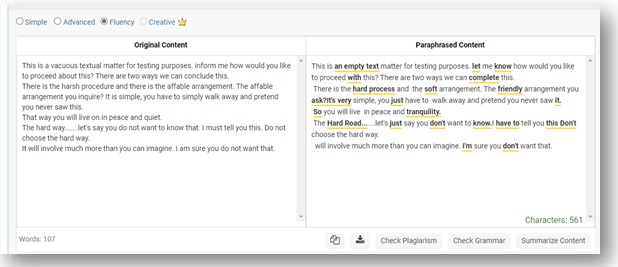
The Prepostseo paraphrasing tool is very useful. It offers a lot of advanced features along with a simple but user-friendly UI.

The tool has various modes available such as Simple, Advanced, Fluency, and Creative. The Creative mode is only available for premium users.

Paraphrasing Tools

Let’s check out each of the free modes.

Simple Mode

In this mode the paraphrasing capabilities are limited. The algorithm that drives this mode only selects some suitable words in the text and replaces them with a synonym.

This is called the synonym replacement technique. This technique is also used in a sentence rewriter tool by SEOMagnifer that rewrite sentence within seconds. It is the simplest paraphrasing technique; hence the name of the mode is “Simple Mode”.

The results of the rephrasing in this mode are very readable, but overall, the text is still very similar to the original.

Advanced Mode

This mode is the same as the simple mode with regard to the algorithm it uses. However, there is one major addition to it that sets it apart.

The result of the advanced mode is randomly highlighted text. On a closer look though, the highlights are parts of the text that was reworded or rephrased.

Advanced mode allows you to click on these highlights and see more suggestions that you can replace them with. Moreover, you can add a word of your own choice if you don’t see it within the suggestions.

This allows you to personalize the results of the paraphrase and make them look more natural instead of robotic.

Fluency Mode

This is the mode that makes this tool great to use. This mode has the most advanced algorithm.

It does not simply use the synonym replacement technique. It complements the standard algorithm by replacing words with phrases and phrases with words.

This changes the sentence structure and the tone of the text. This is the mode that writers want to use, especially when they are trying to avoid using crutch words and bucket brigades.

Creative Mode

This is the premium-only model. In a few words, it can be described as the fluency mode on steroids.

It does everything that the fluency mode does i.e., replacing phrases as well as words. It also changes your sentence structure and tone. Its grammar is good, so you won’t need to edit its results. This mode also changes approximately 80% of your input text.

This is the best mode Prepostseo has on offer and its results are good enough to be called such.

Pricing

There is a premium version of the Prepostseo paraphrasing tool. There are two versions available:

  • Monthly Plan at 19 USD/month
  • Yearly Plan at 125 USD/year

You get to use an extra mode for buying the premium plan which is the “Creative” mode.


Paraphrasing Tools

You can also get more quality-of-life features in the premium version. Some of the features are:

  • No advertisements
  • No captcha required
  • Increased word limit and queries.
  • More languages to work with.

Final thoughts

Prepostseo paraphrasing tool is very extensive even if it’s just considering its free version. You get to use three modes right out of the gate and access to 18 languages. That is quite amazing for a free tool.

Some quality-of-life features are available in this tool, like the capability to upload files for paraphrasing and downloading the results. Integrated summarizer, duplication checker, and grammar checker just add more to this.

The premium plans seem to be affordable, but it depends on the user whether they require those extra queries and word limit. Premium plans can be refunded within a week of buying if the number of queries used does not exceed 10% of the monthly quota. So, you can check it out and refund it if you don’t like it.

All in all, it is a balanced tool with many free features that provide a lot of utility.

3.      Custom-writing.org

This tool is fun to use, to say the least.  It is completely free and does not require any registration. It does not have a premium plan. Custom-writing.org provides other services that have premium plans but this tool they have provided for free.


Paraphrasing Tools

Let’s examine the features of this tool.

Features

  • The algorithm used in this tool seems to be the simple synonym exchange technique.
  • You can choose from 4 settings for the number of words replaced. The settings are 20%, 40%, 60%, and 100%.
  • The output has a lot of highlighted and underlined words which you can manually replace by clicking them and selecting an appropriate synonym from the drop-down menu.
  • No advertisements or captcha.
  • Completely free

Drawbacks

There are some shortcomings as is the norm with free tools. They are as follows:

  • 6,500-character limit.
  • The quality of the paraphrasing is very random. Some sentences are well written while others are really poorly formed.

Final thoughts

This tool is good to use when you cannot paraphrase manually. By using the tool, you will at least have a good starting point.

Professionals may or may not find much use for it. Honestly, it depends on what kind of work they do. Bloggers and content writers might find it useful in rephrasing some of their repetitive text. Students can always use it to avoid repetition in their essays and assignments.

The lack of advanced features is very noticeable. Having one or two could have added more utility to this tool.

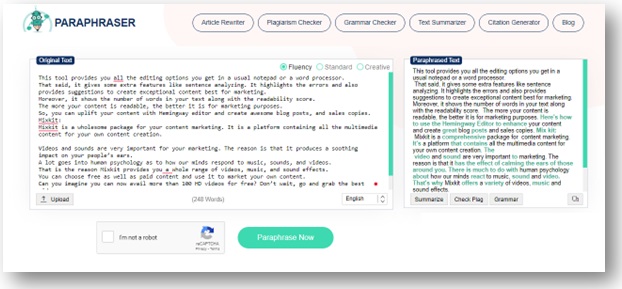
4.      Paraphraser.io

Paraphraser.io is another free-to-use tool that requires no registration.  This tool offers three modes, which are as follows:

  • Fluency mode
  • Standard mode
  • Creative mode


Paraphrasing Tools

We shall examine all the modes it provides.

Standard Mode

This mode is available for free and much like other free paraphrasing tools it only replaces a few words with their synonyms. The final result of this mode is not so different from the original text that is provided to it.

Fluency Mode

This mode replaces more words and sometimes even phrases. It also tries to keep the text readable and grammatically correct.

It utilizes a more advanced algorithm compared to the synonym exchange technique. The results are far better than the standard mode but they still require a bit of tweaking to make them presentable.

This mode is also available for free.

Creative Mode

This is the paid mode that only premium users can use. It can paraphrase your text in such a way that it becomes difficult to recognize the influence of the original.

It changes the sentence structure and it almost completely changes the phrases and words you have used in the original. The final product of this mode is a very smoothly read text that is 90% different from the original.

Pricing

There are two premium plans, a monthly plan, and a yearly plan.


Paraphrasing Tools

The monthly plan costs 20 USD/month while the yearly plan cost 150 USD/year. It does not seem to have a refund policy so be absolutely sure that you want to buy this plan before paying.

Some features that the premium version provides are:

  • The word limit increased from 500 to 1000.
  • Creative mode
  • No advertisements
  • Faster performance

Unfortunately, you still have to deal with the captcha even in the premium version.

Final thoughts

Paraphraser.io is quite a good tool especially considering its free modes. This tool can be used by both professionals and students/casual hobbyists alike. It has some great features such as an integrated grammar checker and duplication checker. This tool also supports more than 11 languages for free.

The only thing that holds it back is the small word limit of 500 words. Even in the premium version this limit only increases to 1000. In my opinion, this should have increased to more than 5000 words at least.

In the end, it is up to your discretion whether you want to buy the paid plan or stick with the free version.

5.      Consizely.com

This is another great paraphrasing tool. Following the trend, it also does not require any account or registration to use, on top of being completely free.  It does have a premium version that offers some quality-of-life features.

However, it does not seem to have different modes that utilize different methods of paraphrasing.

Some features of this tool will be discussed below.

Paraphrasing Tools

Features

  • The result of paraphrasing is broken down into sentences.
  • All changes are highlighted in green.
  • The phrases/words that were removed are shown if you hover over the ‘question mark’ icon at the end of each sentence.
  • The sentences are grammatically correct after rephrasing.
  • No advertisements (even in the free version).

However, there are some clear shortcomings of this tool as well.

Drawbacks

  • Extremely limited input size (15 sentences or less/ 1000 characters only).
  • The paraphrasing is very simple, and the tone and sentence structure remain largely the same.
  • The premium version only increases the input size but doesn’t improve the paraphrasing capabilities.

Pricing

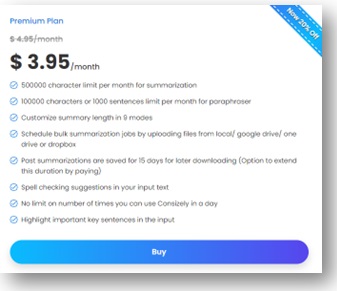
There is a premium version of Consizely. Unfortunately, it is mostly geared towards their other services instead of the paraphraser.


Paraphrasing Tools

For almost 4 USD per month, you get a 1000 sentence limit per month. Yes, you read that right. You can only paraphrase 1000 sentences in one month. That does not sound good at all.

The premium version also does not have any exclusive paraphrasing modes, so there is even less incentive to buy it.

I would suggest not buying the premium version if you are just looking for a paraphraser. There are other tools in this article that have a better premium plan.

Conclusion

These were five of the best AI paraphrasing tools you can use in 2025 for free and without making an account. Some of these are even ad-free.

We took a look at the Linguix.com paraphraser. It provided great results that barely needed to be edited but it had the drawback of having a very small input limit.

We checked out the Prepostseo.com paraphrasing tool. It had great utility due to its integrated features that made it a well-rounded tool for writers in general.

We also checked out the Custom-writing.org paraphrasing tool. It also allowed you to change the words and phrases with the ones you liked in the result.

Paraphraser.io was a great tool with 3 modes for working and it had the outstanding feature of having multiple language support.

Finally, we checked out the Conzisely paraphrasing tool. This tool’s page had no advertisements. It also clearly provided results with all the changes highlighted.

Also, after you have checked your text for plagiarism and used paraphrasing tools, it would be a good idea to check your text for readability. Readability Checker will help you with this: just copy and paste your text into it, wait a couple of seconds, and then correct the errors as the system recommends and the result will surprise you.