UK: +44 2038074555 info@atamgo.com
Top Trends and Innovations in eCommerce You Must Know About

Top Trends and Innovations in eCommerce You Must Know About

ecommerce trends in 2022

The eCommerce industry is ever-evolving, with new innovations and trends coming up every few months. The past year has been no different. The outbreak of the COVID-19 pandemic has led to the rise of many new trends that you must watch out for.

The trends and innovations in the eCommerce industry are mainly focused on taking a customer-centric approach to offer the best possible shopping experience to users. Catching up with these trends will not just help you increase revenue but also give you an edge over your competitors. So, let’s dive right into it.

1. Social Commerce

Social commerce is a potent way to offer native shopping experiences to users on social media platforms such as Facebook and Instagram. This way, shoppers will not have to visit your online store to browse through products. 

Using social commerce, shoppers can directly browse through your products and make a purchase directly from the social media platforms. The trend of social commerce has been on the rise, especially since the pandemic outbreak, after which many brick and mortar stores were forced to shut down.

You, too, can use social commerce not just to increase your sales but to offer an omnichannel experience to your customers. You can get creative by offering personalized product recommendations, using attractive product videos that make users stop scrolling, and using influencer endorsements as a means to attract new customers to your brand.

2. Voice-Search Powered Shopping

With smart speakers finding their way into more and more households, the trend of voice-search-powered shopping also seems to be on the rise. The convenience of voice search allows users to place orders online without having to go through the hassle of visiting the website.

Voice search is also used for other eCommerce related activities such as product research, product and price comparisons, and even get updates on product deliveries. You, too, can take advantage of this trend by hopping onto the voice search game early.

Implementing voice search SEO for your website can be a great way to ensure that your products and your website come up more frequently for voice searches. If you also own a brick-and-mortar store, you should focus on local SEO as it also helps with ranking for voice searches.

3. High-Speed Deliveries

eCommerce giants such as Amazon have normalized same-day and one-day delivery options for customers. Hence, more and more eCommerce businesses are hopping on to the trend to have a competitive advantage in the market.

The advent of drones for deliveries has even made it possible for 1-hour or 2-hour deliveries in recent times. Hence, if you want to stay relevant and offer premium experiences to your customers, it is important to adapt to the quick delivery trend as early as possible.

For offering high-speed deliveries, you should make sure that you pick a shipment partner who offers speedy and automated fulfillment services. This will ensure that your shipping process is speeded up while not compromising on the accuracy of deliveries.

4. Virtual Shopping Assistants

Virtual shopping assistant bots are also increasingly on the rise in 2021. Such AI-powered bots offer shopping assistance to your customers and help them make their shopping experience easier and smoother.

Virtual assistant bots can be versatile and can solve various problems that may otherwise take a lot of manual handling. For instance, virtual assistants can help your customers with simple queries regarding your store, return policies, shipping details, and order updates.

Such assistant bots can also offer other powerful operations such as helping your customers with product research, picking the right sized product, order processing, payment, and assistance in the returns process. Machine learning and natural language processing can enable these bots to adopt a more humanly approach while interacting with your customers.

5. Immersive AR Shopping Experience

Augmented Reality (AR) is not a new concept in the eCommerce industry. But the innovation has been on the rise for the past year. The growing popularity of AR in eCommerce can be attributed to the fact that it helps overcome the biggest disadvantage of online shopping – getting to know the exact look and feel of physical products in a physical store.

AR technology allows online shoppers to view 3D models of your products in real environments. For example, snow camo patterns in fashion items or outdoor gear can be visualized through AR to help customers see how the product fits in a natural or winter-themed environment. AR is mainly on the rise in the fashion and home decor niches where customers can picture the product on themselves or in their home environments.

Brands like IKEA and Target have popularized the immersive AR shopping experience trend. If you own fashion or home decor-related online stores, then you must definitely give AR a try. AR helps eCommerce businesses generate more sales and gain increased visibility amongst the target audience.

6. Value-Based eCommerce Brands

Another trend that has been on the rise is the predominance of value-based eCommerce brands. More and more consumers today are focusing on the values and ethics that an eCommerce brand has to offer. 

A study by Forrester shows that 68% of US consumers agree that the social responsibility and reputation of a brand have an impact on their purchase decision. Hence, taking up social initiatives towards sustainability, environment friendliness, or any other social causes gives eCommerce brands a definite edge over others.

Today, shoppers want their online shopping experience to be transparent and ethical. Shady business tactics that are harmful to the environment with the sole purpose of minting money from the consumers may be an aversion for many. These practices not just turn away a large chunk of shoppers but may also lead to a bad reputation for your brand.

You, too, can take up an initiative towards contributing towards a social cause that aligns with your brand’s values. Even a small initiative can be a game-changer for your eCommerce business while contributing to the greater good. It is also important to make sure that you hire employees whose values align with your business’s values.

Final Thoughts

In 2021, simply having high-quality products and spending good money on ads wouldn’t suffice. The number of innovative eCommerce businesses is on the rise, and the best way to fool-proof your business’s future is by hopping on to these trends early on.

So, start adopting the eCommerce trends and innovations mentioned above right away, and you’re soon to see a definite boom in your business’s profits and popularity.


Our Latest Articles

7 Remarkable Tools to Save Snapchats Instantly (No Login Required)

7 Remarkable Tools to Save Snapchats Instantly (No Login Required)

Want to keep a hilarious video or a cherished memory before it vanishes forever? In 2026, saving Snaps doesn't have to be a race against the timer. This guide reveals the safest, fastest ways to archive content without ever compromising your account security. To save...

The Quiet Tech Transformation in Carpet Cleaning

The Quiet Tech Transformation in Carpet Cleaning

Carpet cleaning still looks like an old school service from the outside. A van pulls up, a technician unloads equipment, and the customer judges the result with one glance at the floor. That part has not changed. What has changed is everything wrapped around the job....

10 Best Alibaba Alternatives: B2B Websites to Use In 2025

10 Best Alibaba Alternatives: B2B Websites to Use In 2025

b2b websites like alibaba

Introduction: Why B2B Websites Are Essential in 2025

B2B Websites have become the backbone of global trade in 2025. Whether you’re sourcing raw materials, wholesale electronics, or niche handmade products, the right B2B marketplace can save you months of searching and thousands of dollars in negotiation.

Alibaba might still dominate the conversation, but it’s no longer the only option. Buyers are exploring new marketplaces that offer better supplier vetting, faster logistics, and improved buyer protection. If you’ve ever thought, “I need a reliable Alibaba alternative”, you’re in the right place.

B2B websites

Beyond listing the platforms, this guide will also touch on things like B2B website design (why user experience matters when sourcing products) and when it makes sense to work with a B2B website design agency if you’re building your own marketplace.

What Makes a Great B2B Website in 2025?

Before we dive into the top platforms, let’s set the baseline: what actually makes a B2B website “great”?

Trust and Supplier Verification

In B2B, trust is everything. A great platform makes sure suppliers are verified and buyers feel safe. Look for platforms that offer background checks, certificates, or even in-person trade shows.

B2B website

Product Variety and Global Reach

If you’re only sourcing from one country, you’re missing out. The best B2B websites in 2025 offer global reach so you can compare prices and quality across regions.

Pricing Transparency and Negotiation Features

Hidden fees are a deal breaker. Top platforms now show transparent pricing and sometimes even have built-in negotiation tools to simplify the process.

Logistics, Shipping, and Payment Security

Sourcing doesn’t end with a signed deal — shipping and payment matter just as much. Strong platforms integrate with logistics providers and payment protection systems.

10 Best Alibaba Alternatives: B2B Websites to Use in 2025

Alright, here’s the list you came for.

1. Amazon Business – Streamlined Wholesale Sourcing

Amazon Business has evolved into a serious B2B marketplace. It offers bulk pricing, tax-exempt purchasing, and easy integration for businesses that already rely on Amazon for distribution.

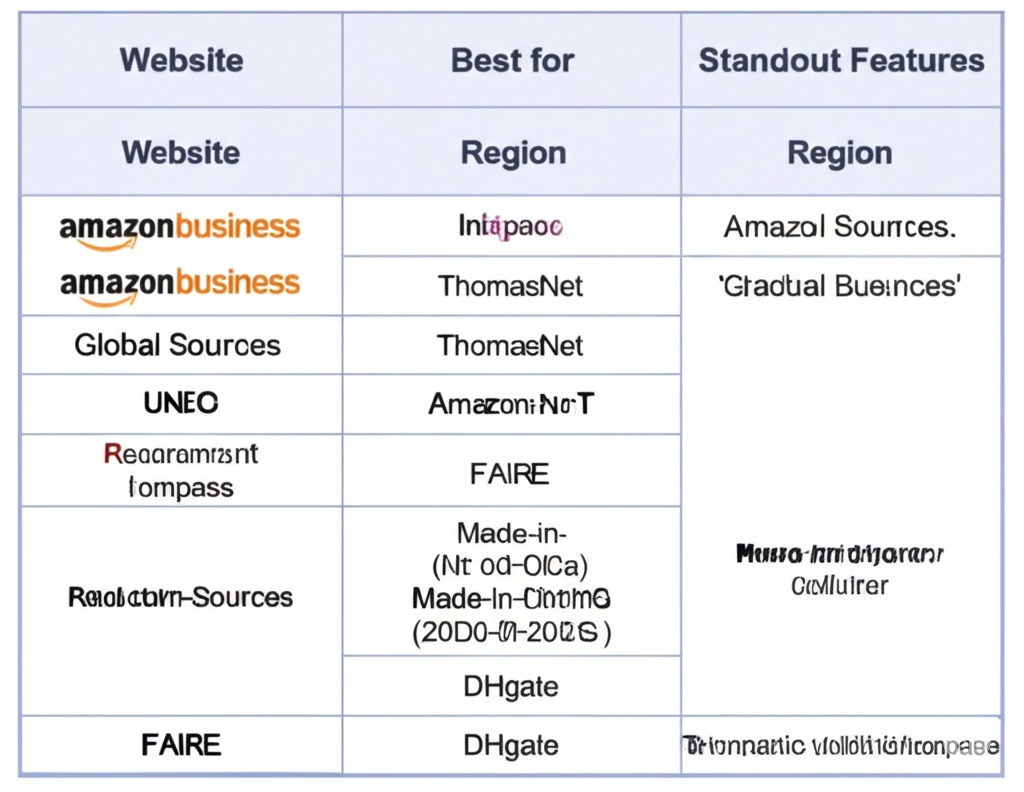
  • Best for: Companies in the U.S. and Europe looking for fast shipping.

  • Standout feature: Built-in buyer protection backed by Amazon’s trust.

2. Global Sources – Verified Suppliers and Trade Shows

Global Sources has a reputation for strict supplier verification. They also run trade shows in Asia where buyers can meet suppliers in person, which adds another layer of trust.

  • Best for: Electronics and hardware sourcing.

  • Standout feature: Hybrid approach (online + offline trade shows).

3. Made-in-China – Competitive Pricing from Chinese Manufacturers

Think of Made-in-China as Alibaba’s cousin, but with more manufacturer-focused listings. The pricing here can be very competitive, especially for large orders.

  • Best for: Businesses prioritizing cost savings.

  • Standout feature: Detailed supplier certifications.

4. IndiaMART – Expanding Access to Indian Suppliers

IndiaMART is booming thanks to India’s growing role in global manufacturing. From textiles to machinery, it’s becoming a strong Alibaba alternative.

  • Best for: Buyers seeking Indian suppliers for textiles, chemicals, or machinery.

  • Standout feature: Local language support for Indian SMEs.

5. DHgate – Affordable Wholesale for SMEs

DHgate is a smaller, scrappier alternative. While it doesn’t match Alibaba in scale, it’s SME-friendly with low minimum order quantities (MOQs).

  • Best for: Startups testing small batch orders.

  • Standout feature: Lower order minimums compared to Alibaba.

6. ThomasNet – Reliable U.S. Supplier Directory

ThomasNet is less of a marketplace and more of a supplier directory. It’s particularly strong for industrial goods and North American suppliers.

  • Best for: B2B buyers in the U.S. and Canada.

  • Standout feature: Transparent supplier information and reviews.

7. TradeIndia – Growing B2B Marketplace in Asia

Another Indian giant, TradeIndia is pushing hard into international markets. It offers a wide range of categories, from agriculture to consumer goods.

  • Best for: Buyers seeking cost-effective suppliers from India.

  • Standout feature: Competitive pricing in niche categories.

8. ECPlaza – International Trade with a Korean Edge

ECPlaza, based in South Korea, is a hidden gem. It’s gaining traction for electronics, beauty products, and K-brands.

  • Best for: Businesses looking for Korean innovation.

  • Standout feature: Strong in consumer electronics and beauty.

9. Europages – European Supplier Network

If you’re in Europe, Europages is a go-to directory for vetted suppliers. It’s widely used by SMEs across the EU.

  • Best for: Companies prioritizing EU-based suppliers.

  • Standout feature: Multilingual supplier profiles.

10. AliExpress – Retail + Wholesale Hybrid for Global Buyers

While AliExpress is technically a retail marketplace, many businesses use it for small wholesale purchases before scaling up. It’s perfect for dropshippers and e-commerce startups.

  • Best for: Dropshipping and small orders.

  • Standout feature: Fast shipping options and buyer protection.

B2B website

How to Choose the Right B2B Website for Your Business

Considering Product Category and Niche

Some platforms are stronger in specific niches. For example, Global Sources dominates in electronics, while IndiaMART shines in textiles.

Supplier Location and Shipping Speed

If you’re selling in the U.S., sourcing from U.S.-based suppliers (ThomasNet, Amazon Business) can save weeks in shipping.

Payment Options and Buyer Protection Policies

Never compromise here. Always choose a platform with escrow, dispute resolution, or verified supplier programs.

Platform Fees and Long-Term Scalability

Some B2B websites charge subscription fees to access premium suppliers. If you’re planning to scale, factor in those costs early.

Future of B2B Websites Beyond 2025

AI and Automation in Supplier Matching

Imagine logging in and instantly being matched with the best supplier based on your budget, location, and volume. AI is already making that happen.

Integration of Logistics and Fintech Solutions

Expect more platforms to offer end-to-end services: supplier sourcing, shipping, customs clearance, and financing — all under one roof.

Sustainability and Ethical Sourcing Trends

More buyers now ask: “Is this supplier sustainable?” B2B websites that highlight eco-friendly and ethical suppliers will stand out.

B2B website

Conclusion: Leveraging B2B Websites for Growth in 2025

The world of B2B websites has expanded far beyond Alibaba. Whether you’re looking for U.S. suppliers, cost-effective Indian manufacturers, or niche Korean innovators, there’s a platform tailored to your needs.

The trick isn’t to rely on just one site. Diversify your sourcing, test platforms, and build long-term supplier relationships. And if you’re building your own marketplace? Investing in good B2B website design — ideally with the help of a B2B website design agency — can make the difference between a clunky catalog and a trusted global platform.

FAQs on B2B Websites and Alibaba Alternatives

What is the best B2B website like Alibaba in 2025?

It depends on your needs. For electronics, Global Sources is excellent. For U.S. buyers, ThomasNet works best. For low MOQ, try DHgate.

Are Alibaba alternatives safe for international buyers?

Yes, as long as you use platforms with supplier verification, escrow payments, and buyer protection.

Which B2B platforms are best for small businesses?

DHgate, AliExpress, and IndiaMART are great for smaller orders and startups. You can also leverage Atamgo’s expertise to grow your B2B online business

How do B2B websites protect buyers from scams?

Most now use verification badges, escrow systems, and dispute resolution services.

Can B2B websites also help with shipping and logistics?

Yes. Platforms like Amazon Business and Global Sources integrate with logistics partners to simplify the process.

Author: Wail Amrani

Wail is a Shopify Expert & eCommerce Growth Consultant. Former digital marketing manager at Shopify I’m helping brands & retailers build 8-figure eCommerce. I’ve been leading digital growth for both online and retail brands for over 7 years.

Squarespace vs Big Cartel – What is The Difference? Review 2022

Squarespace vs Big Cartel – What is The Difference? Review 2022

Squarespace vs Big Cartel

Welcome to the complete Squarespace vs Big Cartel e-commerce builder comparison.

Picking the best eCommerce builder for your online store is a tough decision. It’s even harder when you consider the many excellent options available. How do you know the right one for your business? And even if you narrow it down to 2 options like Big Cartel and Squarespace, which one do you go for?

To help you out, we’ve done the hard work and compared 2 of the biggest eCommerce builders side by side: Big Cartel and Squarespace. Every platform has its strengths and its weaknesses and in the case of Squarespace and Big Cartel, they’re both designed to satisfy different needs. Squarespace, for example, is primarily a website builder that provides eCommerce functionality but Big Cartel is a solution for eCommerce stores alone.

Naturally, this would mean that their target audiences would vary. So before going for one of them you have to be certain that your brand’s needs are in tandem with the target audience the platform creates solutions for.

Squarespace, for instance, aims to provide an all-rounded experience and sophisticated eCommerce features, which makes it the perfect choice for small and medium scale full-time online businesses. Big Cartel, on the other hand, primarily targets hobby sellers, particularly artists. So depending on the purpose of your online store, your preferences and value for the features offered by each will differ.

We’ve run through each builder carefully and listed out their eCommerce features, pros and cons, ease of use, website design, marketing, and website features, pricing and transaction fees, customer support, and lots more.

Squarespace vs Big Cartel: Overview

Let’s have a brief overview of both Big Cartel and Squarespace. This will help bring some clarity into why they offer certain features and give you a general understanding of the platforms.

Squarespace


Squarespace vs Big Cartel


As already stated Squarespace, with over 4.086 million subscriptions, was primarily created as a website builder but they offer Squarespace Commerce as part of their solution. Squarespace Commerce is a perfect choice for online businesses that want to build and manage a state-of-the-art store. The platform is generally easy to use and features a huge selection of functionalities as well as permits unlimited product inventory.

You can view Squarespace Commerce as a professional eCommerce builder. As a user, you will have access to tons of powerful features including unlimited storage and bandwidth, analytics tools, a library of aesthetically compelling professional templates, and POS.

Squarespace Commerce is a completely hosted solution, which means you don’t have to bother about handling or managing any backend task. That said, while Squarespace offers a great platform and feature set, their editor may take a little getting used to and you may notice a couple of limitations with regards to integrations permitted.

So Squarespace Commerce is the perfect eCommerce platform for full-time online businesses that combines an easy-to-learn user interface with the ability to use more advanced features such as discounts and promotions, theme editing, and POS.


Big Cartel


Squarespace vs Big Cartel


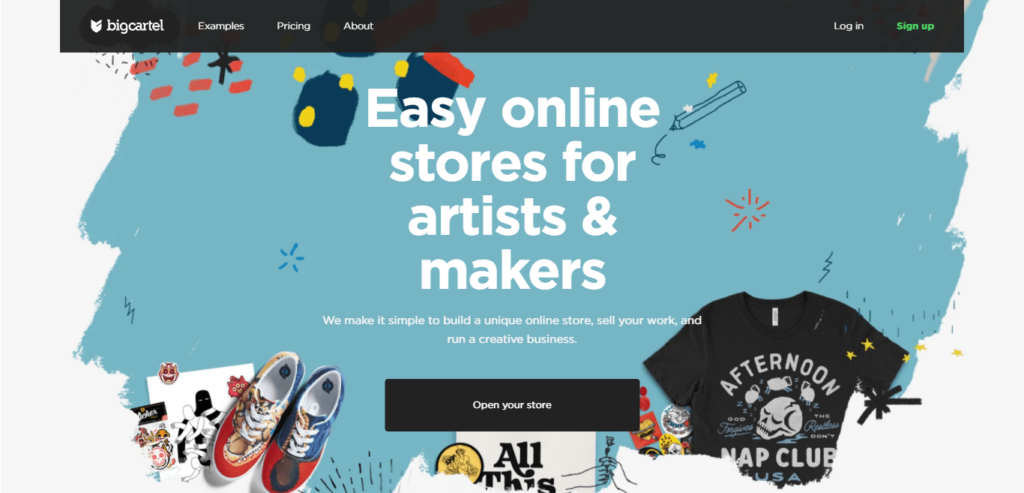
Big Cartel is a completely hosted eCommerce solution that was created especially for small-scale creatives. If you intend to sell original creations like jewelry, refurbished furniture, woodwork, and art then Big Cartel is a perfect choice.

The platform provides functionality and a general look that is straightforward and minimal but this doesn’t mean that Big Cartel skips quality for support or features. As a user, you will have access to comprehensive and in-depth eCommerce tools inclusive of promotional features, social media (like Facebook and Instagram) platform integration, and payment gateways. It is also fairly priced for small-scale creative businesses with its plans starting at $10 per month and also including a forever free option.

But if you are a retailer who wants more than a couple of hundred product listings and an even more powerful feature set then you may want to opt for another solution, as Big Cartel is primarily focused on small-scale businesses. So generally speaking Big Cartel would be your best pick if you are creative with an inventory of less than a couple of hundred products and are searching for a cost-effective and hassle-free solution.


Squarespace vs Big Cartel: Pros and Cons

Regardless of how great these two eCommerce platforms are, every solution has its advantages and disadvantages, so will be looking at that in this section:

Squarespace Pros and Cons

Pros 👍

  • While it may take getting used to Squarespace Commerce offers an easy-to-use management dashboard and website builder.
  • Squarespace allows unlimited products for your inventory.
  • With Squarespace, you get access to professional and stylish themes that are known for aesthetic beauty.
  • Squarespace provides powerful website features that will aid in boosting your online store.
  • Squarespace features some amazing eCommerce capabilities like providing analytical tools and a powerful inventory system.

Big Cartel Pros and Cons

Pros 👍

  • Big Cartel offers a gorgeous and artistic collection of professional-looking themes.
  • This eCommerce builder allows you to set up your online store in a couple of minutes.
  • Big Cartel is easy to use and highly intuitive.
  • Big Cartel allows you to sell without cost as it has a free plan, unlike Squarespace.
  • Big Cartel is great for hobby stores and ideal if you sell individual creation pieces or a small inventory.
  • The on-boarding process is quite straightforward as you just need to follow the helpful tips and reminders for a seamless setup

Squarespace vs Big Cartel: Pricing and Value

Regardless of the amazing features that these powerful eCommerce builders offer, if they cost way above your budget for a builder, then it will mean nothing. Also, even if it’s within your budget you have to be sure that you’re getting the right value for your money.

It doesn’t get better than the assurance that you’re getting quality value for your cash. And when it comes to choosing an eCommerce builder this is especially true. You have to ensure that it is a great return on your investment even from the get-go.That said, let’s look at the pricing options in this Squarespace vs Big Cartel comparison.


Squarespace Commerce Pricing 
 

Squarespace vs Big Cartel


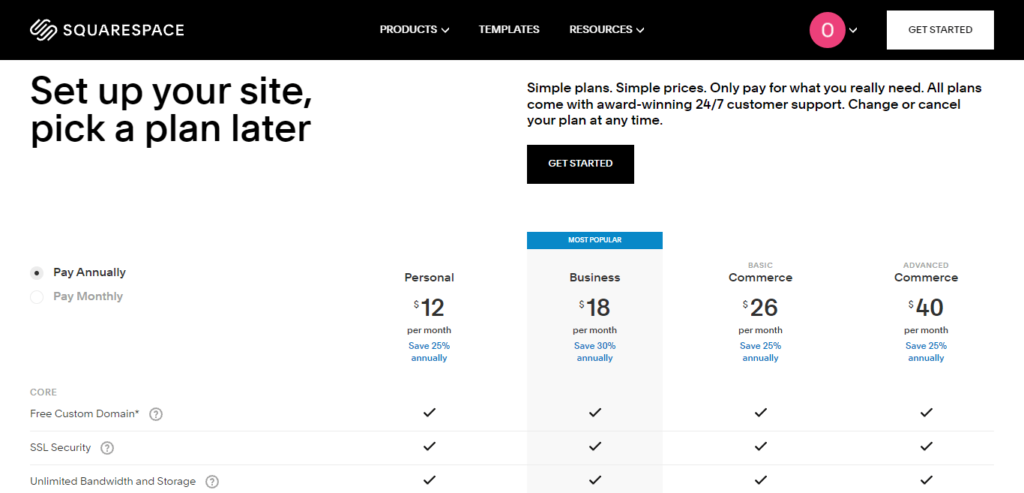
Squarespace does not offer a free plan like Big Cartel. But Squarespace’s eCommerce plans come in the following packages:

Basic Commerce Plan

The Basic Commerce plan costs $26 per month and offers a 25% discount if you decide to pay annually. The features that this plan offers include the following; SSL security, a free custom domain, SEO features for website visibility, unlimited storage and bandwidth, templates that satisfy every need from portfolios to blogs, mobile-optimized websites, Squarespace extensions, basic website metrics, 24/7 customer support, premium integrations and blocks, complete customization with JavaScript and CSS, and a professional Google email.

The eCommerce features of this plan include the following: promotional banners and pop-ups, advanced website analytics, gift cards, fully integrated eCommerce, $100 Google ADs credits, accept donations, zero commerce transaction fees, sell unlimited products, powerful eCommerce analytics, checkout process on domain, Point of Sale, tag products on Instagram, and access to powerful merchandising tools.

Advanced Commerce

The Advanced Commerce plan by Squarespace costs $40 per month and offers a 25% discount if you choose their annual payment option. The general features of this plan include a free custom domain, SSL security, SEO functionality for website visibility, unlimited storage and bandwidth, unlimited contributors, templates that satisfy every website need, basic website metrics, 24/7 customer support, Google professional email, premium integrations and blocks, Squarespace extensions, complete customization with JavaScript and CSS.

The marketing features include advanced website analytics, $100 in Google ADs credit, promotional banners and pop-ups, Squarespace video studio app. The strictly eCommerce features include zero commerce transaction fees, the ability to accept donations, Point of Sale, fully integrated eCommerce, gift cards, sell unlimited products, checkout process on your domain, powerful merchandising tools, powerful eCommerce analytics, abandoned cart recovery, advance discounts, commerce API, sell subscriptions, limited availability labels, advanced shipping, and tag products on Instagram.


Big Cartel Pricing 
 

Squarespace vs Big Cartel


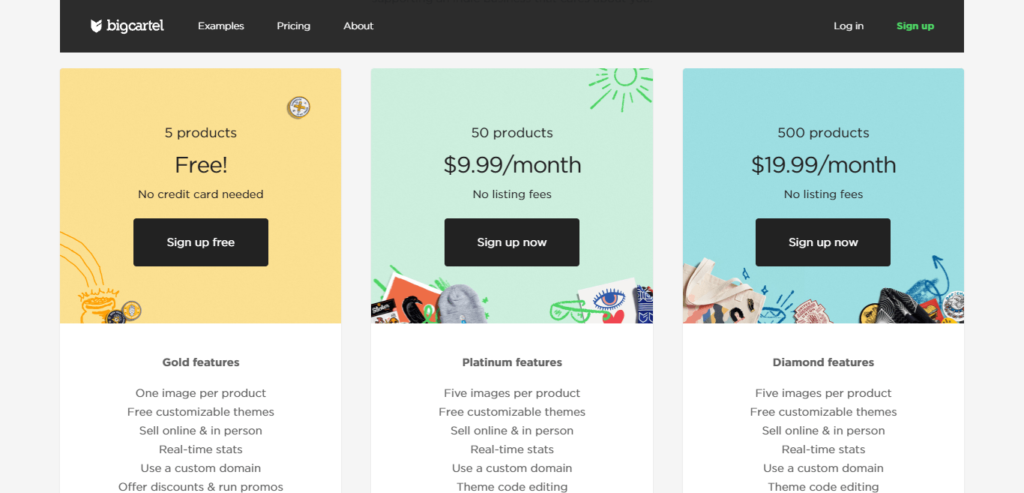
Here are the pricing options from Big Cartel:

Free Plan

The Free plan is just like its name, free. It costs nothing and doesn’t even require a credit card to sign up. Some of the features included in the package are 1 image for each product, real-time statistics, product option groups, shipment tracking, use of a custom domain, sales tax autopilot, free customizable themes, the ability to both sell in-person and online, and run promos and offer discounts.

Platinum Plan

The Platinum plan costs $9.99 per month and can cater to 50 products in your inventory. There are also no listing fees associated with this plan. Some of the features of the Platinum plan include 5 images for each product, real-time statistics, use of a custom domain, Google Analytics, bulk editing, sales tax autopilot, shipment tracking, inventory tracking, theme code editing, free customizable themes, sell in-person and online, run promotions and offers discounts, and product option groups.

Diamond Plan

The Diamond plan costs $19.99 per month and can cater to 500 products in your inventory. There are also no listing fees associated with this Big Cartel plan. Some of the major features of this plan include 5 images for each product, real-time statistics, free customizable themes, theme code editing, Google Analytics, the ability to run promos and offer discounts, bulk editing, sales-tax autopilot, shipment tracking, product option groups, use of a custom domain, sell in-person and online, inventory tracking and theme code editing.

Big Cartel aims to have pricing plans that fit into all types of budgets. If you are just starting with limited or no capital you can opt for the free one. Or if you are a small business, the middle tier (Platinum plan) works fine. For medium-scale businesses with some sort of establishment, the Diamond plan is the perfect fit.

Squarespace vs Big Cartel: Ease of Use

There are two major aspects with regards to ease of use: the getting started the process and managing your store after setup. We will use these 2 aspects to determine the ease of use of both Squarespace and Big Cartel.


Squarespace: Getting Started 

 

Squarespace vs Big Cartel


Starting with Squarespace is a lot less straight to the point. Unlike an AI website builder that can automate much of the process, once you pick your desired template, Squarespace shows you a quick Gif-like tutorial pop-up, and then you can view a setup checklist in the editor. But it’s a lot more difficult to find out where the tools you need are and how to start editing. That said, in the long run, after the learning curve, Squarespace is a lot easier to use. So if you are new to website building, Squarespace comes off as a tad bit intimidating but if you make it through the initial stages, you can get familiar with it in a couple of hours.


Big Cartel: Getting Started 


Squarespace vs Big Cartel


In comparison to Squarespace, Big Cartel provides the most seamless onboarding experience. Once you choose your plan and input your details the platform will direct you to your dashboard using various prompts built to ensure that the setup process is very easy. Big Cartel feels very pressure-free and you don’t have to guess about anything during the setup process.


Squarespace: Store Management 


Squarespace vs Big CartelAfter you get a handle on Squarespace’s editor, you’ll discover it’s one of the simplest platforms to use available and provides an insane amount of creative control regarding your store’s design. The truth is the more you use Squarespace the easier it becomes to navigate. The primary factor that makes Squarespace’s commerce builder come on top concerning store management is that you can build aesthetically appealing websites in a matter of hours without any prior technical know-how or coding. Also, Squarespace offers a what-you-see-is-what-you-get (WYSIWYG) editor, which means that you can see your changes as they are made, so you have a reduced chance for error.

So, despite the initial steep learning curve, Squarespace is easy to use and straightforward when you make it through the initial process and figure out where each tool is. Also, it eliminates the requirement of knowing how to code to get the best out of its templates.


Big Cartel: Store Management 


Squarespace vs Big Cartel


Big Cartel isn’t as straight to the point as it initially appears during the getting started the process. This is because Big Cartel requires a bit of technical know-how than you may expect at the initial stages. The templates it offers are very basic so if you intend to take your store to a professional level you’ll have to know some kind of coding to enhance functionality. This can get frustrating for starters and even experienced designers, especially when you desire to have full control over the appearance of your online store. You can build your online store without knowing how to code but the result won’t be as professional as what you would get with Squarespace’s versatile templates. 

Squarespace vs Big Cartel: Design

Let’s have a look at these two builders’ design features.

Squarespace 


Squarespace vs Big Cartel


Squarespace is king when it comes to the beauty of its website designs. It’s right there on the same level as the kind of templates you can expect from platforms such as BigCommerce with regard to design functionalities.

Squarespace offers a host of amazing templates that you can pick from and they all have the necessary functionalities for creating a compelling online store. Also, Squarespace separates its template by industry which means regardless of what you intend to sell to have a starting point.

That said, you can choose any template that you find appealing enough and then adjust it to satisfy your needs. Squarespace features a drag-and-drop editor that allows you to have an insane amount of creative control over your online store. You can pick and move elements with one 1-click and include additional pages. You can even easily change your colour schemes and fonts to align with your business and brand.

Every one of Squarespace‘s templates is image-centred which means if you don’t have high-resolution visuals of your own, you can use them instead as Squarespace has a partnership with Getty Images. Most of these visuals are free but some require a tiny fee.


Big Cartel 


Squarespace vs Big Cartel


Big Cartel’s templates designs in comparison to Squarespace may come off as a little basic or plain. The platform only offers a couple of templates that you can pick from and even though they have attractive and clean designs when compared to Squarespace’s visually appealing layout they pale in comparison. And if you want to enhance the way they look, that’s where it gets difficult. In fact, customization is restricted by the theme that you pick and the Big Cartel editor only permits you to make minute changes such as adjusting basic layout colours, font sizes, and logo.

If you want to do drastic changes to your online store then you have to get into the code of the theme which isn’t the most user-friendly approach to online store customization.

What’s more, Big Cartel unlike Squarespace does not offer templates that support product videos or product zoom. And since visuals play a huge role in the consumers’ online buying decision, the lack of this feature may even affect your conversion rates.

That said, both Big Cartel and Squarespace permit users to change their themes whenever they choose. You don’t have to bother about choosing the right thing at the get-go. If you find out later on that it isn’t the best fit for your brand you can pick another one. However, Big Cartel will have to re-upload elements such as background images, though your products won’t be affected.


Squarespace vs Big Cartel: Ecommerce Features 

With regards to the eCommerce features of both Squarespace and Big Cartel, the differences between them become obvious very quickly with Squarespace being the eCommerce website builder with a more in-depth list of features. That said, we will look at the important features that an eCommerce platform must have and see how each of these builders aligns with it.


Inventory 

The primary purpose of an online store is to offer and sell your products on your website. So you must ensure that you pick a builder that is capable of accommodating your products. Say, for example, you have 1000 products in your inventory, the builder that you choose has to be capable of catering to that number of items. Big Cartel faces limitations in this area and the number of products you can have displayed and sold is dependent on the pricing plan that you choose. For instance, if you go for the free plan, you can only sell 5 products but with the higher plans, you’ll be able to sell up to 500 products. These restrictions are perfect if you run an online store as a hobby or side hustle but if you are full time into the eCommerce sphere it’s a huge letdown.

Squarespace, on the other hand, provides enough space for unlimited products and even accommodates product variants. So you’ll be able to feature products in different sizes and colours, which is a great function if you are in the fashion industry, for instance. There’s even a function that allows your product variants to be shown to the customer as small thumbnails on the screen. This allows a customer to view all product variants on a single page.

Squarespace also features a content manager that enables you to organize and oversee your stock levels from one place. This is a great feature since you can add an unlimited number of items and a sizable range of product variations. It helps more control and organization.

That said, Big Cartel also features the ability to include different product variations. However, it does not allow you to show them as miniature thumbnail visuals on your product pages rather the customer will have to view them as drop-down lists. While this isn’t as flamboyant it enables your lists to stay straight to the point and tidy.


Types of Products Permitted 

These days eCommerce goes beyond selling just physical products, brand’s offer subscriptions, and digital products as well. Squarespace excels in this area as the platform provides you with all that you need to sell digital products from the get-go. It even allows you to sell services which is extremely useful if you are a SaaS brand or consultant.

Big Cartel, unfortunately, does not automatically support the sales of services or subscriptions, or digital products. If you intend to sell digital products then you must download third-party apps for this. While a couple of them go for no cost, most of them have monthly charges attached and this increases the overall budget for running your online store.


Taxes 

When it comes to eCommerce, taxes are a huge aspect to handle. But the great news is that Squarespace and Big Cartel offer functionalities that will help you out.

Squarespace permits users to create different tax rules for every location that they ship to. This means you can be certain that you comply with the local tax requirements of all such locations. You can even opt for a Squarespace extension like TaxJar to simplify things some more.

Big Cartel automatically calculates your tax as well, and even adjusts the consumer’s total at checkout based on their location. This means you don’t have to waste time and stress over complex tax equations to ensure that you get accurate numbers. However, this feature is currently only applicable to orders within the United States.


Cart Abandonment Recovery and Purchase Confirmation


Both Big Cartel and Squarespace are built to send automated purchase confirmations when you conclude a sale, the process is seamless and fast. They also allow you to send shipment notifications to your customers which enables them to track their order status.

Squarespace, however, goes the extra mile and provides abandoned cart recovery on its highest commerce plan. This implies that when a consumer begins the checkout process but does not complete it, via the platform you can send them an email that prompts them to return and finish their purchase. This is a powerful way of re-engaging indecisive consumers.

This feature isn’t offered by big Cartel and that’s a minus with regards to the platform’s eCommerce functionality.


Integration with Social Media Platforms


These 2 builders feature social media integrations that let you share your products across a couple of social media websites and even tag your offers on Instagram.


Store Analytics


Your online store analytics (data) is one of the most vital aspects of ensuring success. For Squarespace, they satisfy all the necessary factors concerning analytics. They even have a custom analytics solution that allows you to track customer behaviour, track revenue, discover total conversions and orders. However, Squarespace does not feature stock monitoring alerts.

Big Cartel doesn’t feature this ability but depends on third-party apps to offer analytics to users. If you are on one of its paid plans either Diamond or Premium, you’ll have access to Google Analytics which you can use to gain accurate and powerful insights into your store’s performance. What makes this a big loss for Big Cartel when compared to Squarespace is that the latter also allows you to integrate Google Analytics into your store. So with Squarespace, you have access to both custom analytics from the platform and Google Analytics which will help you get even more accurate and precise data.


Squarespace vs Big Cartel: Payment Options


Squarespace vs Big Cartel


Squarespace and Big Cartel both provide a couple of payment options to make the checkout process seamless for your customers. However, of the 2, Squarespace works with more payment gateways than Big Cartel does. But Big Cartel does not feature transaction fees even on its free plan, while Squarespace will charge you an additional 3% unless you upgrade to the Advanced Commerce plan or Basic Commerce plan.

Squarespace is compatible with the following payment gateways: PayPal, Stripe, Venmo, Apple Pay, Afterpay, and Square.

Big Cartel on the other hand is compatible with Square, PayPal, and Stripe.


Do Big Cartel and Squarespace Allow you to Sell Offline?


You may decide to take yourself offline and wonder if Big Cartel and Squarespace allow you to sell in real life. The great news is that both of these eCommerce builders allow you to accept payments in person.

You can do this with Squarespace using its Square integration. You would just have to download the Squarespace Commerce app and buy a Square card reader for an extra $49. You can even sync up with your web inventory so that whenever you make a sale your stock numbers automatically adjust to reflect it.

With Big Cartel you can receive offline payments through its mobile application which is available for both Android and iOS systems. Also with Stripe for Big Cartel, you can receive card payments and even include special offers and discounts to your pricing. The Big Cartel option for offline sales isn’t as sophisticated as the one from Squarespace but it’s perfect for small businesses.


Payment Process


When you use a third-party payment gateway most times the customer will have to leave your store to complete the purchase. This may be inconvenient and can make your checkout process very stressful. But with Squarespace the process is different. Your customers won’t have to go to a different web page to finish off their purchase.

Big Cartel, unfortunately, doesn’t provide this but if Stripe is available for you, customers that opt for Apple Pay can get Instant Checkout, which means they don’t have to leave your page. Also, Big Cartel does not store customer data or provide the option to save payment options and details, meaning potential customers will have to input their details every time they intend to purchase.


Squarespace vs Big Cartel: Marketing Features

While you may just be interested in each platform’s eCommerce features, it’s important to know the marketing features of each of these builders as that is responsible for store growth. So we’ll look at major marketing aspects and how these builders align with them.


Search Engine Optimization


Search Engine Optimization (SEO) is an indispensable part of running an online store. It is what is responsible for your website ranking high on search engines, which boosts your visitor numbers.

Squarespace handles SEO perfectly. The platform comes with a custom suite of built-in optimization functions, which are applied automatically to all of its websites. This handles the technical aspects of SEO such as meta tags, HTML markup, meta tags, and lots more. There’s also an SEO checklist provided that assists you in ensuring that you’re on the right track to improving your website’s ranking, which is great if you’re a fresher to the whole SEO thing.

Squarespace vs Big CartelBig Cartel also offers the same type of features. It automatically allocates alt tags for images and provides search engine-friendly URLs. But in comparison to Squarespace, you’ll have to do a lot more to ensure that it has a valuable impact on your ranking. There’s also no checklist like with Squarespace to aid you in the process.


Email Promotions


Squarespace provides custom software for email marketing. Just like its website templates, every one of Squarespace’s email layouts is aesthetically pleasing and can be customized to fit your brand. There’s a free 14 day trial for testing their email marketing feature but if you want a permanent plan then you need to pay. The cheapest email marketing plan costs $8 per month.

Squarespace vs Big Cartel


With Big Cartel you don’t have access to a custom email solution, rather you need to use an app extension to get this ability. You can integrate Big Cartel to MailChimp for no cost.

Blog 

Squarespace permits you to attach a blog to your online store. The blogs are integrated into all its eCommerce templates. For Big Cartel, adding a blog to your store isn’t as simple. There’s no inbuilt offering, so you’ll have to use a third-party app to include an app. A real bummer is that you may even have to know some code to link it up to your online store.


Squarespace vs Big Cartel: Customer Support

Except you’ve been doing this for years there is a huge possibility that you may face some roadblocks here and there when you try creating your online store. This means that your chosen builder’s support feature is vital.

Squarespace is far ahead of Big Cartel with regards to customer support. The platform offers a massive range of solutions to help you get out of complex issues including email support and live chat. You can even reach out to them on Twitter. Squarespace does not offer phone support currently but taking into account the number of ways you can reach them directly this lack is inconsequential.

Big Cartel in comparison to Squarespace doesn’t measure up, as the only available channel for customer support is through email. And this is only open Monday to Friday from 9 a.m. to 6 p.m. They may seem to offer live chat support due to the tiny box at the left-hand corner of your screen but that’s an email line as well. The answers to the questions you post in there are sent right to your inbox a couple of hours later. So if you face problems beyond the set hours their email support is open, then you have to go to Big Cartel’s help center. It is very easy and clear to navigate and it is extremely text-based. So, if you are a visual learner it may be difficult to understand and use.

Squarespace also offers a knowledge base and this is a great source of information as it features built-in video tutorials and written instructions. In comparison to Big Cartel’s knowledge base, it’s a lot more comprehensive.


Squarespace vs Big Cartel: Security

Squarespace and Big Cartel come out of the box with a free Secure Sockets Layer (SSL) certificate. This means that the connection between your website and browser is secure, and customers don’t have to worry about their data becoming unsafe. If you run an online store, this is a must-have because your customers will input sensitive payment details when they want to make payment for an item.

Squarespace takes this seriously and runs regular scans across every one of its websites and also provides DDoS (Distributed Denial of Service) protection. This means Squarespace protects against competitors using bots to overwhelm a website by sending a spike of fraudulent traffic, which causes your website to crash, ultimately preventing your customers from accessing your online store. This is particularly horrible in eCommerce as downtime means no sales.

That said, with Squarespace an important feature to note is that it is completely PCI-DSS compliant (Payment Card Industry Data Security Standard). This implies that it satisfies all approved standards for companies that handle payment or credit card details.

Unfortunately, Big Cartel isn’t PCI-compliant, which means that if you opt for the platform the responsibility of sticking to these guidelines is completely on you. This isn’t just stressful but it increases pressure as well. Most eCommerce builders and platforms handle this for you, so you can focus on boosting sales and running your store.


Conclusion 

Squarespace and Big Cartel both offer eCommerce services but that doesn’t imply that they are each capable of supporting and building the same kind of online stores. So the best choice for your business would be entirely dependent on the type of store you intend to build.

Squarespace, for example, is the best fit for small to medium-sized businesses or eCommerce agency that intend to scale. It’s also great if you are searching for a visually appealing website that can host high-resolution images. Big Cartel, on the other hand, is best suited for independent creative sellers and artists that need a platform for custom products. This way its limited inventory capability won’t be too much of a restriction. Plus, its free plan and cheap costs are great for people who are in the eCommerce space as a hobby.

Overall, Squarespace offers a lot stronger functionalities and is better for established or full-time brands but if you are an artist or run an online store as a side hustle Big Cartel is the better option.

Tags:

Author: Wail Amrani

Wail is a Shopify Expert & eCommerce Growth Consultant. Former digital marketing manager at Shopify I’m helping brands & retailers build 8-figure eCommerce. I’ve been leading digital growth for both online and retail brands for over 7 years.

How to Generate More Leads for Your Ecommerce Store through Digital Marketing

How to Generate More Leads for Your Ecommerce Store through Digital Marketing

How to get more leads

We’re living in a tech-driven world and today, digital means have changed the way used to manage or market businesses. With most businesses going online on Ecommerce platforms, promoting businesses by launching a flyer campaign and knocking door to door has become obsolete. However, creating eye-catching flyers can still be an effective marketing tool, and utilizing an online flyer maker can streamline this process.

Today, online presence and digital marketing are the new titans of marketing and promotion – not to mention that most of the business activities today are conducted over the internet, boosting up the Ecommerce industry every passing day.

It is reasons like these that custom web development and digital marketing are one of the most highly demanded digital solutions today.

Having said that, let’s begin with how you can generate more leads for your Ecommerce store.

How To Generate More Leads With Digital Marketing Techniques

1. Focus On SEO (Search Engine Optimization)

SEO, or the Search Engine Optimization is a highly popular practice used by website owners in order to stand out from the competition. Basically, it is the best way to effectively reach your target market.

This is especially helpful in the case of Ecommerce where competition is throat cutting due to the dense market.

So how does SEO work? Basically, the entire idea behind SEO is to optimize your site’s content in a way that it ranks well on the first page of Google. This is to ensure that you can effectively reach your target market and convert your audience into customers. An essential aspect of SEO is link building, which plays an important role in improving your website’s authority and rankings. Professionally, a link building agency London can provide strategies to secure high-quality backlinks. These efforts can push your site to the first page of Google, driving more traffic—which leads to more leads and ultimately more conversions. But if you know some link building strategies, it can be a good start.

2. Content Marketing Is Integral For Lead Generation

You can’t rule out the importance of content marketing when it comes to lead generation as it is one of the essential and most beneficial practices. Now people usually refer content marketing to blogging. Even though blogging is a great option for lead generation, there’s a lot that goes into content marketing including images, video marketing, long-form onsite articles, info graphics and guides etc. Implementing ai lead generation strategies can help automate the identification and nurturing of high-quality leads, making the overall content marketing process more efficient.

To generate leads effectively using content marketing, you need to make sure that you’re providing value, timely and helpful information about the products to your audience. Also, it is important to optimize your content using SEO best practices to get maximum output.

Moreover, content marketing is also good for establishing a robust online presence. The search engines and more importantly the audience start thinking of you as a credible source and people prefer making transactions with trustworthy sources.

3. Leverage Social Media

Social media is one of the most robust digital marketing tools that you can leverage today, especially in reference with lead generation. Note that social media has powered up millions of Ecommerce businesses and is one of driving forces for lead generation.

If handled smartly, social media can catapult your business into success in no time. You can start by sharing all the important information users need to get in touch with you, the content you create, and promotions in order to maximize engagement.

4. User Experience of Your Site Should Be Stellar

Even if you manage to generate tons of organic traffic on your site, it is useless unless your website is good looking and highly navigable. Websites with a poor UX and UI have a high bounce off rate. This is because when a website is not easily navigable or cluttered, users don’t think twice before leaving the page and start looking for alternatives. So, why not check here to find someone reliable that can improve your website’s user experience.

Therefore, you need to ensure that your website is designed and developed in a way that it looks good and also easily navigable for the audience. Here are some aspects that you can work on in order to improve your site’s UX.

Page Speed

How much time your website takes to load its content is a factor that significantly impacts the user experience. The ideal time for a website to load is somewhere between 2 to 5 seconds. If your website takes any more time than that to load its content, there’s definitely much room for improvement.

Images are an integral aspect of an Ecommerce site; a great practice is to use compressed media to improve the overall speed of your page.

Design

The design of your website has a great impact on your audience. Technically, it is the most significant element of your website’s user experience. For an effective design, you can look out for competitors that have a modern website design that is performing well. Take inspiration from such sites and use visual elements like colors and fonts that suit your brand’s image. The biggest advantage of doing that is people start remembering your business as they associate these elements with your business.

To better understand what resonates with your visitors, using an AI survey maker can give you quick insights into their preferences and expectations. This helps you align both speed and design with what your audience truly values.

Navigation

The navigation of your website should be simple. What you can do here is to create non-cluttered menus for every category of the products. Moreover, there should be filters to make it easier for the users to sort their desired products in terms of size and colors. Simply put, your navigation should be simple to use. This will generate a positive experience on your site and keep visitors on it longer.

Conclusion

Digital media is the new promotion giant in this tech driven world. If you focus on these techniques mentioned above, you can quickly maximize your lead generation’s efforts, and eventually the conversions and revenue.


Digital Maturity Model Value In Business Growth In 2022

Digital Maturity Model Value In Business Growth In 2022

Digital Maturity Model

There could be a misunderstanding that digital maturity is only for large businesses. Local businesses may have a tough time since they have fewer sources. However, any type of company, regardless of dimension, can work toward a digital maturity model.

Consider the field of marketing and advertising as an instance. For the longest time, marketing professionals have actually depended on print marketing as well as TV advertisement places to advertise their items.

After that came the Web as well as social media sites. Companies, big and tiny, are relying on internet marketing and advertising. By doing this, these companies have ended up being digital mature.

To be clear, digital maturity is not directly proportional to the quantity you purchased your service’s digital innovation. A business, for instance, can spend thousands of dollars in cutting-edge innovation however if its employees refuse to utilize these due to the fact that the tech is as well complex or does not include value, they are not really digitally mature.

Consequently, digital maturity does not simply refer to using technology in your company. It likewise includes your human resources. Just how ready are they to shift to a digital system? Are they savvy enough to learn brand-new modern technologies and also systems independently, or do they require considerable training?

It’s rather comparable to an individual’s maturation degree. The individual might have access to all the resources as well as connections required to do well. Still, if he or she isn’t mature enough, the sources will just go to waste.


The Difference Between Digital Maturity as well as Digital Transformation

The digital makeover is typically made use of synonymously with digital maturity. But are they really the very same?

Digital change occurs when a company undertakes a radical change in its digital systems. It may overhaul its process and shift from handbook to totally digital procedures. Ten years later, the very same company may again change operations and make use of the current digital modern technology.

Thus, digital makeovers might bring about digital maturity, yet they are not the same.

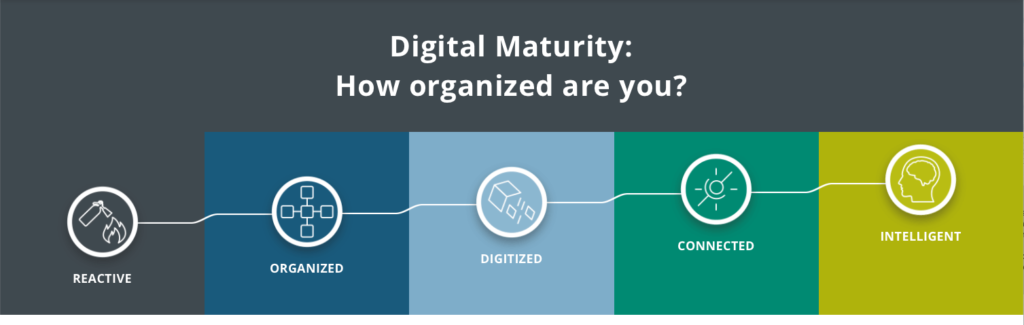
Digital Maturity Model

Digital Maturity Value In Business Growth

The COVID-19 pandemic motivated leaders to accept the digital transformation maturity model earlier than anticipated, causing the implementation of digital technologies at a rate never before seen. This is shown by these digital improvement stats,

63% of leaders specify that they embraced  digital improvement earlier than originally intended as a result of the COVID-19 pandemic.

85% of execs said their services have somewhat or greatly sped up the application of technologies that digital makes it possible for worker interaction and partnership since the start of COVID-19– weeks rather than normal months or years.

97% of global IT supervisors said their companies went through digital makeover due to COVID with 60% of them mentioning the transformation was a “large amount of adjustment.”

To make these quick digital transformations, companies with a high standard of digital maturity were able to adjust better and also much faster, providing a competitive advantage.

Deloitte reports 43% of highly digital mature businesses to see significantly higher internet earnings than their market averages.

When assessing digital maturation campaigns, it is necessary to remember– digital maturity itself is not the objective; instead, it is a means to an end.

Take into consideration the adhering to qualities of digital maturity

Gain access to

Automation

Customer-centricity

Efficiency

Adaptability

Digital Maturity Assessment

Digital maturity assessment assists organizations establish where they are as well as create strategies to come to their wanted maturity level. Numerous businesses have come up with digital maturity assessment tools. And while there is no generally accepted evaluation technique, most of the tools can be found in the form of questionnaires that cover the following areas:

Organization technique

Individuals as well as culture

Workflow and also processes

Technology

Consumers and also companions

After responding to the concerns, you can after that assess which level you go to, depending upon your rating. The degrees depend on the digital maturity assessment tool you use. The Australian Government, as an example, uses a five-level technique, with Degree 1 (Minimal) equating to the very least mature and Degree 5 (Transformed) as a lot of mature.

One more example of an digital maturity assessment device is by Axway, which utilizes the terms “Struggling,” “Reacting,” “Exploring,” “Coasting,” as well as “Interrupting” to describe one’s maturity level.

Regardless of the terms utilized, digital maturity evaluation aids figure out where you remain in your business’s digital trip. It assists you plan out strategies to end up being  digitally fully grown.

Keep in mind that even if your company ratings high in your digital maturity assessment, your trip toward maturity does not end. There will certainly always be brand-new systems and also modern technologies that will certainly interfere with the market as we know it, and you have to be ready to adjust. That’s what digital maturation is everything about.

Advancement

Operational efficiency

Understanding

High quality

From raised effectiveness to boosted top quality, digital maturity model drives results that sustain business development.

Read More: How to choose the best Shopify Marketer

Author: Wail Amrani

Wail is a Shopify Expert & eCommerce Growth Consultant. Former digital marketing manager at Shopify I’m helping brands & retailers build 8-figure eCommerce. I’ve been leading digital growth for both online and retail brands for over 7 years.

How to Drive Online Sales for Small Business With 5 Simple Strategies

How to Drive Online Sales for Small Business With 5 Simple Strategies

In this article, I will reveal 5 simple strategies to drive online sales for  small business.

In today’s digital environment, any type of firm left without an eCommerce store has a serious drawback when boosting ecommerce sales

Although consumers are now flocking right into shops and also enjoying the reduced Covid constraints, e-commerce sales expanded 9.3% in the 2nd quarter of 2021.

Companies of all shapes and sizes are seeking efficient approaches to aid enhance their eCommerce service and social media presence, particularly in such an oversaturated market.

With all of the demanding and vibrant variables to consider when taking care of a system, varying from digital marketing to key metrics and several management tools, it’s very easy for business leaders to get sidetracked from what’s actually essential– raising sales.

So, what should a small business use to make certain that they’re offering the best customer experience to begin driving online sales?

1. Analyse the bounce rate

The base of any kind of sale procedure surpasses the product and services provided. Building significant relationships with clients via reliable communication leads the way to greater sales.

However simply how can we measure this engagement with our eCommerce and also make certain our firm is connecting with the right people?

Monitoring your website’s bounce rate will give you a clear understanding right into just how useful as well as loved one your product or service is to your target audience.

Keep in mind that a high bounce rate is a clear sign that you have actually stopped working to encourage a consumer to purchase, your website was difficult enough to follow or your advertising as well as your onsite messaging are not in sync.

On the other hand, a reduced bounce rate often shows that the user has actually interacted with your web page or has actually found the details they require.

Improving your bounce rate can be carried out in numerous ways. The most significant step is to individualize your web content to connect with your target market and also directly address their demands and pain points.

With the boosted value you convey on your website, you construct customer engagement, translating right into lower bounce rates.

2. Lower cart abandonment

Picture on your own in a supermarket picking items and placing them in your cart as you walk down the various aisles. Then, unexpectedly, you transform your mind and decide you do not wish to go through with the purchase.

What happened that made you desert the experience? Possibly the check-out line was too long, the rates were wrong or the cashier clocked out right before you were going to pay.

Similar to the real world, eCommerce cart abandonment rates show anomalies in the consumer’s shopping experience.

Nonetheless, there are numerous methods to fight cart desertion as well as impact sales:

Display a check-out progress indication on the check-out web page so the visitor understands the complying with steps, streamlining the procedure itself.

Make certain that the navigation in between the shop and also the cart is simple and easy. No client would certainly intend to spend lots of time putting items in their cart and afterwards have their effort lost when going back to the internet store or clicking the incorrect switch.

Consist of a thumbnail item picture throughout the check-out process to comfort the consumer of what they’re purchasing.

Make sure transparent prices– clickbait is the surest means to lose a sale. In our own experience, our customers’ conversion rates increased by a monstrous 5% when we altered rates structure and removed shocks throughout check-out.

3. Include reviews

Structure trust is essential, especially if the product is not in front of the individual currently in the purchase.

This indicates that relying on testimonials and also favourable experiences will offer your website and organization considerable press towards the right direction.

See to it they show up the moment the check-out procedure starts and help your customer relieve their minds when purchasing.

4. Simplify the check-out procedure

The check-out process on an ecommerce website can make or break a sale. When seeking ways to influence a sale, it is pertinent to be mindful of your client and also make sure that the messaging, repayment options, as well as overall procedure, aligns with their way of living and purchasing behaviours.

The more clear this procedure is, the even more success will be shown in your sales.

Prevent any type of surprise fees as well as supply clear, clear information to increase the likelihood of closing a sale.

5. Make certain personal privacy as well as security

Businesses frequently manage delicate client details when managing their eCommerce system.

Guaranteeing privacy and also security provides the users extra self-confidence as well as trust in your site and also organization generally, particularly when they’re sharing personal information and also trusting you with delicate information such as bank card or various other repayment methods.

To give your consumers peace of mind, add any trust fund indications or protection logos on your site, particularly during check-out.

Building depends on is the initial step to constructing resilient business connections in the future.

In sum, your online business is an extension of your brick-and-mortar store, both requiring an analytical and thorough method to get to greater success.

The recent pandemic caused a huge rise in online buyers obtaining specific instinctive expectations based upon their experience with large eCommerce leviathans like Amazon.com– trust fund, easy settlement, after-sale experience and also ease of return. An online service that remains in placement with these expectations will benefit widely by riding the e-commerce growth wave.

With the approaches stated over, you can witness a significant rise in sales in addition to a boosted customer experience and also partnership. Allow your organization to be as clear and also credible as feasible and begin enhancing your online presence to maximize your sales.

6. Driving Online Sales for Small Business

By applying the above 5 strategies you can start driving sales for your online business. Wish you all the success.

Subcribe to Our Newsletters

Stay Updated on The Latest Digital Marketing Trends.