

UK: +44 2038074555 info@atamgo.com
Customer Retention Strategies for Shopify Stores

Customer Retention Strategies for Shopify Stores

internet is a boon for growing businesses that want to reach a wider audience without physical or geographic boundaries. But with this increase in opportunities, the competition also increases significantly. An eCommerce customer is spoilt for choices. The internet era has bought along with it an increase in customer expectations. They want better products, faster services, and more empathetic customer support. And if they’re unsatisfied, they switch unscrupulously.

And given that most of your business costs like warehousing, transportation, and production are unvarying, customer retention is the key to scaling your business. It is no secret that retaining a customer is much cheaper than finding a new one. Ensuring customer retention is one of the most effective ways to increase profit margins. With increasing customer acquisition costs, customer loyalty is the key to eCommerce success. You don’t want to keep knocking on new doors to keep the lights on.  

So how does an eCommerce business retain its customers? Well, a study by Gartner suggests that 80% of companies today compete based on customer experience. The solution is apparent but not straightforward. Your eCommerce business needs to aim for customer delight to retain customers. Your customer support team plays an integral role in realizing this goal. It defines how your clients perceive your brand and can help you build meaningful relations with them instead of just answering questions or dousing fires.  

Customer support has the potential to act as a revenue channel and be one of the strongest mediums for customer retention.  

Factors that Affect Customer Retention: 

  1. Responsiveness: one of the most significant factors that affect customer retention is how the business responds to issues and the state of return and refund policy, quality guarantee, etc. 
  2. Contact Point: this determines the efficiency of your support system and how many contact points are available to customers, such as online chatting, email, and phone.
  3. Convenience: the most significant factor in customer experience is the convenience of use. How easy to find what you want on your website and reach out to you or even make payments for their purchase?
  4. Site Design: Good website designs are integral to the customer experience. Since most eCommerce customers use mobile devices, it matters how mobile-friendly your website is or how easy to navigate and find information. 
  5. Security: Determines how secure your website and payment getaways are concerning personal information, whether security or financial. It also matters how their customer data is collected and used. 
  6. Serviceability: Considers things like delivery, packaging, and other services related to your business. 
  7. Customization: Determines how your business personalizes the recommendations and entire purchase experience to meet customers’ preferences.

How You Can Improve your Customer Retention for Shopify

Ecommerce encompasses a vast array of businesses, each with its unique goals and propositions. There is no one solution or framework that will help each business champion customer retention. The aim is to identify your business goals and creates a plan based on actionable steps you can take to further your cause. Here are some of the most effective tips to increase customer retention: 

  • Personalized Shopify Customer Accounts: 

There’s nothing like the feeling of being valued. A customer deserves to be treated like an individual with unique preferences rather than a “type” or “persona.” On the other hand, discounts, strategies, or campaigns that target a set of audiences can be replicated by competitors easily. However, customer experience tailored to suit individual needs cannot be copied and offers an advantage for your business like no other.  

Another study by Gartner suggests that 38% of customers switch brands due to a lack of personalization. They would rather receive service and recommendations that were relevant to them personally instead of being clubbed with other customers.  

Similarly, personalization plays a crucial role in your customer support functions. Customers have different needs, demands, and problems that your business needs to address individually. For example, a business does not treat repeat customers with high lifetime value like they treat new customers.  

Data drive this type of personalization. Without the right Shopify integrations and the ability to extract relevant data about your customers, you cannot achieve this level of personalization. 

  • Leverage Automation for Better CX

Automation is a boon for eCommerce businesses when used correctly. However, most companies are lured by faster responses and use automation to deflect customer queries. While speed plays a vital role in determining the user experience, it takes away from the goal of personalization. You should use automation smartly to make customers feel valued. It should encourage more meaningful conversations rather than promoting speedy responses. 

Automation increases efficiency and allows agents to concentrate on more pressing matters- issues that require human intervention and demand more empathetic interactions. 

  • 24/7 Support through Live Chat

One of the most underutilized mediums of ecommerce customer support is live chat. With the right Shopify integrations, you can collect a website visitor’s browsing history, order history, and analyze their website journey. An excellent live chat support software will help you understand the interests and issues that the customer faces. For example, suppose an agent observes that a customer frequently visits a product page. In that case, they can reach out to the customer and offer to address any queries or inhibitions the customer is facing.  

You can significantly improve the customer experience by using live chat software to provide pre-purchase services and turn website visitors into customers. You can also use live chat to upsell and cross-sell products. It increases revenue driven by customer support- directly impacting the bottom-line profitability.  

It is a great way to improve the shopping experience and strengthen your relationship with your customers, leading to increased customer retention. 

  • Implement Omni-Channel Support

An eCommerce business can’t thrive using only one platform or channel. Every eCommerce business utilizes different channels, such as Instagram, Facebook, and Shopify, to reach their target audience, where they spend most of their time. The customers also view these channels effectively communicating with your brand.  

Streamlining customer support across all these channels is essential for a better customer experience. The best way to achieve this is to rely on helpdesk software that provides a centralized communication hub for all your customer support functions. 

  • Self-Service

Your customer support should aim to empower customers to solve their problems without relying on your agents or waiting in a queue for simple problems. The right support software, including knowledge base software, will allow them to efficiently deal with issues like returns, tracking, and more, without contacting a support agent. It not only resolves problems quicker but also improves the customer experience by adding a layer of transparency to your processes. It promotes a sense of independence and ownership in your customers.  

Your customer self service flows can achieve much more than solving queries. You can utilize self-service to provide information on your products, such as tutorials, benefits, and how-tos, refining their pre and post-purchase experience. It allows you to educate your audience about your products and services so that they make the most of your offerings. The power to take simple order actions and find answers to their queries adds unparalleled convenience, which is bound to increase customer retention.  

Common Mistakes Businesses Make with Customer Retention Practices: 

  • Ignoring Customer Service:

Imagine a customer walks into a physical store wanting a product unique to your brand. What if they can’t locate or figure out how to use it and there’s no customer service representative around? Ecommerce works in the same way. You could provide unique products and the best services for your intended customers, but without good customer service to back it up, you will not be able to retain customers. 

This also includes spending the right time and resources to train your support team members as well. Equip them with the knowledge to address issues pertaining to different departments and also the right tools that smoothen out processes and make their job easier. A happy agent means a happy customer.  

If investing, say $10,000 in training your agents helps them cross-sell 1,000 worth of products weekly, you will be seeing your money back in no time!

  • No Proper Feedback Loop:

Loyal customers are not only the source of revenue for you; they are stakeholders in the growth of your business as well. The customer wants the best, and they will help you provide it if you can collect and analyze customer feedback to ensure you identify all the areas of improvement in your business. 

  • Lack of SLAs for Customer Service: 

Transparency plays a key role in building a relationship with your customer. SLAs or service level agreements help the customers set expectations from your business- how fast can they expect delivery or how much time they will wait to receive service. These SLAs help promote accountability in the marketplace and staying true to this contract will help you build your reputation in the online marketplace. Set achievable goals and realistic standards for yourself- 

  • What benchmarks define success?
  • How flexible can your SLAs be?
  • Do you want to set up rewards based on these targets?
  • Do your SLAs match your business goals?

These are questions to ask yourself when defining the parameters of your agreement with your customer. These will help you engineer intentional reliability and help create a strong bond with your customers. 

  • Not Rewarding Loyalty: 

Your loyal customers are worth so much to your business. They are pivotal in your growth, and it’s always a good idea to show them that their support matters. Set up loyalty programs that help you show appreciation for customers that have stayed with you for a long time and add value to your business. 

  • Not Preparing for Growth: 

With increased onboarding or even frequency of orders, everything from logistics to customer support becomes a bigger task. You need the resources to meet demands, and the right people to get the job done. Most businesses fail to scale their operations and teams when faced with increasing demand. More often than not, the quality of service suffers due to this, leading to customer churn.  

To avoid being caught off guard, you need to identify the most repeatable processes and use automation to your advantage. This helps safeguard against any boosts or fluctuations, even when the right talent is difficult to find.  

This brings us to the last and most overlooked factor:

  • Not Leveraging your Tech Stack Enough:

Goals require an actionable plan. If you want to increase customer retention, you must identify the things that are working for you, what aren’t and how to optimize your processes to get the best results. One of the most important things to do is to pick the suitable eCommerce tools and Shopify applications that will help you achieve your targets- this can include helpdesk software, the correct returns app, or strengthening cross-department communication.  

But much like the different departments in your business, your tools should also work as one cohesive unit and help you deliver the best results. Tools that provide great functionality and deep integrations with the other tools in your tech stack. For example- you’d want your helpdesk should be able to pull customer information from your site and act as a CRM to improve customer service. It should also be able to access information on returns and deliveries from the tools you have set up for these processes.

It will reduce friction in your day-to-day processes and help you utilize your technology stack to its full potential.  

Conclusion: 

Customer retention is the key to eCommerce success in the competitive eCommerce landscape. As a business owner, your aim should be to enable better customer support and improve customer satisfaction scores so that you don’t incur increasing customer acquisition costs. One of the most straightforward solutions to this challenge is to invest in helpdesk, CRM software, and other tools that enhance the customer and agent experience to help create a lasting bond between your brand and your customers. 

17 Proven eCommerce SEO Techniques (For Search Engine Traffic)

17 Proven eCommerce SEO Techniques (For Search Engine Traffic)

eCommerce SEO Techniques


Introduction 

Congratulations on starting the process of changing your company.

You must be looking for sophisticated marketing techniques for your e-commerce website or interested in optimizing your store to appear in the top Google searches if you have arrived at this post.

You will discover how to increase leads and customers for your e-commerce site in this well prepared article. I bet what you learn in the next few minutes will astound you.

In order to better comprehend the world of sales and conversion in your Ecommerce site, let’s first grasp a few simple principles.

1. Choosing the right keyword 

What keywords should I use for SEO? 

Relevance, authority, and volume will all be taken into account when choosing the optimal keywords for your SEO campaign. Locate popular keywords for which you may reasonably complete depending on: the degree to which you are competing. Your capacity to create material of a higher caliber than that which is already ranked.

When selecting SEO keywords What three factors should you think about? 

The relevancy of each particular term, search volume, and user intent are three elements you must take into account while performing your SEO keyword research. This will assist you in determining whether you want someone who is writinga certain word into Google to interact with your own brand.

2. Keyword in Product Title 

What should an SEO tile include for best results? 

This is the page title or SEO title, often known as the HTML title tag. When you use a search engine to seek anything up, you receive a list of results that are presented as snippets. The SEO title, at the very least a URL, and a meta description are frequently included in the snippet.

Because they will help you rank, keywords are important when it comes to SEO. Include focus or primary keywords in the title of your product, and make sure it is precise, clear, and educational.

If you are an online ecommerce store, i.e. a seller at Amazon or Walmart, then you can go through the blog – 71 Amazon SEO Ranking Factors. 

3. Use Image & Video in Product page 

Does including photographs and videos improve SEO? 

For SEO, use images and videos on the product page.

Images are essential for making your content more user-friendly, appealing, and engaging, but they’re also key for SEO. They first provide significant contextual data to search engines.

How can I make videos and photos SEO-friendly? 

Maintaining modest picture file sizes makes it easier for your sites to load fast, which is crucial, especially for a positive mobile user experience. SEO Advice: Make it simpler for the browser to view your photographs. Each picture should be resized before being uploaded to your website, and the image tag should include the height and width properties.

4. Adding bullet points in Product page

Do numbered lists aid with SEO? 

Your Friend for Benefits and Internal Links: Bullet Points. Bullet points, like headers, provide incentives for both your SEO and conversion metrics. They distinguish themselves from the surrounding text and break up the page, increasing the likelihood that readers will read them.

What format should you use when including bullet points in your product listing? 

There are some badly worded bullet points. It is preferable to use simple and unambiguous bullet points. Keep your bullet points under 1,000 characters overall,

meaning for all five bullets together, not individual bullets. Their readability is improved by having less than 1,000 characters.

5.  SEO-optimized Product Description 

Does SEO factor into product descriptions? 

The answer to the aforementioned query is affirmative; product descriptions have an impact on the SEO of your website. It increases sales, conversions, and organic visitors. As you may know, websites hosted by Shopify are unique since they rank higher.

How much SEO should go into a product description? From 305 to 400 words

A product description should be between 305 and 400 words long, or as long as is

required to cover all of the product’s key attributes and give a succinct rundown of its advantages for the consumer.

Writing SEO-Friendly Product Descriptions: 5 Tips 

Make your writing compelling. Advertising tycoon David Ogilvy argues that sales may result from compelling language.

Tell stories through the power of words.   Keep your writing brief.

Be search engine friendly.

Keep your product descriptions unique.

If you are an online store owner,and also you want to excel as an Amazon store holder, then you can go through the following blog- How to create the perfect product page

 that ranks high on Amazon search results.

6. Customer Support 

In what ways may SEO enhance customer service? 

If you have a customer service department, SEO can help them produce better work. They may profit from search engine optimization by creating an internal knowledge base to enhance user experience and assist clients in finding the information they want. As a result, they can respond to inquiries and problems more quickly and proactively. Additionally, it aids in boosting customer satisfaction because satisfied consumers are more likely to return.

7. Boost Site speed 

Does SEO Impact Site Speed? 

Page speed has an impact on SEO.

The speed of your website affects how it will rank on Google as a direct ranking element. In addition to affecting SEO, page speed can also effect your site’s bounce rate and average session length.

Best Practices for Increasing Website Speed 

  1. Lessen the Frequency of HTTP Requests
  2. Implement HTTP/2
  3. Image size optimization
  4. Utilize a Content Delivery Network (CDN) (CDN)
  5. Write mobile-first code, please
  6. Reduce First Byte

Select the Appropriate Hosting Service Plan

  1. Make Gzip Compression use
  2. Minify and combine HTML, CSS, and JavaScript files
  3. Consider Using Prefetch, Preconnect, and Prerender Techniques
  4. Load JavaScript Asynchronously
  5. Cut Back on the Plugins
  6. Use website caching
  7. Adopt Cloud-Based Website Monitoring

8. Category page optimization 

Do categories help with SEO? 

E-commerce sites receive higher traffic from category pages.

To determine if product or category pages performed better in SEO rankings was the objective. The findings revealed that category pages fared better at 27 of the 30 sites looked at. They had 19% more ranking keywords than product pages and a stunning 413 percent higher traffic.

How to Optimize Category Pages?

 Begin with the metadata. The fundamentals of content optimization are title tags and meta descriptions.

Use featured content, include text, make headings pertinent, and so forth.   Make the link text pertinent.

Emphasize Header and Footer Links, Category Navigation, and Header.

9. Improve usability 

How could usability be made better? 

These are the top seven steps you should do to make your website more user-friendly:   Speed up the loading of pages.

Maintain uniformity throughout your website.   Make sure your website is responsive.

Use a recognizable navigation structure.

With your material, use headers and subheadings.   Highlight your standout qualities.

Use pictures, but don’t use too many.

10. Write share-worthy blog 

Is writing blogs beneficial for SEO? 

Does blogging assist with SEO? By establishing your website as an appropriate

response to the queries of your clients, blogging helps improve SEO quality. You may

increase your chances of ranking in search engines and improve the user experience of your website by using a range of on-page SEO techniques in your blog articles.

How can I make content that people want to share? 

Ideation for 7 Things Content Creators Do to Produce Shareable Content.

Ideation for 7 Things Content Creators Do to Produce Shareable Content.

Brainstorming- It’s impossible to generate content ideas out of thin air.   Concentrate on titles,

conduct research,

take the time to get feedback,   strive for excellence, and

Focus on titles.

Do your homework. Take the time. Get some feedback. Aim for excellence.

Increase visibility.

11. Create a site with Hierarchical structure with no more than 3 levels 

How can you build a website using hierarchies? 

To improve SEO, create a site with a maximum of three tiers of hierarchy.

Let’s begin by going step by step through the process of developing a website structure. Take a look at what your rivals are doing.

Gather and classify the keyword list for a website.   Classify each page.

Keep your URL structure simple.   Link pages together internally.

Build an easy navigation system.   Publish a sitemap.

Check out your webpage.

12. SEO Friendly URL and Best Permalink Structure 

Which URL format is more beneficial for SEO? 

A picture of an SEO-friendly URL and the ideal permalink structure SEO-friendly WordPress Permalink Structure

In the URL, add Your Target Keyword. A target keyword is a term or phrase that you want visitors to use to reach your website on a search engine.

Use Hyphens Instead of Underscores, Avoid Using Dates or Years in Your URL, Use HTTPS-Secured URLs, Include Categories on Big Sites, etc.

How can I optimize my URL for search engines?

Making a URL slug that is search engine optimized   The page title should come first.

Take special characters out.   Eliminate numbers.

Delete information that is not necessary.   Reduce it to a single word.

Include keyword modifiers (optional)   To make it readable (optional)

Lowercase is preferred.

13.  Keep URLs Short and Sweet 

Does SEO depend on URL handle? 

Yes, the keywords you decide to incorporate into the URL structure may unquestionably affect your SEO and ranks.

Do shorter URLs perform better in SEO? 

The shorter the better. Shorter URLs “often tend to rank higher than lengthy URLs,” claims Backlinko. They conducted rigorous testing on one million Google search results to demonstrate this. This graph illustrates how Google ranks drop as URL length increases.

14. Add a breadcrumb menu on product pages 

How effective are breadcrumbs for SEO? 

Because they make navigating simpler, breadcrumbs serve as a crucial component of an

SEO-friendly website, which is why visitors adore them. They encourage users to browse more pages on a website before leaving, which lowers the bounce rate. They help with SEO.

It’s really simple to add breadcrumbs; just click the huge + button to add a block. Enter the name of the block in the search box or scroll down to the Yoast section to find the Yoast SEO breadcrumbs block. As an alternative, you may just enter /yoast breadcrumbs in a blank sentence.

15. Allow customer reviews on product pages 

Are customer reviews helpful for SEO? 

Given that reviews may enhance your social presence and authority, keeping your attention on reviews and how to increase them is crucial for your SEO. Google does, in fact, take into account your site’s ranking, and as is obvious, it prioritizes the websites with better ratings.

16. Design for Mobile 

Can we perform SEO on a phone? 

Mobile SEO is the process of optimizing websites for search engines while ensuring that they display perfectly on mobile devices like smartphones and tablets. Due to the growing popularity of portable devices, webmasters need to pay close attention to their mobile SEO strategy.

What makes mobile SEO so crucial? 

Mobile optimization, which takes into account factors such as site design, site structure, page speed, and more to create a superior mobile user experience, makes sure that

mobile visitors enjoy an experience that is optimized for their mobile device.

What can I do to enhance my mobile SEO? 

You should concentrate on the following two areas to increase your mobile SEO:   Make the user experience enjoyable.

A responsive website is a must.   speed up your website.

Implement organized data.

Don’t block HTML, CSS, or JavaScript code.   Avoid overusing redirects.

Select the appropriate viewport.

Don’t employ pop-ups or interstitials.

17. Use HTTPS / Secure Your Website 

Is HTTPS beneficial to SEO? 

It is obvious that HTTPS gives the protection that many Internet users need, and it is the best course to take if you want Google to favor your website.

Website security is manifoldly affected by the proper use of HTTPS.

Why SEO For E-Commerce Is Vital For Your Business? 

Ecommerce SEO focuses on increasing your online store’s exposure in search engine results. According to research, around 70% of consumers use search engines to identify products and read reviews of them before deciding whether or not to purchase them.

The internet has increased people’s flexibility to choose, compare, and, most significantly, save time while making purchases.

Making your online store more visible on search engine results pages is done through ecommerce SEO (SERPs). You want to show up as high in search results as you can for the things you sell to draw in as much traffic as you can. Paid search can get you visitors, but SEO is considerably cheaper.

You may attract a highly relevant audience to your website if your store ranks better in organic search results. Organic traffic is more beneficial for raising brand exposure, and customer loyalty is highly prized for its contribution to credibility building.

In actuality, 43% of shoppers conduct internet research while in a store. Your online business, which has a cheap cost of operation and provides greater value to your customers, is undoubtedly a win for everyone.

Author: Sarwar Abdullah

Founder of VATASK.COM

Author Bio: 

Content writing is my passion. And I believe in following my dreams to achieve my goal in life! I am a full time entrepreneur who believes in investing his time behind profession and passion equally.

Reasons You Should Consider Online Team Building Activities

Reasons You Should Consider Online Team Building Activities

Online Team Building

Team building involves bringing together people to take part in bonding activities under the guidance of a team leader. The conventional version is usually in-person, but team-building tasks can now happen virtually, thanks to technology.

If unfamiliar, the following are the upsides of online team building.

Boosts Morale

A general working environment can be tense, with people trying to observe all the rules and deliver. On the other hand, online team building makes work more exciting and fulfilling to be a team member.

One of the most significant advantages is that it enhances mutual respect and eliminates conflict among employees. Therefore, people work better, knowing that the company cares and wants to invest in them.

Increases Productivity

When away from the typical work environment, everybody comes together for a common goal without the related pressure. Team leaders will find it more effective to help teach the organization’s goals and, in turn, motivate the team members to strive for success.

The communication channels will open up, allowing everyone to air their views and troubleshoot problems. Thanks to online team building, you will notice the work improving without employees burning out.

Fewer Costs

If you have previously planned a regular team-building exercise, you will attest that it can be pretty costly. You must factor in the costs of the venue and several other aspects.

However, online team building is relatively cheaper. It makes it a go-to for most companies, given that the funds can be tight and it can be hectic to convene people in one single space.

Enhances Creativity and Versatility

When away from the work environment, your creativity may diminish but having others around can help you brainstorm and bounce off ideas. You will get more creative ways to solve problems that you may not have thought of while working alone.

Organizing online team building creates a comfortable environment to experiment with ideas without fear of failing. Additionally, you can get inspiration from anybody, creating mutual respect.

Maintains Connections

The current trend has seen people working from home. Since there is no way to meet in person and talk with staff during random meetups, being away from the office can be pretty isolating, especially after months apart.

Online team building is the perfect way to get everybody together to maintain the connection and improve communication. You can catch up with colleagues after a while and interact even in the comfort of your home.

Connect Your Team

Creating online team building is the ultimate solution to connect people regardless of being apart. You benefit from regular team exercises at low cost and at everybody’s convenience. In the long run, you will enjoy a dedicated, hardworking workforce that effortlessly achieves the company’s goals.

Selling on Amazon vs. Shopify

Selling on Amazon vs. Shopify

Amazon vs Shopify

With the growth of e-commerce and the number of Amazon sellers, it is no wonder the marketplace has changed so much. And it’s probably the primary reason why many sellers choose Shopify instead.

Some say Shopify provides higher profit margins because it charges lower fees than Amazon. But there may be a reason why many stay on with Amazon.

This post will tell you all about the two platforms—how they differ, their pros and cons, and recommendations on which may be the best marketplace for you.

The Difference between Amazon and Shopify

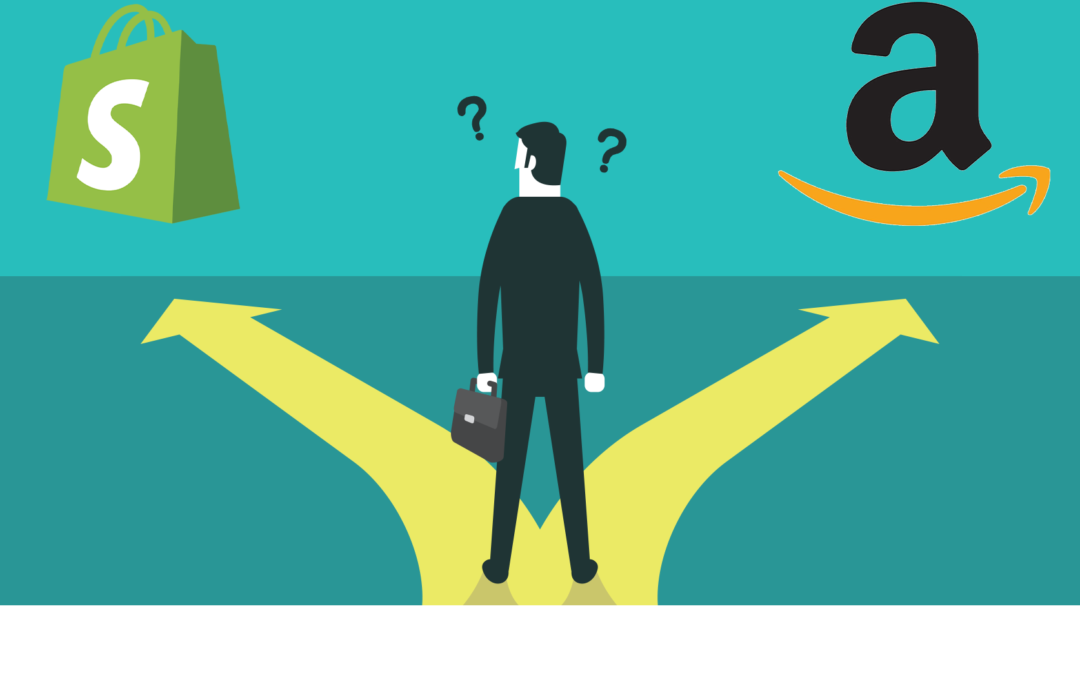
The most significant difference perhaps between the two is that Amazon is an online marketplace, whereas Shopify is an e-commerce platform.

While both platforms allow you to sell any product, they do so differently. On Amazon, you don’t get your own store per se. Instead, you post products individually alongside fellow sellers. Shopify, meanwhile, lets you build your own online store where consumers can find all your offerings.

Think of it this way: Selling on Amazon is like supplying the store with your products, while doing so on Shopify is more comparable to putting up your own store in a shopping mall. Your choice would thus depend on how you want to be seen as a seller.

As with any business decision, you need to consider several factors before deciding which platform is right for you. So we’ve broken down these considerations to make choosing more manageable for you.

Pros and Cons of Selling on Each Platform

While you both get to sell all kinds of products on both platforms, each has unique benefits and drawbacks. And you must understand these before making your decision. Let’s dive in.

Amazon

In addition to selling books, music, movies, household items, electronics, toys, and other products, Amazon.com acts as a middleman between businesses and its legions of customers.

Pros

  • Ease of getting started: Opening an account and becoming an Amazon seller is not difficult at all. Plus there are a few business models you can start selling with. Depending on your ambitions, you can whether launch your own brand or do
    reselling on Amazon with dropshipping or arbitrage.
  • High traffic: Amazon’s most significant selling point is most likely its vast customer base. And because you sell alongside all other vendors, you can tap into your competitors’ customer bases, along with your loyal customers.
  • Global reach: Amazon currently has the biggest audience compared to other marketplaces globally. It currently serves 13 countries, each with its own dedicated site.

Cons

  • High competition: Millions of products are currently being sold on Amazon, making the competition really tough. Selling the exact item as tons of other sellers means you’ll be vying for the Amazon Buy Box.
  • High fees: Because Amazon typically houses all of its sellers’ inventories and takes care of processing and shipping, even customer service provision, your business can rack up costs. Even if sellers can choose among various shipping options (i.e., providers), the fees can still be significant.

Shopify

Shopify is a subscription-based platform that makes it simple for any seller to start an online store. But just like Amazon, using it has pros and cons too.

Pros

  • Low fees: Shopify charges fees that are significantly lower than Amazon’s. That gives sellers more significant profit margins. Its membership fee is also lower, making it a winner in this case.
  • Completely customizable storefront: Shopify is one of a few e-commerce platforms that lets sellers customize their storefronts. You can use different colors, add images and videos, and even create your own logo on your page.

Cons

  • Additional apps can be costly: All sellers need a way to promote their stores, right? Doing that on Shopify may require subscribing to specific apps. The more apps you use, of course, the more money you need to shell out.
  • High upfront costs: Unlike Amazon, where you can start selling at practically no cost, you will need to pay for a subscription on Shopify first. And that comes with additional charges, too, depending on how you want to set up your storefront.

Which Market Is Right for Your Business?

Choosing which platform is right for you depends on your business requirements. If you just want to start selling products to earn extra money, then, by all means, start selling on Amazon. But if you’re looking to grow your business and establish your own brand, Shopify may be the better option.

Given all the information we divulged here, it’s still hard to say which is better—Amazon or Shopify. So if you’re serious about your business, why not try them both? Each has its ups and downs, so you’ll have to see which works better for you. If you’re not sure you can consult with Shopify experts or an Amazon agency to gain insights into which platform aligns best with your business goals.

Conclusion

While Amazon remains the biggest online shopping platform to date, Shopify isn’t far behind. If you’re looking to start selling at once, picking Amazon may be the way to go. But if you have a longer-term goal in mind—establishing your brand—Shopify may be better for you. Whatever choice you make, consider your budget, needs, and objectives.

Our Latest Articles

7 Fastest Facebook Downloaders for Instant HD Saves (No Signup)

7 Fastest Facebook Downloaders for Instant HD Saves (No Signup)

Tired of losing your favorite videos to the endless scroll? Whether it’s a viral Reel, a helpful tutorial, or a memory from a friend, saving content shouldn't be a struggle. We have tested the fastest tools in 2026 to help you download Facebook videos in high...

Stop Buffering: 10 Best 4K Video Downloaders That Actually Work

Stop Buffering: 10 Best 4K Video Downloaders That Actually Work

Tired of watching your favorite 4K content stutter through a slow connection? In 2026, streaming high-bitrate video requires massive bandwidth that most public Wi-Fi can't handle. Downloading your videos in advance is the only way to guarantee a flawless, stutter-free...

The Growing Power of Mobile Shopping: Understanding Mobile Commerce

The Growing Power of Mobile Shopping: Understanding Mobile Commerce

Mobile commerce

Online shopping behaviors have changed with the increased functionality of smartphones. And in 2025, most people prefer mobile shopping instead of buying through desktops. 

That means, as a Shopify merchant, you should take place in the mobile world in the best possible way. In this article, we explained how you can achieve that. Let’s start. 

What is the Meaning of Mobile Commerce?

Mobile commerce, also known as mCommerce, means achieving the buying and selling of products & services activities through smartphones and tablets. Mcommerce comprises in-app purchasing, mobile banking, digital wallets and mobile apps of virtual stores. 

What is the Difference Between eCommerce and Mobile Commerce?

Ecommerce (electronic commerce) means achieving the buying and selling of products & services activities through the Internet. It includes any kind of commercial transaction such as money transferring and data executing processes.  

eCommerce activities could be achieved through desktop computers, smartphones and tablets. In other words, we can say that eCommerce includes mobile commerce. 

If shoppers achieve eCommerce activities through smartphones and tablets, this is mobile commerce. If they achieved them through desktop computers, this is still eCommerce however not mCommerce.  

Why is Mobile Commerce Important?

The significance of mobile commerce is so much more than the last decade since more than 80% of eCommerce activities are generated on mobile now.

It is a huge but understandable percentage if we think about how smartphones are developed and become so much more functional compared to previous years. 

Shoppers carry their mobile phones with them anywhere they go. And because their phones are fully functional for eCommerce activities, they don’t need to change to a desktop for shopping anymore. 

In other words, they do not only spend more time on their smartphones, but they also spend more money than in previous years.  

That means, most of your potential customers prefer to shop via their phones and your website has to be mobile responsive to meet their needs. Leading brands such as Amazon, Zara, Sephora, etc. are aware of this trend and they invest in their mobile website and mobile app more than ever. 

Why Do You Need a Mobile App?

There are thousands of eCommerce stores and the way to attract shoppers on mobile and make more money is by providing the best mobile user experience. The best and easiest way to achieve that is by turning your Shopify store into a mobile app.

You can achieve that easily by native mobile app builders in a shorter time and with less cost since you don’t need to hire designers and developers. 

How To Decide Which Mobile App Builder Is The Best For You?

There are some actions you should take to select the best Shopify mobile app builder for you:

  • Check the customer reviews: It is the easiest way to understand other people’s experiences when using the app. You can have a general idea about the app builder and understand if users have any bad experiences. 

  • Try the customer service: Send a message to support, ask for help and make sure if they are really helpful. There could be some little problems in every kind of product, however, the significant point is whether you can solve them easily and in a short time. 
  • Start your free trial and check if it is easy to use: It is going to be a new dashboard for you. So it is important the simplicity of the user dashboard for an easy design process.  
  • Check the integrations: If there are must-have applications that you already use in your Shopify website, make sure that you can use them in your mobile app, too. 
  • Make sure it has a fitting theme for your store: Different product types should be displayed with different themes. For instance, clothing products may not seem appealing in a theme that is designed to display foods.

    That is why make sure your Shopify mobile app builder includes different theme options for different product types. 
  • Check the features: It is crucial that your app offers features of;

 in-app messages to convert visitors in real-time, push notifications to decrease marketing ad spends, and fast check out to make the payment process easy.  

Mobile Commerce

Which Features Make Shopney the Best Choice for You?

With Shopney, you can solve your two biggest problems: marketing ad spending and low mobile conversion rate. You can decrease your marketing ad spend down to %45 and increase your mobile conversion rate up to 5x. 

Shopney helps you to achieve these two points by building native mobile apps. In this way, you can offer the best mobile experience to increase mobile conversion rates and send limitless push notifications for free to decrease your marketing ad spend. 

Also Shopney:

  • Has 8 different layout options to make sure your product looks appealing.
  • Offers fast check out and abandoned cart notifications to decrease abandoned cart rates.
  • Allows you to send push notifications directly to your customers’ phones with special offers, and promotions.
  • Offers live chat features to connect with your customers in real-time and convert them.
  • Has 7/24 multilingual customer support to help you anytime you need it.

Besides, Shopney is the best-rated Shopify mobile app builder with +450 customer reviews and a 5.0 overall rating in Shopify App Store.

How To Turn Shopify Store Into App with Shopney?

Here are the steps that you should follow:

  1. Install Shopney and set up your account.
  2. Design your mobile app with the easy drag & drop editor without needing any code and design skills. You can easily ask all your questions to customer support in this process. 
  3. Launch your mobile app in both iOS & Android app stores.

Final Thoughts

As a summary, we explained the significance of mobile commerce and what you should do to take your place there. We mentioned that the best way to attract customers’ attention on mobile and make more money is by building a native mobile app for your Shopify store. 

Then we made a list of the points you should be careful of when choosing your Shopify mobile app builder. If everything is clear, now it is time to turn your Shopify store into a mobile app!

Tags:

Our Latest Articles

7 Fastest Facebook Downloaders for Instant HD Saves (No Signup)

7 Fastest Facebook Downloaders for Instant HD Saves (No Signup)

Tired of losing your favorite videos to the endless scroll? Whether it’s a viral Reel, a helpful tutorial, or a memory from a friend, saving content shouldn't be a struggle. We have tested the fastest tools in 2026 to help you download Facebook videos in high...

Stop Buffering: 10 Best 4K Video Downloaders That Actually Work

Stop Buffering: 10 Best 4K Video Downloaders That Actually Work

Tired of watching your favorite 4K content stutter through a slow connection? In 2026, streaming high-bitrate video requires massive bandwidth that most public Wi-Fi can't handle. Downloading your videos in advance is the only way to guarantee a flawless, stutter-free...

Online Business Guides: Top 5 Most Successful Online Business

Online Business Guides: Top 5 Most Successful Online Business

Does the idea of launching an online business entice you? Well, you are not alone. Staying away from the lucrative digital Renaissance is hard. We are living in the middle of a digital revolution – every single aspect of life is becoming digitized! Thus, it was only a matter of time before people started looking for professional opportunities online.

In fact, finding a job is no longer an issue – the world is a stage, and entrepreneurs are owning it. So why shouldn’t your entrepreneurial dreams come true? However, launching anything is a big step, ensuring success is a bigger step. But what if we told you that are a few online business ideas that would prove to be successful?

Keep reading to find out more on the same.

Online Business Guides: Top 5 Most Successful Online Business Ideas

Even five years ago, experts would say ‘the future is digital,’ but what if we tell you that the future is now? Thus, make the most of this transformation – Scroll down to find out the top five online business ideas that will bring you success.

1. Trading in Digital Products 

If you have not considered trading in digital products, you have no idea what you are missing out on. We are living in a digital era ruled by digital products and services. What better than launching a business specializing in digital products? These products are all around you.  For instance, you could consider creating and selling guides on LLC registered agent services as a digital product. 

From informative products to eBooks, WordPress plugins, and tools, the era of digital products has begun! You can either start your own business specializing in some digital products, or you could also give drop shipping a chance. In this case, you simply need to sell another company’s products.

2. Creating Digital Content

There’s nothing bigger than digital content at the moment and if you have got even a percentage of that skill set, go for it! The entire world needs content, and the necessity for content creators has simply expanded. But the sad reality is that agencies often exploit content specialists – these professionals have no idea about the significance of their job roles.

Why work for an exploitative agency when you can start your own? Content is pretty crucial at the moment. You could dip your feet in the water by starting with a few freelancing gigs. If you are good at it, then hire a bunch of creators, and get creating. All you need are good employees, and your online business is booming!

3. Starting A SEO Business

An online business specializing in SEO is pretty cool at the moment. But, if the need for content is booming, the need for SEO is also thriving. And the more you make the most of it now, whether by becoming an SEO reseller or offering direct services, you stand to benefit. Search Engine Optimization is a powerful field, provided you have the skills to deal with it.

Without an SEO strategy, most businesses will not do how to proceed with their content strategy. As discussed above, you could do just the same. Start by dipping your toes in the water with freelancing gigs from third-party platforms before starting your own agency. It’s a service-based business, and generating leads for the same online would not be a problem.

4. Website Flipping 

When selling a highly valuable website for more than $100.000 it’s common to use structure financing and create a business note, where the seller receives a down payment and then (usually) monthly payments to repay the full unpaid principal balance. Often, additional interest is collected, allowing the seller for a higher total sales price and steady income stream. If you ever need to fund a new business idea, you can always sell a business note for a lump sum.

One of the best sources of a stable passive income, you can do this if you have the right skills and the perfect team. The importance of having a team is utmost in this case – you most definitely need a team of SEO experts and content writers to guide you smoothly through this. Also, you need the skill set!

Provided you have got everything that you need for starting your career in website flipping, you can now decide upon two things.

  • You could start from scratch. Create websites in bulk quantities, work on them and then sell them. It’s a lot like selling ready-made sites.
  • You could acquire other sites, upgrade content, boost SEO and sell them for more money.

5. Become A Reseller 

Are you good with sales and marketing? Reselling could very well be your calling. And it doesn’t even take much for you to begin your career in reselling. Simply put, reselling means you are ‘re-selling’ products of some other brands. It’s a lot like Affiliate Marketing, and you could always do a combination of both. To maximize efficiency, consider leveraging professional sales outsourcing to handle repetitive tasks, freeing you to focus on strategic growth.

Reselling can turn into a very lucrative online business. All you need to do is watch whether demand for a particular product increase. Strike when the iron is hot and buy them in bulk. When the brand fails to provide the product to people, you can step into saving the day – simply resale those products at a higher price.

Conclusion

Now that you have a fair idea about a few successful online business ideas, it’s time to start your journey. Do your research, make some calls and run towards your dream today. Yes, you might not like the digital age always, but there’s no denying the popularity of the same. Thus, launching your business online is a crazy idea. The question is, when are you doing it?

Author: Wail Amrani

Wail is a Shopify Expert & eCommerce Growth Consultant. Former digital marketing manager at Shopify I’m helping brands & retailers build 8-figure eCommerce. I’ve been leading digital growth for both online and retail brands for over 7 years.